Standing On Your Own…With Assistance
The room at 7am looked the same every day.
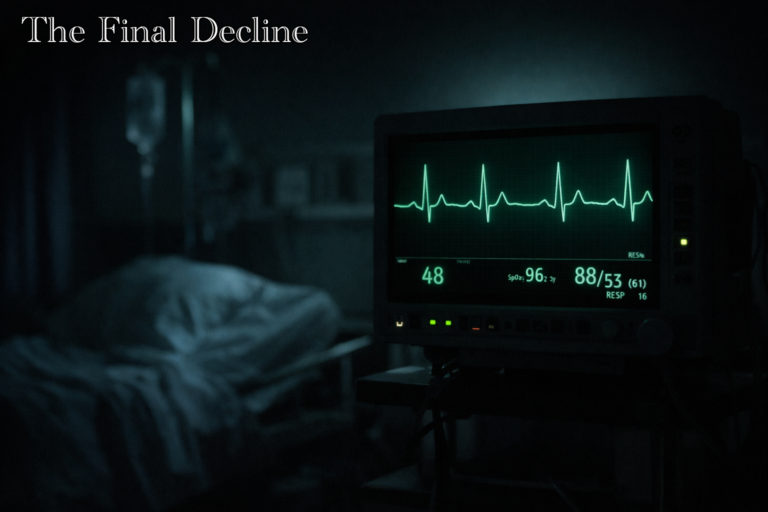
Lines in, lines out. The Impella running its quiet mechanical rhythm in my chest. The monitor glowing green behind my head, numbers I had learned to read the way you learn to read a dashboard—not alarming anymore, just information. The ward coming to life outside the door, the first shift change of the morning, the familiar sounds of a place I had been living in long enough to call familiar.
And my phone, already active, already carrying the day’s first messages.
That is what a support system looks like from the inside: not dramatic, not cinematic. It looks like logistics. It looks like someone already moving before you’ve asked them to move.
The People
My mother came every day.
Every day—with exceptions so rare they stand out in memory—from the first admission at Mercy Health West through the full six weeks at The Christ Hospital. She came in the morning. She coordinated from outside when she couldn’t be there: Kroger runs, Amazon orders, the specific brands I wanted and the coupons she tracked down for them. Tissues, SmartWater, Progresso clam chowder for the potassium. She couldn’t drive in the dark, so she came when it got light. She stayed until it made sense to leave.
I called her daily visits the anchor. She was there when listing came through, when the AFib came back, when the thyroidectomy changed everything. She organized a prayer brigade—people I had never met, nurses and their families, members of the Jewish community I had studied with for years—all of them pulling for me in ways I couldn’t see but, in some sense I will address later, could actually feel.
I told her twice to stay home. Take a day. Go to breakfast with Jan. Take care of yourself. She pushed back both times. I pushed back harder. More on this shortly.
Niles came most days. He was in the room the afternoon the listing came through on October 11th. He had watched the cognitive change after the Impella—what he described as day and night, a man retrieved from something—and said so plainly, which meant more than he probably knew. When he couldn’t come, he sent texts in the morning: positive thoughts, brother. When I gave up one of his visit slots and told him to clean his kitchen instead, he actually did it. That’s Niles. The kind of friend who takes you seriously even when you’re horizontal in a hospital bed.
Eric came after I transferred to TCH. He had his own history with a prolonged hospitalization and understood something about what extended waiting actually feels like that most people don’t. He coordinated with my mother when he couldn’t reach me directly. He visited on Sundays and stayed a real visit’s worth of time. On October 3rd, the morning of the Impella surgery—one of the moments when I genuinely did not know if I was coming back from it—he sent me a message: One minute, one hour, one day. He did not know he was writing the title of a book. I did not know it either, not yet.
Sherrill was out of state, which meant Zoom and text and long conversations held in the particular candor that distance sometimes makes possible. She was my primary spiritual sounding board throughout—the most honest conversations about acceptance, about what I was experiencing that didn’t fit cleanly into any rational frame. She kept her rose-colored glasses on and said so. I’m going to keep them until I need to take them off.That is its own kind of courage.
My sister Lisa came up. There was a conversation between us—a real one, an attempt to mend something that had been broken for a long time—that I initiated from the hospital bed because it felt necessary. That it happened matters. What came of it is its own story for another piece.
The circle extended outward from there: the chaplain Doug, who visited twice a week and held real conversations rather than performing comfort. The transplant support groups on Facebook, where people a year or two out would answer questions with the particular authority of lived experience. Other recipients who had been through it and come out the other side. The nurses and physicians who became a genuine part of the daily human fabric of those weeks—people who knew my preferences, my register, my sense of humor, who opened up about their own lives and formed real bonds. All of the doctors and nurses were nothing short of incredible. I am still, to this day, stunned by the level of care.
Up on a Roof
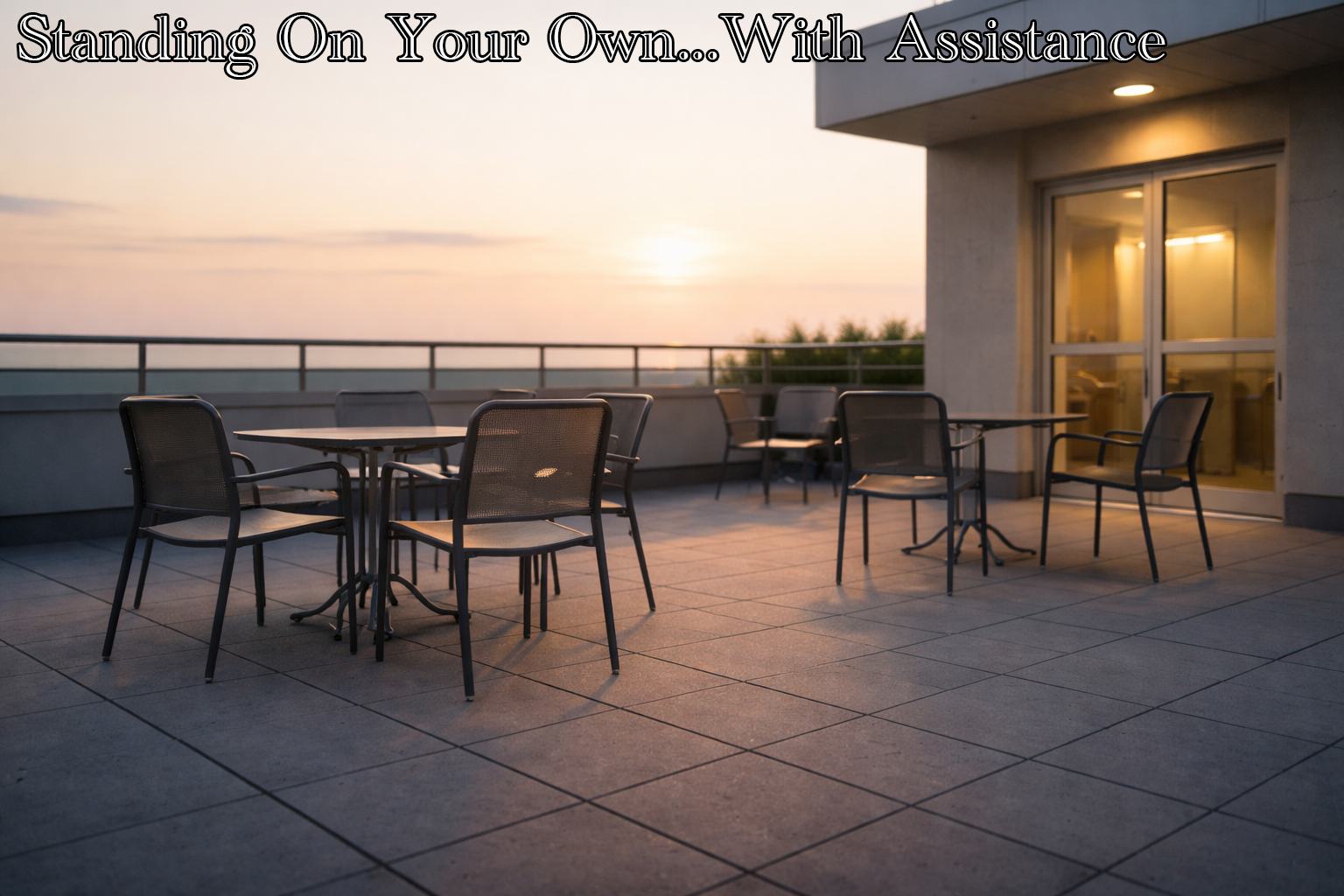
The nurses began insisting on fresh air and sunlight sometime in the middle weeks. TCH had outdoor seating areas on the roof of an adjacent structure, and we would walk there and I would sit for a few minutes in the open air.
The first time, they walked me out and I stood there—taking in the sun on my face, the breeze across my skin, the fresh air in my lungs after weeks of fluorescent lighting and the stale, recycled hospital air that had been giving me nosebleeds. The nurses held back. They didn’t crowd me. I don’t think any of them came within twenty-five feet. They just let me have that moment.
They somehow knew.
A thought arrived that I did not invite but did not push away either: this might be the last time. Not despair—something more clear-eyed than despair. A reckoning. The honest acknowledgment, without drama, of what was actually at stake. I held it for a moment. I let it be true.
Then I went back inside.
Later visits to the roof were different—conversation, sometimes Niles walking with me, the nurses chatting. But that first one was its own thing. The support system makes that possible: the ability to stand in the open air and face the possibility of death honestly and then turn around and walk back through the door, because the people on the other side of it are part of why walking back is possible.
Humor Is Not Optional
Dark humor was not a choice. It was a mechanism—as necessary as the medications, more reliable than some of them.
After the thyroidectomy, with Halloween approaching, I photographed myself in the hospital bed with my head hung back—the fresh incision across my throat looking, by general consensus, like something from a horror movie. The nurses thought this was a riot. The surgeon, when informed of the comparison, was somewhat less enthusiastic.
There were the ne’er-do-wells in the alley directly behind my room who, one afternoon, decided it was a fine time to smoke marijuana. My room, it turned out, was not as well-sealed as I had assumed. I reported to Niles that I had a slight contact buzz. He found this funnier than the situation probably warranted.
There were the ongoing negotiations around pain management—escalating discussions with the medical team about what options were available, at the end of which I suggested that if we were going to keep ruling things out we might as well go straight to heroin and save everyone some time. They were not on board with this proposal.
There is a story involving a nurse at Mercy West with her hand on the defibrillator dial that I am still laughing about a year and a half later. The details belong in another piece. The fact of it belongs here.
Niles called it medieval and he was right. What they need to do to keep you alive during a prolonged cardiac hospitalization is genuinely, viscerally difficult to allow. The fight-or-flight response is not a metaphor—it is a biological fact, and it fires hard and consistently every time someone approaches with a needle, a scope, a catheter, a defibrillator. The humor was not avoidance of that reality. It was the mechanism for overriding it long enough to let them do what needed to be done. I often threatened to grab my Impella and make for the exit; the nurses reminded me they could run far faster than I.
Rabbi Nachman of Breslov taught that despair is not permitted—not as reassurance, but as an instruction. You are allowed your grief. You are not allowed to live there. The dark humor was the expression of the same principle: acknowledge the weight of the thing without allowing that weight to become your permanent address.
You run this thing serious and you are finished.
The Weight on the People Who Show Up
The genuinely caring caregiver—the present one, the one who actually shows up—is also under strain. Significant strain. And nobody is particularly looking after them while they are looking after you. These are the people who come when you call—even if it is 10pm at night and they have to get up for work the next day—just because they know you need them.
I saw it in my mother’s face on the days she had been there too long. I heard it in Niles’s voice when I called late and he was tired. The people who show up fully, who are actually present and engaged, are spending something real every time they walk through that door.
I told my mother twice to stay home. I told Niles something similar. Not because I didn’t want them there—my mother was my daily visit and I meant it every time I said it—but because I could see the cost and I was not willing to be the thing that ground them down. There was also the practical consideration: I needed these people still standing when I came home. A caregiver who has spent themselves into the ground during the hospitalization has nothing left for the recovery, which is its own long road.
If you are reading this as someone supporting a patient through something like this: take the day off when you’re told to. Go to breakfast. Sleep in. The person in that bed will be better served by a rested version of you than a depleted one.
The long hospitalization has a particular gravity. It pulls at every relationship around it. Marriages are tested under the strain—some don’t survive. Friendships thin. The stress finds every weakness in every connection and applies steady pressure. What matters to the person in the bed is not complicated: who showed up, and who didn’t. The reasons given for absence vary. The felt experience of it does not.
If you are in that bed right now with a phone that isn’t ringing—the Facebook transplant support groups, the chaplaincy available at most major transplant centers, the broader transplant community—these have genuine value in their own right. They are not a consolation prize. Use them.
The Spiritual Dimension
There are questions that arise in a prolonged cardiac hospitalization that the medical staff cannot answer. They are not equipped to, and it is not their job.
One of them came to me in the weeks before the transplant and would not leave: the heart is widely understood, across many traditions, to be the seat of the soul. Remove it—accept another person’s in its place—and what does that mean for the essence of who you are? What happens to the self in that exchange?
I am not a religious man in any institutional sense. But I am a man who takes these questions seriously, and I needed people equipped to take them seriously with me. I asked Fr. Adrian Hilton—the priest who had also performed last rites before the Impella surgery—and Rabbi David Evan Markus, and the chaplain Doug. All three, from their different frameworks and traditions, gave me the same answer: take the heart. The soul remains.
That answer did not resolve the question entirely. I was deeply out of sorts for a long time after the transplant—my energies, for lack of a better word, needing time to realign around this new configuration of self. There are documented studies of heart recipients taking on characteristics, cravings, even memories that appear to originate with their donors. Children who knew details about their donors they could not have known. The science is not settled and the phenomenon is not well understood. I have my own experience of it, which belongs in a different piece. What belongs here is the acknowledgment that these are real questions, arising for real people, and that having someone equipped to sit with them makes a difference.
Whether or not you are religiously inclined, a spiritual dimension to this experience is likely. Find someone to talk to about it. The chaplaincy at a major transplant center is not there to convert you. It is there to hold the questions that don’t have medical answers.
Prayer and the Flow of Energy
Two things. Distinct.
The first: knowing. Just knowing that people are pulling for you—people you have never met, people your mother organized into a chain you didn’t know existed, people lighting candles and saying prayers in traditions you don’t practice and never will. The not-aloneness of it. The knowledge that you exist in the thoughts of more people than you can see from that room.
I am not a religious man. I was not asking for doctrine. But the knowledge of a prayer brigade working on my behalf—visible to me only as messages from my mother telling me about it—carried real weight. The not-aloneness is real and it matters, independent of any metaphysical framework you bring or don’t bring to it.
The second is harder to explain and I am not going to try to explain it. I am going to report it.
You can feel when someone in a room hates you. Not always consciously, not always immediately—but the information arrives, below the level of reason, native to the organism. The reverse is also true. The flow of positive energy from people genuinely pulling for you has a felt quality. During the worst weeks of the hospitalization, when it should by rights have been hardest to feel anything but fear, I felt it. It isn’t a matter of applying doctrine or arriving at understanding. It is simply observing and allowing the experience to be what it will be.
I am not asking you to believe this. I am telling you what happened.
The Other Side of the Door
The room at 7am looked the same every day.
But it was never just a room. It was a room held up by a structure of people—daily visitors, every-few-days visitors, out-of-state voices on a phone, prayer chains I never saw, energy I felt but cannot account for. That structure wasn’t incidental to what happened next. It was part of the medicine.
Know who your people are before you need them. Let them come. Protect them from the cost of coming. Find the absurdity where you can. Find someone to hold the questions that don’t have medical answers. And when someone walks you to the roof and the sun hits your face—hold that. Keep it with you.
There will be another time.
Discover more from One More Beat
Subscribe to get the latest posts sent to your email.