The Year of Living Carefully
This is the companion piece to “Living With Immunosuppression: What the Science Actually Says,” which covers the clinical and biological dimensions of post-transplant immune management. This piece covers what it actually felt like to live inside those constraints.
My transplant was November 9th, 2024. I came home around November 21st—nine days in the hospital, a brief readmission for a suspected infection that turned out to be a nicked lymph node draining chyle, then home again. Thanksgiving was four days away. Cold and flu season was well underway, and COVID remained the more significant concern of the three. My immune system had just been deliberately suppressed to its lowest point. The timing was not ideal.
The heightened vigilance of those first weeks was not irrational. It was calibrated to the actual risk—an important distinction. Everything I was concerned about was a real thing that could really happen. The question was whether that calibration would eventually loosen as the suppression reduced and the graft stabilized, or whether it would calcify into something permanent, a hypervigilance that outlasted its own biological justification.
That question took about eighteen months to begin answering.
The House
There were five of us in the house. Nobody was particularly good about hygiene under ordinary circumstances. Now they were required to mask when sick, stay in their rooms when sick, wash their hands immediately on coming home—before touching door handles, before handling food, before making contact with shared surfaces. No drinking after each other. No handling other people’s food without washing up first.
They resented it. When I reminded them, they expressed that resentment. Conversations went poorly. As the father and head of the household, I had a degree of authority—but even that only goes so far when you are asking people to maintain a level of daily vigilance they find onerous. What I was ultimately dependent on was the voluntary cooperation of people who were tired of being reminded, and that cooperation was inconsistent.
You find a strategy eventually. Confrontation requires energy and breeds more resentment than it resolves. What worked better, in the end, was simply leaving—getting up, moving to another room, disengaging from the situation without making a production of it. Preserving safety and dignity simultaneously, even if it left an awkward silence behind.
A recent example. Pizza with the family. Someone was handling the plates and the food, reaching across, rearranging things, hadn’t washed her hands. I watched this for a moment, ran the internal calculation—her hands, the food, my plate, what I know about transmission—and quietly got up and left the room. She took offense immediately. Thought I was being dramatic.
There was nothing to say mid-meal that would have improved the situation. No explanation that wouldn’t have turned dinner into a seminar on transmission and contamination. I left. Later I prepared my own food. When possible, that’s the approach—cook for everyone, get my own serving before the communal handling starts. Not a perfect solution. The least costly one.
The First Holidays
Thanksgiving was never a question. Four days home and the immune system at its most suppressed—there was nothing to weigh. Christmas followed the same logic, and New Year’s after that.
I celebrated at home. That was it.
My nieces and nephews FaceTimed during Thanksgiving. The grand nieces too. I got to wave from afar at a table full of people I hadn’t seen in months, people I love, and they got to wave back at a small rectangle on someone’s phone. It was kind of them. It was sweet. It also bummed me out considerably. Present but not present. Included by technology in something I couldn’t actually attend. I was glad to see their faces and glad when the call ended.
That’s the specific emotional texture of the first year’s social losses. Not simple grief. Not simple gratitude. Both things occupying the same moment, neither resolving the other.
The Paranoia
I have always been a germaphobe. Not dysfunctionally—I have held jobs, raised children, eaten in restaurants—but I notice what people touch and when they wash their hands and whether they wash them properly, and I have always been this way. When my children first started school, I spent a year getting sick with everything their little immune systems were casually processing and discarding. Every school has its own biome. A five-year-old who has never been to daycare is a walking epidemiological event. Elementary school: brutal. Each new school my youngest attended brought a new round of the same, compressed but recognizable. By the time the younger two arrived, we’d already encountered most of what any school biome had to offer.
The transplant did not create the vigilance. It removed the part where everyone could confidently tell me I was overreacting.
What changes over time is not the awareness itself but the speed and the emotional volume of it. Early on it is loud and exhausting—every decision weighted, every room evaluated, every contact registered consciously. Later it becomes automatic and quieter. Still running, but no longer in the foreground.
Now the stakes were real in a way they had never quite been before, and I knew it. Coming home in late November, into COVID and cold and flu season simultaneously, with suppression at its heaviest—the concern about ending up back in the hospital was not disproportionate. It was a statistically reasonable response to the circumstances.
More than the illness itself, though, what weighed on me was the prospect of being yanked back. The hospital had already taken months. The idea of returning, even briefly, carried its own particular dread—not quite like the original apprehension going in, but a conditioned response to what months of hospitalization does to a person’s sense of autonomy. The facility that saved your life also becomes the place you most want to never see again.
There was one readmission in the early weeks—the milky discharge from the last chest tube, the suspected infection, one day and one night while they determined it was a nicked lymph node draining chyle rather than anything more serious. Clinically unremarkable. Psychologically, it hit hard anyway. The hospital reaching out a hand to pull you back in, even briefly, even for something minor—that registers differently than you might expect. The confidence it cost took longer to recover than the lymph node did.
The Second Thanksgiving
The second Thanksgiving—I could go. Suppression was down, the graft was stable, the team was comfortable with it. I went.
Someone came in with a sick child.
I was out of there before most people at the table had registered what was happening. Sick child, enclosed space, crowded holiday gathering, no good outcome if I stayed—the assessment ran in seconds, the decision made itself, and I was already moving toward my coat while the social processing in the room was still catching up. Heads turned at how fast I left. I understood why it looked the way it looked. I couldn’t slow it down.
The drive home was quiet. Not agitated, not particularly troubled—just aware of the specific weight of leaving somewhere you wanted to stay. Of the holiday continuing in a house ten minutes away. Of the table full of people you love carrying on without you, of the gap between the life you’re managing and the life you’d have chosen if the management weren’t necessary. You don’t mourn it, exactly. You hold it for the length of the drive, and then you’re home.
The following week, nearly everyone at that table got sick with something.
I didn’t.
The Kids
By the time I received a heart transplant, my children were essentially adults. The youngest was a junior in high school. The other two were done. I genuinely cannot imagine how younger parents manage this with small children in the home—a five-year-old who doesn’t understand what a germ is, who cannot be asked to mask up and stay in their room, who cannot be reasoned with about hand washing. The calculus with adult children was difficult enough. With young children, I don’t know what it looks like.
My youngest did bring things home from school occasionally. You get sick. The illness runs longer and harder than it would in someone with an uncompromised immune system, and the tail end drags on after everyone else has moved on. That’s the reality of it. You manage it, you notify the team, you take the Coricidin HBP, and you wait it out.
He graduated high school last week. I did not attend. The ceremony was in a massive coliseum—close to ten thousand people. The assessment wasn’t close. I watched the simulcast on my iPad from home.
For his school plays, the drama club cleared space for me—moved chairs, designated a section where I could sit with some distance. At one theater where they couldn’t arrange a final dress rehearsal accommodation, they cordoned off an area at the far side of the back of house so I could attend at all. People making room for you, literally and figuratively. Learning to receive that gracefully is its own thing. The gratitude is real. So is the awareness of what the accommodation signifies.
The Social Negotiation
Most people are understanding. They still don’t get it.
The high-alert status of the immunosuppressed is simply not a register most people maintain. The constant environmental read—who touched what, whether hands were washed, whether that surface was handled by someone who then handled food, whether the person across from you is running a low-grade something they haven’t mentioned—runs automatically in the background of every social interaction, every meal, every gathering. For most people, this level of awareness doesn’t exist. They’re not negligent. They’re just not wired for it, and there’s no particular reason they should be.
What wears on you eventually is not acute distress. Acute distress burns too hot to sustain for that long. It’s the constant low-level awareness running beneath ordinary life—the continuous, quiet environmental assessment that never fully switches off. You adapt to it. But it’s always there.
Last fall, I attended the end of the high holidays with a congregation I’m close to. They had hand foods—bagels, bread, spreads. Before anyone else approached the table, several people made sure I got my own selections first. Unprompted. They had thought of it before I arrived. That kind of thing—effortless, anticipatory, unforced—is genuinely moving in a way that’s hard to articulate. It signals something beyond accommodation. It signals that someone held you in mind when you weren’t in the room.
The contrast is every situation where you have to explain it. The server—asking whether anyone handling the food has been sick recently, knowing you have no choice but to believe them when they say no. The mild, tragicomic theater of it. The absolute necessity of the question and the simultaneous awareness of its limitations. You ask anyway. You eat the food anyway. You sit in the outdoor seating—always preferred it, now it’s practical too—and you have a reasonable dinner with people you like, and you don’t give the server’s answer another thought for the rest of the evening.
The telephone repair guy who came this week to fix the internet connection. I didn’t wear a mask. I did ask him, before he came inside, whether he’d been sick in the last two weeks. He said no. I believed him. We got the internet fixed.
You develop a style. Direct without being clinical, brief without being dismissive. Inform the server, ask the repair guy, tell the host. Then let it go and be present in the situation. The alternative—treating every social interaction as a contamination event to be actively managed—is not sustainable and not a life.
The Advice
There is a category of well-meaning counsel that every transplant recipient encounters, delivered with varying degrees of emphasis but consistent in its essential message: you have to live life.
It comes from friends and family who see the mask, the declined invitations, the questions to the server, the exit from the Thanksgiving table, and interpret all of it as evidence of a life diminished. It comes from the transplant team, who will tell you at some point—with good intentions and clinical accuracy—that they didn’t put that heart in you so you could live in a bubble. It comes from fellow recipients in the support groups, some of whom report that by one year out they had stopped masking entirely, were eating in restaurants at peak hours, attending concerts, traveling internationally without particular precaution.
What the “live your life” response almost always misses is that the calibrated approach is living your life. The assessment before walking through a door, the choice of outdoor seating, the question to the server, the exit from the room when a sick child arrives—none of that is retreating from life. It is the mechanism by which a life is maintained. The assumption underlying the advice is that risk aversion and living are in tension. They are not. They are the same activity, described from different vantage points.
The cardiac rehab experience clarified this more directly than any piece of counsel could. The hospital’s cardiac rehab facility—which should, by any reasonable expectation, be the most carefully managed environment an immunosuppressed post-transplant patient can exercise in—turned out to be a space thirty paces corner to corner, with a dozen or more patients at any given time, equipment not reliably wiped down between users, and one regular attendee who spent every session producing a cough that sounded like he was trying to expel something structural. I was the only person there wearing a mask. The implicit contract of “just go live your life” is that someone else is managing the environment. Nobody was. I eventually moved to a smaller community gym during off-peak hours—not because I retreated from exercise, but because I found an arrangement that made it possible without the unnecessary exposure.
The most useful voice on this subject I’ve encountered belongs to a recipient thirty years out who, after COVID nearly killed her in 2024, picked up airborne precautions she hadn’t previously maintained. She judges indoor safety by airflow now—vaulted ceilings, open windows, fans. She goes places. She has been going places for three decades. She is not living in a bubble. She is also not pretending the calculation doesn’t exist.
I posted a question to the support group recently about a Thursday night dinner invitation—family gathering, Olive Garden, dinner rush, middle of May. A crowded indoor restaurant is exactly the kind of situation where I pause. The responses ranged from “just go, stop worrying” to a careful breakdown of how to assess airflow and timing. Both were offered in good faith. The honest answer is somewhere in the middle, and it shifts based on where you are in the suppression timeline, what your current trough levels look like, what season it is, and what the specific room looks like when you walk in. Not a fixed rule. A moving calculation.
Germaphobia, it turns out, is something of a superpower in this situation. The habits that felt neurotic before the transplant—noticing what people touch, registering when hands were last washed, reading a room for ventilation before choosing where to stand—are exactly the skills the post-transplant environment requires. The transplant didn’t create them. It validated them.
The Road Trip
Months ten and eleven. I drove from Cincinnati to New York City—seven hundred and fifty miles each way, driven rather than flown. Commercial flights are still not something I’m comfortable with at eighteen months out, a calculation I revisit periodically and keep arriving at the same answer.
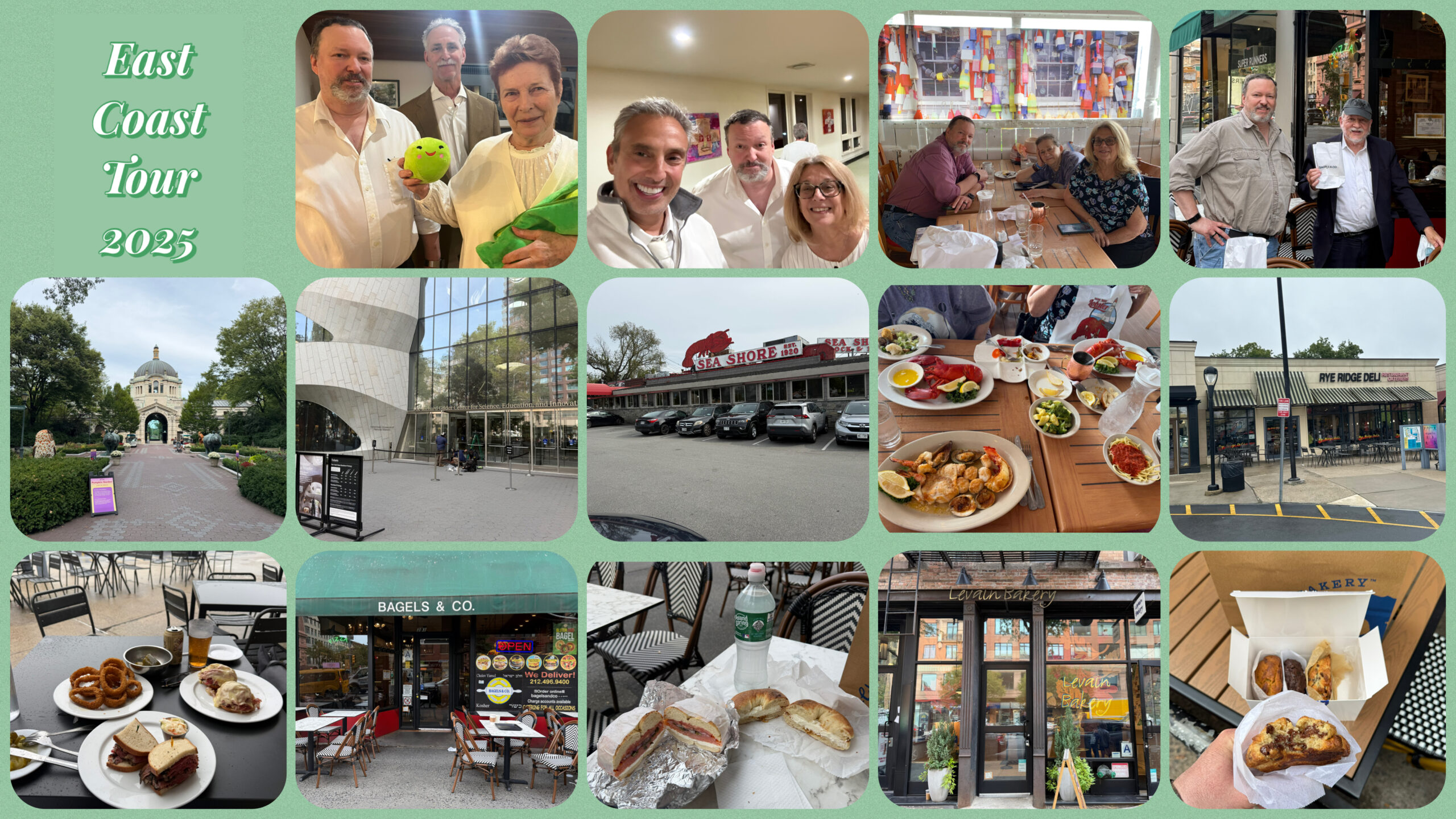
The Bronx Zoo. The American Museum of Natural History. Manhattan. The high holiday services with the congregation—one of them without a mask, which registered to me as something worth noting. Lunch with one of my favorite living rabbis, who had been sick and wore a mask for much of our visit while I sat upwind and kept a reasonable distance. The famed Levain Bakery on the Upper West Side. A box of their chocolate chip cookies. No mask. A bagel at a deli in Rye. Dinner at Sea Shore in the Bronx. Every rest stop on the road had a mask. Every convenience store. But the trip happened.
That matters more than it might sound. A man eighteen months out from a heart transplant, driving 750 miles to eat a cookie and have lunch with a rabbi and spend a few days in a city he loves—that’s the piece in miniature. The restrictions didn’t disappear. The life resumed anyway, around them and through them. The vigilance didn’t go away; it just ran faster and quieter, in the background, while the rest of it was happening in the foreground.
The Sun
Man, what a pain in the ass.
When I go for walks, I choose shaded paths. Hikes only in well-wooded areas—which introduces ticks as the replacement concern. You trade one thing for another. Sporting events are essentially out; I’m a baseball fan and outdoor stadium seating in direct sun for three hours is no longer something I can just do. I was standing in my own driveway a few days ago having a conversation with family and had to position myself under the open hatch of someone’s car to stay out of direct sunlight.
That detail—standing under a car hatch in my own driveway to avoid the sun during an ordinary conversation—is what permanent recalibration actually looks like. Not dramatic, not cinematic, just a constant low-level negotiation with the environment that runs every time you walk out the door. SPF 50+ every morning, not just for the beach. UPF clothing when I know I’ll be outside for any length of time. The automatic calculation about shade that now happens before I choose where to stand.
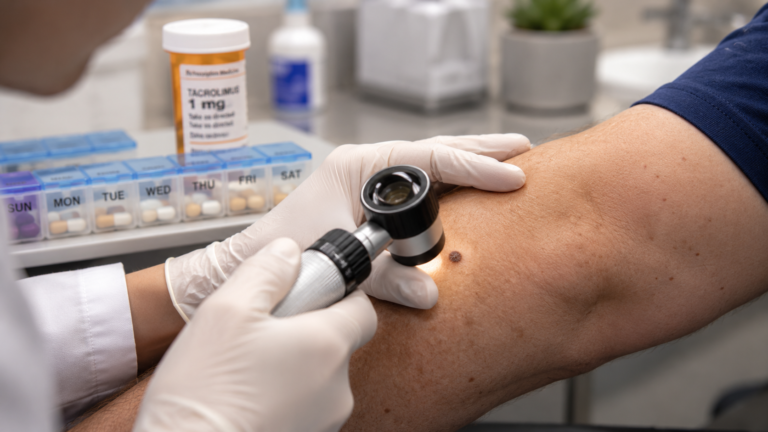
There’s a mole on my back I’ve had for years. At some point it grew and stopped. It was this size when I received the transplant—nobody flagged it as urgent then. Now, given where I am and what the skin cancer risk looks like for heart transplant recipients specifically, it’s a more urgent matter. Getting in with a dermatologist has been on my list; I’m working on getting that scheduled. The mole needs to come off, get tested, get handled. One more thing on the management list—which is also the honest reality of what post-transplant life looks like at eighteen months. The list doesn’t get shorter. You get better at carrying it.
The Hardware Store
This morning, eighteen months out, I needed to pick something up at the local Ace Hardware. The front door was open; just two other people in the building. I walked in without a mask.
Not because the risk had disappeared. Not because the rules had gone away. Because the read of that specific environment on that specific morning—open door, two people, warm weather, brief errand—said: this is fine. The assessment happened in a second, arrived at an answer, and I walked through the door.
That’s what reclaimed looks like. Not the absence of vigilance. Vigilance becoming second nature—quick, accurate, unobtrusive, running in the background while you go about your business.
Some things came back. Restaurants, outdoor seating preferred and now doubly so. Friends. Road trips. Synagogue. Cookies from a bakery in Manhattan. Going into a hardware store on a May morning. Some things haven’t come back and may not—commercial flights, large indoor crowds, Ohio Renaissance Festival, opening night of anything, a coliseum full of ten thousand people celebrating my son’s graduation.
And some things changed permanently. The sun. The mole on my back. The awareness of what people do with their hands before they reach for shared food. The question I ask the server. The route I choose for my walks. These aren’t temporary inconveniences on their way to resolving. They’re the new operating conditions—permanent additions to the system that I’ve stopped waiting to remove and started building around instead.
The Year of Living Carefully doesn’t end at twelve months or eighteen. It compresses, recalibrates, and becomes something you carry without noticing most of the time—until someone reaches for your plate with unwashed hands, and you’re already standing up to leave before you’ve consciously decided to.
The clinical companion to this piece—covering the biology, the medications, the surveillance panel, and the science behind the restrictions—is Living With Immunosuppression: What the Science Actually Says.
Discover more from One More Beat
Subscribe to get the latest posts sent to your email.