

Permission to Feel
There is a narrow emotional script caregivers are expected to follow. Be strong. Be grateful. Be present. Be hopeful. Hold it together for the person in the bed, for the children at home, for the medical team that needs your cooperation, for the friends who don’t know what to say and are watching your face for cues about how worried they should be.
The actual emotional experience of caregiving looks nothing like that script.
This piece is permission to feel everything that came with it—including the parts you were certain you were not allowed to have.
The Fear Continuum
Fear is the sanctioned emotion. The one everyone expects, nobody judges, and everyone around you knows how to respond to. Of course you’re afraid. Anyone would be.
But the fear caregivers carry is not a single thing. It is a sequence that shifts shape without warning, and it begins long before the operating room.
Will he survive the surgery? That is the first fear, the one with a clear object. But underneath it runs a current of harder questions. What if he doesn’t survive it cleanly? What if he comes home diminished—alive but impaired, present but unreachable, dependent in ways neither of you can yet imagine? What if something goes wrong on the table and he comes back to you changed in ways the surgeons didn’t anticipate and the discharge paperwork doesn’t cover?
Then there are the trial runs—the hearts that looked promising and then weren’t. The caregiver who had already told the children, called their mother, begun mentally turning the page toward the next chapter—and then got the call that this one isn’t happening. That whiplash is its own trauma. It can repeat. Some caregivers live through it multiple times before a match finally arrives, each false start requiring them to rebuild an emotional readiness they had already spent.
And then there is the inability to watch.
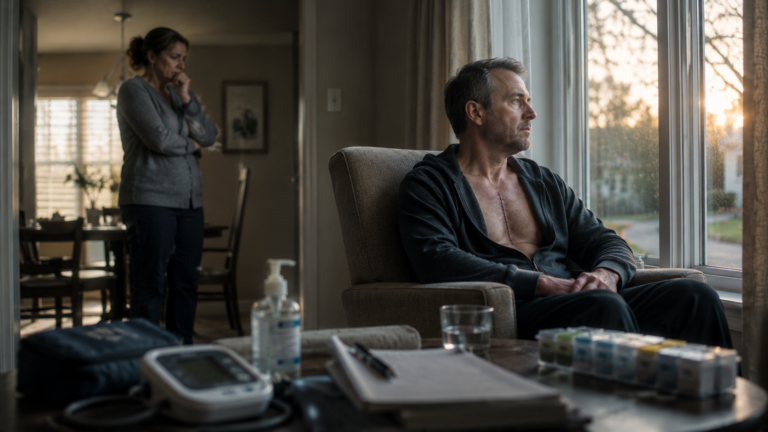
Loving someone completely does not guarantee the ability to witness suffering indefinitely. There are moments when love and visual endurance diverge—when the nervous system simply refuses, when the caregiver has to leave the room, step into the hallway, find a chair and sit with their back against the wall and breathe. The tubes, the wires, the machine doing the work a heart is supposed to do. The person in that bed who looks like they are already somewhere else. Caregivers who cannot stand at the bedside without something cracking open are not failing the person they love. They are responding honestly to something almost unbearable. There is a difference.
The Dark Interior
Nobody asked.
One day life was what it was—complicated, perhaps, imperfect certainly, but navigable. Then biology made a decision and everything changed. The role of caregiver was not applied for, not trained for, not chosen. It arrived. And with it came responsibilities that have no end and no off switch: the medications and the appointments and the diet restrictions and the insurance calls and the bills and the logistics of keeping another human being alive while also keeping the household running and somewhere in the background keeping yourself running too.
I did not sign up for this.
That thought is not a betrayal. It is an honest response to an impossible situation, and pretending otherwise doesn’t make it less true—it just forces the person thinking it to carry it alone.
Then there is the resentment. At the situation. At the randomness of what life handed this family. At the patient who gets to be sick while the caregiver keeps the world running. At the non-compliant patient—the one who pushes dietary limits, skips medications, takes risks he has no right to take anymore, as though the caregiver’s sacrifice has a price he doesn’t have to acknowledge. When a patient gambles with his health after transplant, he is not just endangering himself. He is gambling with the currency the caregiver spent their own life to earn. That anger is legitimate. It belongs here.
And the role reversal—the one nobody warned about and nobody prepared for. The last thing I wanted was to become my spouse’s nurse. Now I have to be the breadwinner too? The life that existed before—however imperfect, however complicated—is gone, and the grief of that loss is real and almost entirely unacknowledged, because what kind of person grieves their old life when their spouse just received a second chance at theirs?
The kind of person who is human. That kind.
The Anti-Transplant Shadow
This territory is different from ordinary resentment. What some caregivers experience is not frustration with the situation—it is something deeper and stranger, sitting at the intersection of grief and identity and belief, and it deserves its own space because it is far more common than anyone discusses.
Some caregivers enter the transplant experience carrying convictions that sit in direct tension with what is happening. The donor conspiracy narrative—the belief, sometimes spoken and sometimes only held—that hospitals are more inclined to let someone die to harvest their organs. The identity question: is this still my husband, or is he carrying someone else’s essence now, someone else’s history, something foreign that has changed the fundamental nature of the person I married? The guilt arithmetic: someone had to die for him to live, and I am not okay with that.
You’re carrying a dead man’s heart inside you.
That sentence has been spoken in real rooms by real people who love the patient and could not find another way to hold what they were feeling.
Name this without judgment. Because these reactions—as disturbing as they may feel to the person experiencing them—are almost never what they appear to be on the surface. They are grief looking for an argument. They are the mind’s attempt to manufacture distance from a situation that has become genuinely unbearable. When the weight of full emotional commitment becomes unsurvivable, the psyche reaches for a narrative that allows it to step back—if he is fundamentally changed, if the organ carries contamination, if the system itself is corrupt, then the caregiver does not have to be fully vulnerable to this outcome. The mind sometimes creates distance because distance feels safer than risking devastation twice.
The caregiver who has had these thoughts is not a monster. They are a person in extremis, reaching for whatever their mind can find to help them survive.
The Reversal
This may be the least discussed emotional experience in the entire caregiver arc, and among the most consequential.
I expected you to die. I was prepared to grieve. I was not prepared for this.
When a patient’s decline has been long and visible, the caregiver often begins—not consciously, not willingly, but inevitably—to organize themselves around an ending. The psychological work of anticipatory grief is real work. It takes months. It takes energy. It moves the mind, carefully and painfully, toward a particular future, building a structure that can hold the loss when it arrives.
Then transplant appears as an option, and that structure has to come down immediately. Everyone around the caregiver expects relief. The transplant is good news. Why wouldn’t they feel relieved?
But the mind does not pivot that cleanly. The caregiver who had been moving toward acceptance of one outcome now has to reverse course entirely—recommit to hope, take on the enormous logistical and emotional weight of what a transplant actually requires, and do all of it while the grief that was building has nowhere left to go.
Sometimes the reversal produces something that looks, from the inside, uncomfortably like disappointment. Not at the survival—but at the complexity of what survival now requires, the loss of the ending that had been, in some private and unspoken way, already accepted. That experience is not shameful. It is the predictable consequence of asking a human being to turn around in the middle of emotional preparation for loss. The reversal has its own cost. Nobody warns them about that.
The Light
None of what came before this cancels what comes next.
Relief arrives. It does not arrive cleanly, and it does not arrive alone—it arrives tangled with exhaustion and residual terror and the disorientation of a situation that has finally, improbably, turned. But it arrives.
The moment the person in the bed looks at you and is recognizably themselves. The first conversation that sounds like the person you married, the parent your children have, the friend who has been absent from behind those eyes for longer than you realized. The surgeon who comes out of the OR and says it went well, and the way those words land somewhere below language.
The joy of watching someone you love get their life back is real. It is also complicated—because the caregiver’s life is still in pieces, and the patient is already looking forward while the caregiver is still processing everything that happened on the road here. One caregiver in a transplant community described it this way: watching him recover felt like watching him grow up and earn his independence back. She was proud of him. She was also standing there wondering what came next for her.
But the love that turns out to be larger than you thought—that is worth naming too. Not as a resolution. Not as a lesson learned, or a silver lining earned, or a redemptive conclusion to a story that resists redemption. Just as a fact that arrived without asking, in the middle of everything else.
The Whole of It
The emotional experience of caregiving is not one thing. It is not the narrow script you were handed when this began, and it is not the version you were afraid to admit even to yourself in the quiet moments. It is all of it—the fear and the fury and the love and the guilt and the grief and the relief—living in the same body at the same time, without resolution.
None of it disqualified you from love. None of it meant you carried this badly. None of it made you the wrong person for the room.
The people who survive these roads do not survive them cleanly. Feeling all of it was never failure. It was the cost of loving someone through catastrophe.
That was always enough.
Discover more from One More Beat
Subscribe to get the latest posts sent to your email.




Excellent article! Being a heart transplant recipient I cannot even begin to fully comprehend what my caregiver lived through.