
The Other Side of the Bed
The transplant system is extraordinarily good at keeping the patient alive. It is a synchronized, meticulously calibrated engine—surgeons, coordinators, immunologists, pharmacists, and technicians working in absolute alignment to drag a human being back from the edge of mortality.
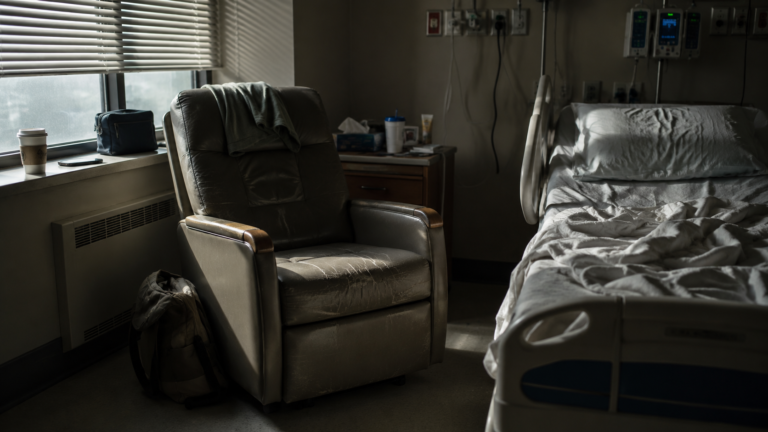
What the system is significantly less good at is supporting the person in the chair next to the bed.
Every ounce of expertise, every laminated checklist, every detailed discharge instruction is aimed squarely at the one in the gown. The caregiver is assumed. Present, necessary, and largely invisible to the machinery that saved the patient’s life. They are treated like a fixed piece of medical equipment—expected to plug in, function flawlessly, and require no maintenance. But while the patient is hooked up to monitors that scream the moment a heart rate dips or blood pressure spikes, the caregiver sits in the corner, quietly depleting their own battery in total silence.
I know this because I watched it happen from the pillows.
During the long weeks of waiting and the even longer stretch of recovery that followed, I watched the people who had rearranged their lives around my survival. I told Niles to go clean his kitchen—not because it was dirty, but because he needed to remember a world that existed outside of ICU alarms. I told my mother to take a day off and have lunch with her oldest friend. I found myself sending people home before they utterly ruined themselves, because a caregiver who has nothing left by the time the patient finally comes home is not a resource anymore. They are another casualty the system did not plan for.
I could see that from the bed. The system could not.
The Gap
To say there is no help is unfair. Programs exist, and we will name them. What they traditionally offer is peer connection, logistics guidance, and emotional support groups. They are real offerings and they help.
What they largely do not do is prepare a caregiver for what is actually coming before it arrives. They don’t adequately address the specific emotional weight, the relationship fractures, the psychological toll that clinical research has documented for decades and that hospital programs largely leave unaddressed. There is a vast difference between learning how to manage a medication schedule and learning how to survive the night your partner stops looking at you like a partner and starts looking at you like a burden.
There is also a dimension that rarely gets named at all: the caregiver is often the only continuous thread running through a system where everyone else rotates. The patient is overwhelmed. The doctors rotate. The nurses rotate. The transplant coordinator changes shifts. The caregiver becomes the institutional memory—tracking medication changes, insurance approvals, appointment schedules, lab trends, names, and phone numbers. That is an enormous and largely unacknowledged responsibility layered on top of everything else.
The Roads In
We talk about transplant caregivers as if they are a single type of person. They are not. They arrive at the transplant waiting room by very different roads, and the people walking those roads are not interchangeable.
The most common road—and the one that carries the heaviest accumulated weight—is the long slow decline. A parent or spouse manages serious cardiac disease for years. Sometimes decades. The people around them adapt so gradually, taking on one small responsibility after another, that they don’t recognize how much of their own life has been quietly set aside. They have learned not to plan too far ahead. They have stopped making assumptions about the future. They have, in ways they may not have named, already begun to grieve—not a single loss but a series of them, each one small enough to absorb, cumulative enough to reshape everything.
That grieving has a clinical name: ambiguous loss. The person is still present, still themselves in many ways, but the life that was expected has already changed beyond recognition. The caregiver carries those losses privately and largely without acknowledgment, because the patient is still alive and grief is supposed to wait.
And then the bad weekend comes. Or three of them in a row. And then the really bad turn. The caregiver who has been waiting for this moment for years is suddenly inside it, and it is nothing like they imagined, and somewhere in the middle of the crisis a word surfaces that wasn’t quite real before: transplant. The person who was ready—or as ready as anyone gets—to let go now has to find their way back to holding on. That reversal is its own particular work, and nobody warns them that it is coming.
A second road runs through mechanical circulatory support. The LVAD caregiver did not simply become a support system; they became a de facto medical technician. They live in a house with spare batteries, backup controllers, and sterile dressing kits. They carry the specific, low-grade terror of managing a device that is keeping their person alive, sleeping with one ear open for the particular pitch of an overnight alarm. Hope and grief run simultaneously in that house, neither one permitted to fully resolve, because the device bought time but time toward an outcome that remains uncertain. When the transplant finally comes, the exhaustion these caregivers carry into the waiting room is unlike anything that can be explained to someone who hasn’t lived it.
A third road is sudden acute hospitalization. No preparation, no gradual adaptation. One day life is functioning; the next day someone is in a fluorescent hallway being told things for which there is no vocabulary. The caregiver is thrust into the deep end with no runway and no precedent, absorbing language that will determine whether the person they love lives or dies, in real time, with no time to brace for any of it.
All three roads end in the same waiting room. The people sitting in those chairs are not the same people.
What This Does to Children
The effect on children in these households is seldom discussed with the honesty it deserves.
Young children cannot process what is happening cognitively, so they process it in the ways available to them: emotionally, physically, and through magical thinking.
“My daddy is in the hospital and might die” is the entire world to a six-year-old. There is no frame to put it in. The adults around them are too consumed to explain it in terms a child can hold, and so the child fills the silence with whatever their imagination produces, which is almost always worse than the truth.
Older children and teenagers often respond by stepping up. They take on quasi-adult responsibilities. They suppress their own needs and defer their own milestones to avoid adding weight to a household already buckling under strain. That looks admirable from the outside. It is costly in ways that don’t always surface until much later, when the habit of subordinating their own needs has become structural and the crisis that required it is long over. Worse, it often leads to resentment or a numbing that manifests as a reduced emotional responsiveness across the board.
And then there are the ones who shut down. Children and adults both. This response gets the least sympathy because it looks like absence or indifference, and it is neither. It is the nervous system’s protective response to something it cannot process. The person who goes quiet, who stops visiting, who becomes unreachable, is not callous. They are overwhelmed in a direction that has no visible expression. They often carry significant guilt about it afterward, sometimes for years.
These children grow up in households where everyone is walking on eggshells. Where certain topics are unsafe. Where they have learned to read the emotional atmosphere before they speak. That becomes the baseline. They don’t know it is unusual because it is the only household they have known. And when the transplant happens and the patient recovers, these children are expected to transition into relief and normalcy—a normalcy many of them have never actually known.
What Nobody Warns Them About
If we are going to talk about this honestly, certain things have to be said plainly.
Clinical research has documented elevated rates of depression and anxiety in caregivers of transplant recipients for years. It is real, it is common, and it is not a sign of weakness or failure. It is the predictable consequence of an extended, high-stakes, high-demand experience that the caregiver did not choose and cannot control.
Relationship strain is pervasive and frequently severe. Many relationships do not survive the transplant journey, and many more do not survive the recovery that follows. This is not a private failure—it is a pattern well documented in the literature on serious illness and caregiving. The roles shift too violently. The dynamic changes from mutual partners to patient and provider, and that shift does not automatically reverse when the sutures heal. Some relationships that appear intact during the crisis fall apart afterward, when the emergency that held them together has passed and what remains is two people who have been changed by it in different directions.
There is also what might be called donor death guilt, and it does not stay with the patient. The reality is exactly what it sounds like: someone had to die for this heart to be here. Some caregivers and family members cannot make peace with that calculus. A caregiver who cannot reconcile that grief will carry it into the household, where it will find expression in ways that may not be immediately recognizable but that quietly damage the patient’s recovery environment.
Finally, there is the post-transplant life tension that almost no one discusses. When the patient gets their life back, they want to run. They want to reclaim everything that was deferred, everything that was contracted, everything that was held in suspension during years of illness and months of hospitalization. The caregiver, meanwhile, is often still inside the crisis that has ended on paper but not yet in the body or the relationship. They may be exhausted in ways that look like reluctance. They may have built an entire identity around the caregiving role and have no clear sense of who they are without it. Their own deferred needs are surfacing at exactly the moment the patient is finally able to look forward. The timelines do not match, and almost nobody prepares either person for that.
A Role Larger Than Most People Understand
Caregiving in this context is not simply offering comfort and presence. It is a part-time administrative and advocacy job layered on top of the emotional and physical labor. It means navigating the medical care team, arguing with insurance companies, managing specialty pharmacies, maintaining an aggressive medication schedule, tracking a strict restrictions calendar, fielding questions from extended family, and sustaining a level of vigilance that never fully turns off.
One person cannot carry this alone for long. Just as the patient needs a support system, the primary caregiver needs a circle—not a solo performance. And the people in that circle need to understand what useful support actually looks like, because checking in and disappearing is not the same thing as showing up.
The Rooms Where You Can Say the Hard Thing
This is where genuine community becomes a lifeline. Not a brochure. Not a checklist. A room—virtual or physical—where the patient is not present. Where the caregiver can say the terrifying thing, the resentful thing, the exhausted thing, without worrying about being overheard or causing harm to the person they love. Where someone else in the room already knows exactly what it is like to live inside this particular version of love and fear.
If you have recognized yourself anywhere in the preceding pages—the exhaustion, the contracted future, the relationship that has shifted beneath your feet, the child who went quiet—you are not unusual. You are not failing. You are describing the experience of transplant caregiving with more accuracy than most clinical literature manages. And you are not alone in it.
Here is where those rooms exist:
TCH Caregiver’s Heart (tchcaregiversheart.com) — Founded by George Cecere after his wife Terri’s heart transplant at The Christ Hospital—she was the program’s first recipient. Virtual, peer-led, and confidential. Open to caregivers of any solid organ transplant recipient, with multiple meeting times per month at varying hours to accommodate different schedules. No agenda beyond what the people in the room need that day.
HeartBrothers Foundation Caregiver Support Group (heartbrothers.org/caregiver) — Built by heart failure and LVAD survivors who lived the gap firsthand and vowed to close it. A dedicated caregiver-only virtual group, focused on advanced heart failure, VADs, and transplant. Because the patient is not in the room, caregivers can speak without editing themselves.
Mended Hearts (mendedhearts.org) — The oldest and largest cardiac peer-to-peer support network in the country, with chapters at more than 460 hospitals plus virtual options. Open to patients, families, and caregivers. Long track record of trained visitors and structured support that includes the people who never get the gown.
AST Caregiver Toolkit (myast.org/caregiver-toolkit) — The most comprehensive clinical resource available, produced by the American Society of Transplantation. Covers before, during, and after transplant with practical guidance on responsibilities, legal and financial considerations, mental health, and self-care. Free and open to all.
Mayo Clinic Connect—Transplants (connect.mayoclinic.org) — A large, moderated online community with active transplant-specific threads. Not limited to Mayo patients. Caregivers post alongside recipients and donors; the conversations are ongoing and searchable, which means the answer to a question you haven’t thought to ask yet is probably already there.
Also On This Site
One More Beat is written with transplant recipients in mind. It is also, whether it was designed that way or not, essential reading for the people around them. Understanding what the patient is going through—the medications, the labs, the physical and psychological reality of recovery—makes a caregiver a more effective advocate and a less frightened bystander. The categories below are worth knowing.
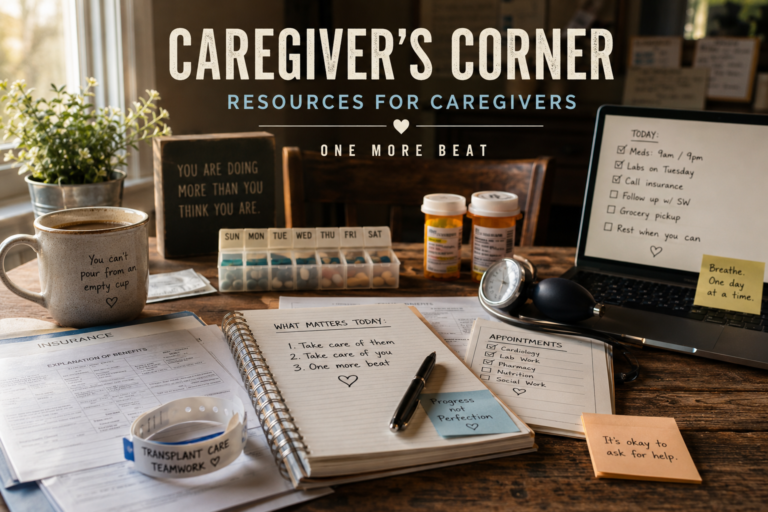
Caregivers Corner is where you are now. This is the dedicated section of One More Beat written specifically for the people on the other side of the bed. The pieces here will follow the arc outlined above—the roads in, the hospitalization, the return home, the relationship, and life on the other side. Bookmark it. Come back to it as the series develops.
The Journey covers the chronological arc from diagnosis through transplant and into early recovery. If you want to understand what the person you love actually went through—the decisions made, the procedures endured, the moments that defined the experience—this is where that story lives. Patients often cannot fully articulate what happened to them. This series does it for them.
Health & Management is where the clinical mechanics live. The medications, the glucose management, the lab values, the dietary restrictions, the day-to-day operational reality of life on immunosuppression. A caregiver who understands why tacrolimus levels matter, what magnesium depletion does, and how the medication schedule is structured is a far more effective partner in the patient’s care than one holding a list of drug names with no context.
Life After Transplant is forward-looking. Post-transplant living, the ongoing medical reality, the CAV diagnosis, the recovery milestones, the emotional and psychological dimensions of survival. This is the territory the household is navigating together, and it is useful to understand it from the patient’s perspective before it arrives at the front door.
Reflections covers the terrain that resists clean categorization—the identity questions, the weight of carrying a stranger’s heart, the honest costs of survival, the spiritual dimensions of an experience that doesn’t resolve into simple answers. For caregivers wrestling with donor death guilt, with what it means that someone died so this person could live, or with their own reckoning about what just happened, this category may be the most personally useful one on the site.
Where This Series Is Going
This is not a single article, because a single article cannot hold the weight of what caregivers are carrying. This is the beginning of a sustained conversation.
The pieces ahead will go deeper into each of the roads in—the long decline, the mechanical bridge, the sudden hospitalization, and the crisis that was always coming but arrived before anyone was ready. We will spend real time on the hospitalization itself and what it demands of the people on the outside of the bed. We will cover the immediate post-transplant period, the medications and what they actually do to the person you love, and the operational reality of the first months at home.
We will raise the relationship questions that almost never get asked in clinic. And we will talk about life on the other side—when the patient is recovering and the caregiver has to figure out who they are now that the crisis that defined them has changed shape.
Many of the pieces published elsewhere on this site are written for transplant recipients. They are also essential reading for caregivers. Understanding what tacrolimus does to mood and sleep, what magnesium management actually requires, how the glucose numbers are being managed and why—that knowledge belongs to the person in the same house as much as it does to the patient. We will flag those pieces as this series develops.
The caregiver did not choose this diagnosis. Neither did the patient.
But one of them is receiving nearly all of the institutional attention, the protocols, the follow-up calls, and the narrative.
This corner is for the other one.
Discover more from One More Beat
Subscribe to get the latest posts sent to your email.