The Hospitalization
The hospital is built for the patient. Every system, every protocol, every staff interaction is organized around the person in the bed. The caregiver walks into that institution and immediately discovers they have no designated place in it. There is no orientation, no handbook, no role definition. They are expected to be constantly available, immediately useful, and largely invisible.
What follows is what that actually looks like.
The Institution
The first thing a caregiver learns is that the hospital does not run on normal time. Days inside the institution are not measured in mornings and evenings but in lab draws, physician rounds, imaging schedules, medication administration windows, and shift changes. Tuesday and Thursday become indistinguishable. A week passes and the caregiver cannot account for most of it. They stop knowing whether they ate lunch. They lose track of what is happening in the world outside the ward because the ward has become the world.
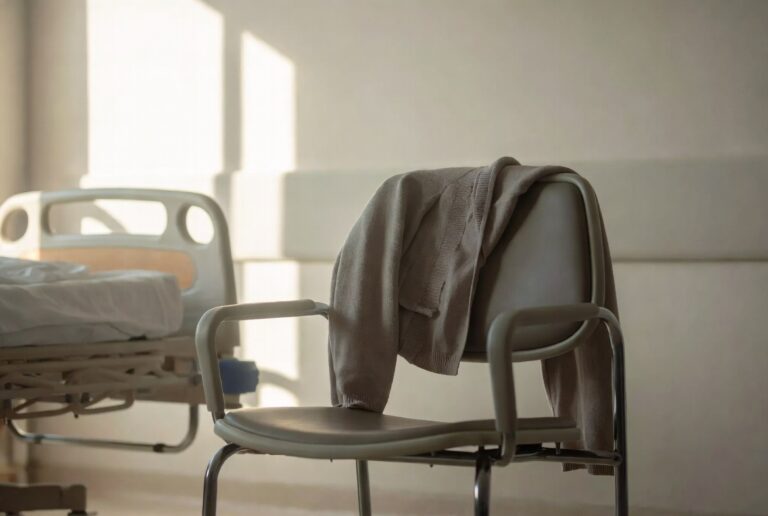
The physical geography of a long hospitalization is its own education. The parking garage, the elevator bank, the particular smell of the cafeteria at two in the afternoon, the waiting room chairs that are designed for short stays and become instruments of endurance after the first week. The caregiver learns all of it by necessity. They learn which entrance is open at 4am. They learn which floor has a vending machine worth stopping at. They learn the route from the waiting room to the room in their sleep because they have walked it hundreds of times.
They learn the institution itself—without being taught. Which alarms mean urgent and which mean adjustable. Which shift change produces a communication gap that lasts two hours. Which staff member actually has answers and which will redirect them to someone else. Which doctors respond to direct questions and which need to be caught in the hallway. Nobody offers this information. The caregiver acquires it by watching, by asking, by being present so consistently that the institution eventually stops treating them as a visitor.
The nurses, over weeks, become something like community. The social worker appears once. The chaplain, if found, is often genuinely helpful. Everyone else is occupied with the patient, as they should be—which means the caregiver exists at the periphery of every interaction, absorbing what they can and filling in the rest on their own.
The Logistics Machine
Nobody tells the caregiver that they are about to become a logistics operation.
Hospital food is often nutritionally inadequate, inappropriately seasoned, and wrong for the specific dietary needs of a patient managing a complex cardiac condition. Someone has to notice this, solve it, and execute a solution repeatedly across weeks. That someone is usually the caregiver—researching what the patient can eat, sourcing it, getting it there while it is still edible, doing it again tomorrow.
The personal care items follow. Shampoo, because the hospital-issued substitute is not what the patient uses and after three weeks it matters. Toothbrush, toothpaste, Q-tips, comfortable clothing that accommodates the lines and wires running in and out of the body. A pillow that isn’t institutional issue. The specific snack that settles a stomach upset by medications. The particular drink the patient has been craving for two weeks. None of this appears on a list anyone gives the caregiver. It accumulates through observation and request, item by item, run by run.
And then there is the information. The extended network of family and friends who want updates—constantly, sometimes urgently, occasionally with an emotional demand that bears no relationship to their proximity to the crisis. The aunt three states away who needs to know everything immediately. The colleague who means well and calls at the wrong moment. The friend who wants more than a text and less than a phone call and cannot quite say what they need. Someone has to manage all of them. Filter what goes out, calibrate how much, field the responses, absorb the anxiety of people who are worried and have no useful outlet for that worry.
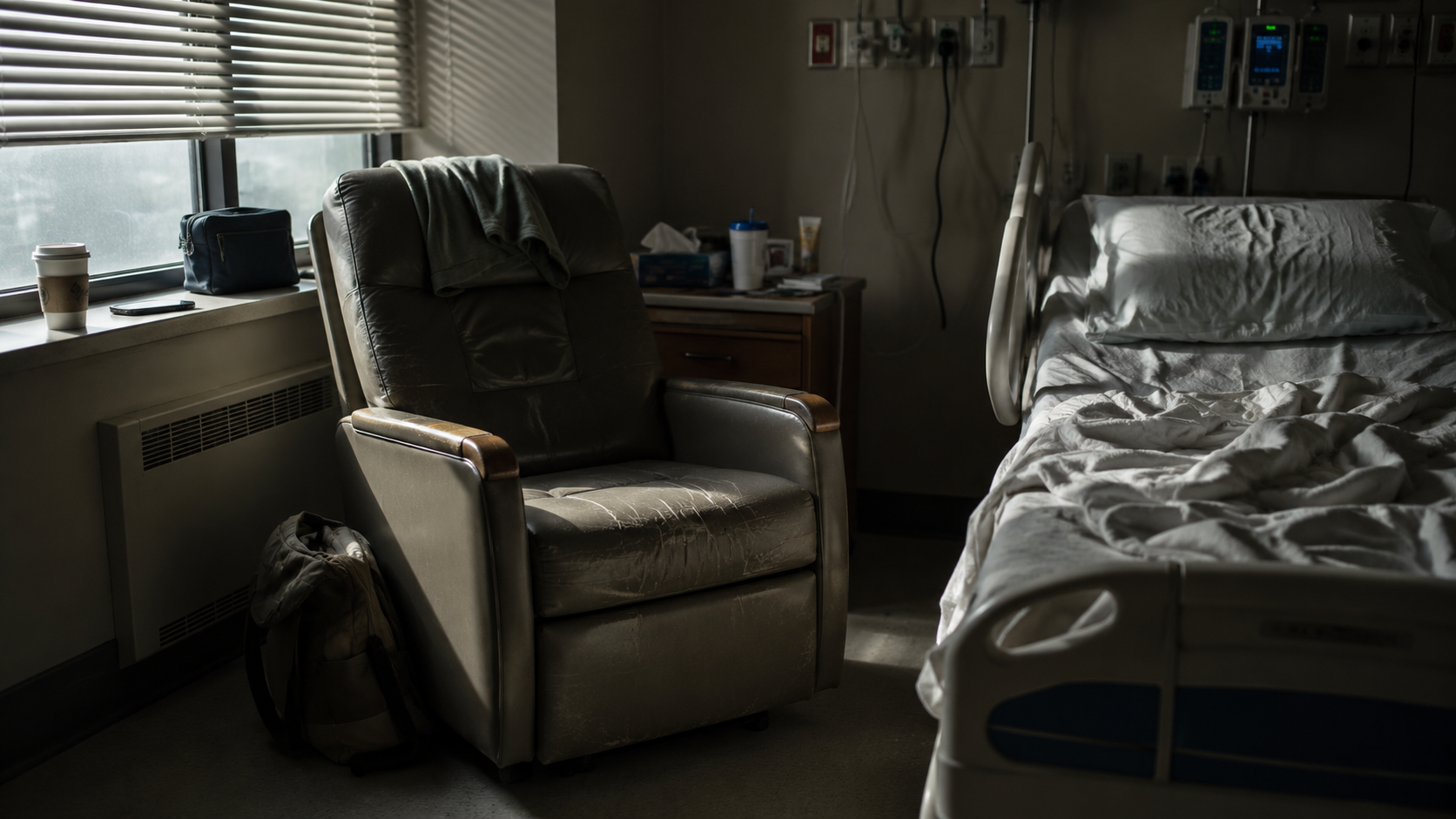
The caregiver becomes spokesperson, rumor control, family diplomat, and emotional regulator for an entire network simultaneously—while sitting in a vinyl chair in a cardiac ICU, trying to remember when they last ate something.
The Social Coordinator
Everyone wants to come. They do not all belong in the room at the same time, and some of them do not belong in the room together at all.
Hospitalization produces social gravity. The event pulls people toward it—family, friends, acquaintances who become newly attentive in a crisis. Some of them are genuinely helpful. Some come too long and leave the patient exhausted. Some come too briefly and carry guilt about it that then requires management. Some cannot come—geography, illness, work, children—and carry the absence as its own weight that eventually lands somewhere, usually on the caregiver. Some want to help and instead create work. Some have complicated histories with the patient, with each other, with the primary caregiver, and those histories do not suspend themselves at the door of a cardiac unit.
Someone has to coordinate all of this. Manage the timing, prevent the overlaps, navigate the person who shows up unannounced, handle the family member who expects to be treated as the primary information source despite minimal presence, absorb the social friction so it doesn’t reach the patient.
In a functioning caregiving situation, that falls to the caregiver. When it doesn’t—when the designated caregiver is largely absent, or present but disengaged—the coordination vacuum gets filled somehow. Sometimes by another family member. Sometimes by a friend who steps into the gap without quite knowing that’s what they’re doing. And sometimes by the patient, from the bed, managing everyone else’s experience of a crisis they are simultaneously living through.
That last one deserves to be named directly. The patient who becomes host of their own catastrophe—fielding texts, sending updates, coordinating visits, managing the feelings of the people in the room—while tubes run into their neck and a machine keeps their heart pumping. It happens. It is extraordinary. It should never be necessary.
Tunnel Vision
The narrowing happens the way most things in a long caregiving arc happen—gradually, then completely.
It does not announce itself. The caregiver does not decide to let their own life recede. They simply keep showing up, and each time they show up, a little more of the world outside the institution loses its immediacy. Work becomes something managed at a distance. Social obligations are deferred. The household runs on minimum viable function—the bills that absolutely must be paid, the tasks that will cause real problems if left undone any longer, nothing beyond that.
After several weeks, the caregiver’s life has contracted to the size of a parking garage, a cafeteria, a hallway, and a room. They have adapted so completely to the institution’s rhythm that they have lost track of their own. Their sleep is organized around visiting hours and procedure schedules. Their meals happen when the hospital day allows. Their conversations are with nurses and with other families in waiting rooms who understand, without explanation, exactly what this is.
The patient often sees this more clearly than the caregiver does. From the bed, they are watching. They notice the circles under the eyes, the meals skipped, the way someone who was once fully present in their own life is now entirely organized around someone else’s survival. Sometimes the patient is the one trying to push the caregiver back toward the world—go home, get some sleep, you don’t have to be here every day—because they can see what’s happening and the caregiver cannot.
The Bridge
A long hospitalization is isolating by design. The institution pulls inward. The routine narrows. The world outside the ward becomes increasingly abstract, increasingly unreal. After enough weeks, it is possible to lose the felt sense that there is a life waiting on the other side of this—that the ordinary texture of things continues without you, that you have a place in it still.
The caregiver is one of the primary bridges back to that world. Not through grand gestures but through small ones. A picture of the dog. News about the neighbors. A stupid joke from work. The ordinary, continuous evidence that life outside these walls is still moving, still specific, still connected to the person in the bed. These are not trivial. They are the things that keep a patient tethered to a future worth returning to. They anchor the will to survive to something concrete—not the abstract good of being alive, but the specific good of going home, cooking a meal, sitting in a familiar chair, being in the world again.
When that bridge isn’t being built, the patient feels the absence. Not always consciously, not always in words, but as a deepening of the isolation that serious illness already produces. The gap between the institution and the life outside it widens. The patient becomes more fully a patient and less fully a person, and that shift has consequences that are not clinical in nature but affect recovery nonetheless.
This is a caregiving function with no medical name, no entry on any checklist, and no one to notice when it isn’t happening. It matters anyway.
The Procedures
The caregiver steps out for coffee. They come back to a hallway they cannot enter.
There is equipment that wasn’t there before. Staff moving with the particular controlled urgency that means something has happened and the response is already underway. Nobody explains anything because nobody has time to explain anything. The caregiver stands in the corridor and waits, because waiting is the only available action, and they have become very practiced at it.
What they are not practiced at is what comes next—being brought back into the room after the immediate crisis has passed, and seeing what is in the bed.
The person they love, after a brutal sequence of procedures—cardioversion, line placements, catheters, defib—does not look like the person who was talking an hour ago. They look like someone the institution has been working on. The color is wrong. The stillness is wrong. There are things attached to the body that weren’t there before. The monitors are speaking a language the caregiver has learned to read, and what they’re reading does not look like stability.
The patient, from inside the experience, knows it looks worse than it is. They know what just happened, they know they are still there, they know the team did what needed to be done. What they cannot do is close the gap between that knowledge and what the people standing at the bedside are seeing. They can say it looks worse than it is. They can mean it. It does not fully land, because the people in the room are not responding to what was said—they are responding to what they saw when they walked in.
That image stays. Years after discharge, years after recovery, the caregiver carries the specific memory of that room. The exact quality of the light. The sound the monitors were making. Where they were standing when they first saw it. What the patient’s face looked like before it registered that people had come in. Trauma memory is precise in ways ordinary memory is not, and this is one of its fixation points—the moment when the abstract knowledge that things were serious became something they could not unsee.
Inside, Outside
The hospital saw the patient.
That was its job, and it did that job. The monitors tracked the heart. The teams ran their protocols. The institution processed a medical crisis with the machinery it was built to deploy.
The caregiver saw everything else. The life outside the room. The people orbiting the crisis. The logistics that kept a human being functional inside a system not designed for human comfort. The social ecosystem that had to be managed from a vinyl chair. The world waiting on the other side of survival that someone had to keep real.
None of that work had a protocol. None of it appeared on a chart. None of it was asked for, trained for, or acknowledged.
It happened anyway. It had to.
Discover more from One More Beat
Subscribe to get the latest posts sent to your email.