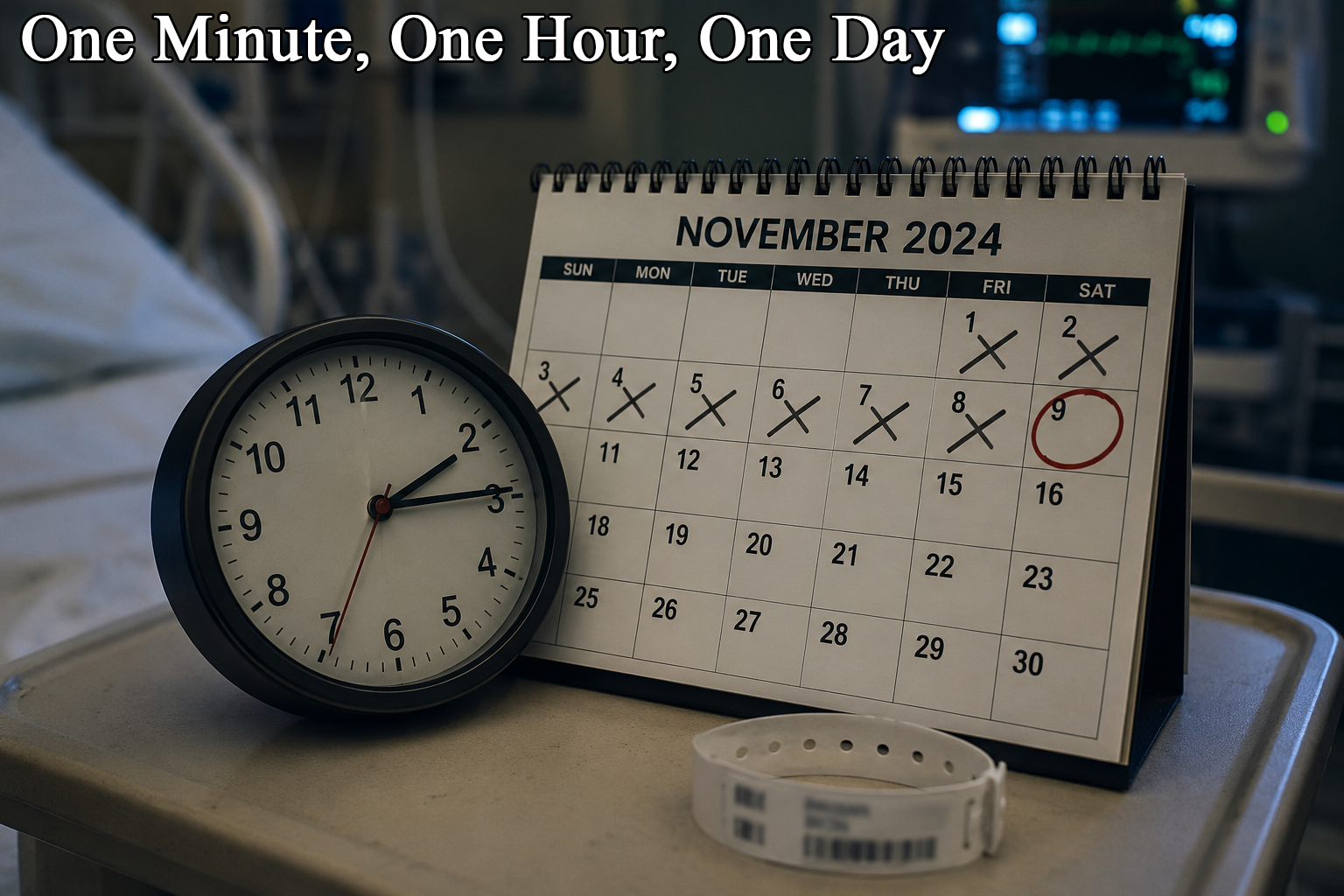
One Minute, One Hour, One Day
There is a moment in every transplant process when the psychological weight of what is happening lands fully. For some it comes at listing. For others, the wait. For others still, the operating table or the ICU or the long recovery after. It comes for everyone eventually—the moment the full cost of survival presents itself in exact terms.
For me, it came before any of that. It came the moment I said yes.
Not the surgery. Not the hospital. The decision—the moment the transplant option became real and I accepted it without reservation, without negotiation, without a second thought. That was the moment the die was cast, and everything that followed—the suffering, the waiting, the slow grinding days in that room—was simply the cost of executing a choice that had already been made and would not be revisited.
How people carry that weight varies enormously. What follows is how I carried mine.
The Question Nobody Asked
Somewhere around the second week at The Christ Hospital, the transplant team started checking on my mental state with a frequency that suggested they were waiting for something to go wrong. The questions were gentle, professional, designed not to alarm. How are you holding up? How are you feeling—not physically, but otherwise? Is there anything you want to talk about?
I kept giving them the same answer: I was fine.
Not performing fine. Not fine in the way a person says fine when they mean the opposite and wants someone to push. Actually fine—clear-headed, decided, forward-facing. I had accepted the situation. I had made my decision. I was executing.
They kept asking anyway, because the answer didn’t match the circumstances. I was tethered to an Impella device that was doing a meaningful share of my heart’s work. I had wires and tubes exiting my body from locations I had not previously considered plausible entry points. My right ventricle had staged a brief and alarming revolt. I had been cardioverted multiple times—once while not quite unconscious enough to not notice. The waiting list had no timeline. There was no way to know if the call would come tomorrow or in six weeks, and no guarantee I would still be viable when it did.
By any reasonable measure, this was a situation that warranted psychological attention. The team was not wrong to look. They just kept not finding what they were looking for.
What the Room Actually Looked Like
Before going further, the inventory deserves to be accurate.
My mother was there every day of my time in the hospital—logistics, presence, the particular steadiness that only a mother carries into a hospital room. Two close friends showed up consistently throughout. Niles visited most days, present in the room the afternoon the listing came through. Eric came when he could, masked and careful, and was there on some of the harder days. There was the occasional visit from my brother, sister, niece…always nice to spend a little time with them.
That was the full roster.
The room was otherwise empty in the ways that matter most in a hospital—the particular absence that anyone who has spent serious time in one will recognize immediately. It was what it was. I was, in the ways that counted, managing this alone.
I am telling you this not for sympathy but for accuracy. What follows only makes sense against the actual conditions under which it occurred.
The Framework
On the morning of October 3rd, 2024—the morning they were taking me down to implant the Impella—I told Eric I might not come back from this.
He said: one minute, one hour, one day at a time.
I have thought about that line many times since. It sounds like comfort. It isn’t, or not only. It is a precision instrument for a specific problem—the mind’s tendency to run too far forward, to calculate costs it cannot yet afford to calculate, to stack the suffering that hasn’t happened yet on top of the suffering that has. That calculation, at sufficient scale, becomes unmanageable. The framework interrupts it. You do not think about the year. You think about the next hour. Then the one after that.
I already understood this, in some form, before he said it. But hearing it named made it useful in a way that unnamed things rarely are.
How I Am Built
Here is what the transplant team was actually encountering, though I am not sure they had a category for it.
When I make a decision, I move forward. I do not look back. I do not relitigate. The decision has been made; what remains is execution, and execution is where all the work lives. This is not a discipline I developed. It is not a practice I maintain. It is simply how I am designed—how I have always been designed, in every domain, across every circumstance my life has produced.
What the team could not see—what most people cannot see—is what sits behind that orientation. It is not patience. It is not equanimity. It is something closer to will operating as a force that doesn’t negotiate with obstacles, only moves through them. When I commit to a course, I will drive myself to the absolute limit of what is physically possible to see it through. That is not a figure of speech; it is a description of how I function.
Before the transplant option appeared, I had made a different decision: I was not going to suffer needlessly for a lost battle. I want to be precise about that word—lost, not losing. A losing battle still has an outcome in play. A lost battle is already decided; the only remaining question is how much you are willing to endure for a result that is already written. The answer, for me: not much. I had accepted what was coming. I was at peace with it.
The moment the transplant option became real, the variables changed. A result that was not yet written appeared in front of me. That was the moment the decision was made—and once it was made, the suffering I had just declined to accept for a lost cause became simply the cost of execution.
So, I paid it.
Every cardioversion, every needle, every procedure, every blood draw at three in the morning, every slow grinding day in that room—the cost of executing a decision that had already been made. It didn’t require courage. It required follow-through.
The open loops—the fear, the doubt, the what-ifs, the midnight calculations—they require something to grab onto. A question still in play. An alternative still on the table. I had closed every question. There was nothing for them to grab.
This is what the team kept not finding. Not courage, exactly—courage implies the presence of something to overcome. What they were looking for was doubt, and I didn’t have any. The decision was made. I was executing. The mental state was sound because there was nothing to make it unsound.
They kept at it anyway, eventually pushing hard enough on the question of pharmaceutical support that I agreed—not because I believed the diagnosis, but because the cost of continuing to decline it was higher than the cost of the pill. Maybe two weeks later, the transplant came. The medication disappeared from my list that day. No taper, no conversation. Gone. It had not had time to do anything. The whole episode said more about the framework they were working from than it did about my actual state.
I want to be careful here, because none of this is a template. I am not describing a method anyone can adopt. I am describing a particular kind of person operating under maximum load in exactly the way he was built to operate. For recipients reading this who are white-knuckling their way through the waiting period, processing fear and doubt and uncertainty in the completely normal way that most humans process those things—you are not doing it wrong. I am not the standard. I am one data point at one end of a spectrum, and the honest thing is to say so plainly.
The Slow Hours
Psychological stability, I should be clear, is not the same thing as comfort.
The hours passed slowly. Painfully slowly. I am, by nature, a very patient man. That said, I have no tolerance for sitting idle when there is nothing productive to do with the time. That is not a circumstantial frustration. It is a permanent feature of how I operate. A hospital room does not offer a great deal of productive activity. I watched television until my brain threatened to liquify. I read medical journal articles. I researched nutrient profiles in the hospital menu and coached a friend through his cardiac CT results from my bed. I drafted the early outline of this blog in a text message at six in the morning because the alternative was staring at the ceiling.
This is what a functioning mind looks like when it has been given nothing adequate to function on. The stability was real. The restlessness was equally real. They coexisted without contradiction—one a description of my psychological state, the other a description of the conditions I was living inside.
I raise this because the waiting period is genuinely hard even when nothing is psychologically wrong. The slowness is its own category of difficulty, separate from fear or doubt or grief. For someone who lives in his head, the enforced idleness of a long hospitalization carries its own particular weight. You find ways through it. You do not pretend it isn’t there.
The One Night
There was one night.
October 15th.
The previous evening, my right ventricle had been declared in failure. A new Swan-Ganz catheter (got the VIP model this time). A cardioversion I was present for in ways I would not recommend. The RVAD surgery had been scheduled for the following morning and then, mercifully, stood down when the ventricle recovered enough to hold. I had gotten almost no sleep. I had been awake long enough that my eyes were going strange at the edges.
Late that night, I sent a text that said I was beginning to question my decisions.
I want to be precise about what that was and what it wasn’t. It was not doubt about the transplant. That door was closed and had been closed for weeks. What happened was simpler and more physiological: I ran the numbers forward. Tubes, wires, procedures, the suffering already accumulated, the suffering presumably still ahead—another decade or more of life that would have its own weight to carry. The calculation, at that hour, in that condition, got dark.
I diagnosed the problem in real time:
I got inside my head.
The solution was not a phone call. Not a therapeutic breakthrough. Not medication. It was sleep. The team gave me a “sleep holiday”. This is a thing—they put a do not disturb sign on your door and for 5-7 hours, nobody goes in unless there’s a really good reason. I went to bed. Five or six hours later I was back—same baseline, same clarity, same forward orientation. The wall had been physiological all along. Sleep deprivation will do to even the most settled mind what no amount of genuine doubt could.
This is also what mental fitness looks like. Not the absence of hard moments. The ability to correctly identify what a hard moment actually is—and respond accordingly.
One Minute, One Hour, One Day
The phrase works because it is honest about the scale at which survival actually operates.
You do not survive a transplant. You survive the next hour. Then the one after that. The transplant is an abstraction—a future event, a destination, a word on a medical chart. The hour in front of you is real. The tube in your neck is real. The blood draw at 3am is real. The framework keeps you at the resolution where you can actually function, and out of the resolution where the math becomes unmanageable.
I have always lived closer to this resolution than most people I know. The decision is made; what’s in front of me is what requires attention. That orientation—that refusal to live anywhere other than the present problem—turns out to be exactly what the waiting period demands.
I did not learn this in a hospital room. I brought it with me. But I understood it better when I left.
Discover more from One More Beat
Subscribe to get the latest posts sent to your email.