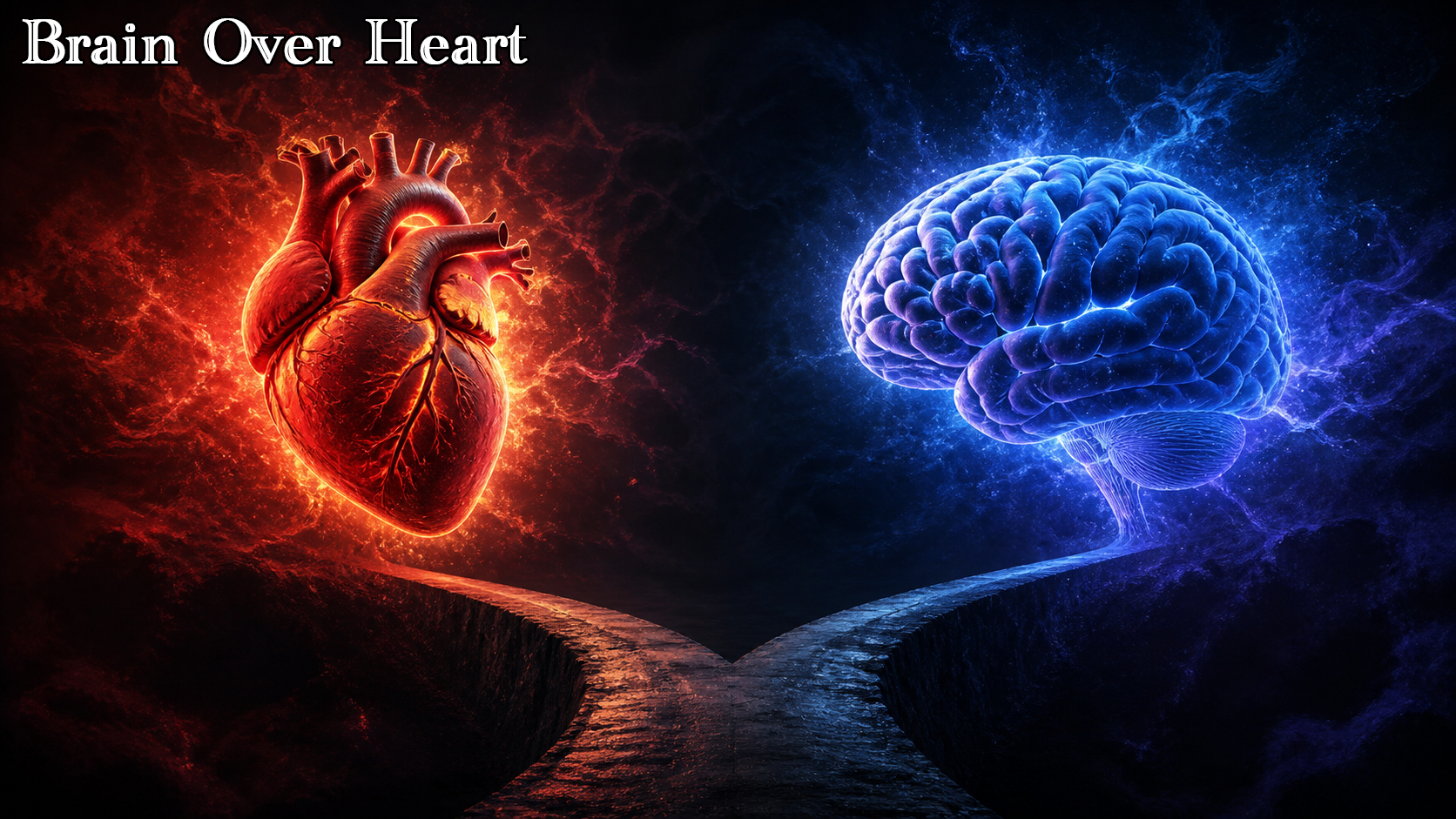
Brain Over Heart
The number 55 had been hanging there for years.
Not a premonition in any mystical sense—a calculation. The kind that runs quietly in the background when you know your body well enough and have been paying attention long enough to see where the trajectory leads. When things started going downhill fast after my 55th birthday, it did not surprise me. The math had been right.
I am an intellectual. I live and breathe in the mind. It is not simply how I prefer to operate—it is who I am, at the level of identity, the way some people are defined by their faith or their relationships or their work. The intellect is the instrument through which I navigate everything: problems, decisions, relationships, uncertainty. It is the first tool I reach for and, in most circumstances, the only one I need.
When the body started failing in earnest, the intellect did what it always does. It assessed the situation. It ran the numbers. It arrived at a conclusion.
Making Peace
Acceptance of one’s death is not something to be considered lightly. Anyone who reduces it to a platitude—the reaper comes for us all, every day is borrowed time, we are all dying from the moment we are born—has not actually done it. The words are true enough. The work of arriving at genuine acceptance is something else entirely.
I knew the science. I understood what was happening to my heart and what the trajectory meant. As a spiritualist—someone who has studied seriously across traditions, who has had direct experiences that resist rational explanation—I felt there was something more, some dimension of existence that does not simply end when the body does. But my intellectual side refused the pat answers of any religion. The simple fact of the matter is that we do not know what happens when we die. No tradition has demonstrated this with the kind of evidence the intellect requires. The uncertainty is real, and it had to be sat with directly—not papered over with doctrine, not dismissed with materialism, but held honestly in the space where it actually lives.
So I made my peace with both things simultaneously: my impending death and the genuine uncertainty of what, if anything, follows it.
What I wanted was an uncomplicated passing. Reasonably quick. No suffering. I had watched others die slowly—the medical establishment working frantically to save them, the loss of dignity in the long march to the final gasp, the body failing by degrees while the mind remained present for all of it. I had come to understand, in those cases, the relief that death finally brings. I did not want that. Especially knowing that I would likely remain in heightened awareness all the way through—the intellect running to the end, observing everything, unable to look away.
The acceptance arrived. Not without weight—it is never without weight—but genuine. The mind had looked at the situation, done the work, and arrived at a position it could stand behind. Filed. Done.
The Option
Then something happened.
Where death had seemed inevitable, it turned out it was not inevitable at all. There was an option.
For some people, this would be a sudden spark of joy in an otherwise dark tunnel—a glimmer of hope, enough to send them spinning with optimism, the desperate reaching for the last available handhold. For me, it was more a matter of reflection. I had already made my peace. The news that the peace might be premature required processing, not celebration.
I was genuinely surprised that transplant was even on the table. The weight. The type 2 diabetes—well-controlled by diet, but still a comorbidity to be considered. I questioned the doctor. I am sure we talked for quite some time.
In the end, the reality resolved itself clearly: there was an option. I did not have to die. But I had to make a decision.
The Decision
The decision was not immediate. It was not simple. And it needs to be said plainly that it was not the lunging of a desperate man for the last available hope.
I knew what a heart transplant meant. The immunosuppression—a lifetime of it, titrated and managed and never finished. The complications. The follow-up that never ends. And more than any of that: the permanent dependency on a medical system I had always preferred to navigate on my own terms, now becoming a system I could not live without.
I knew exactly what saying yes meant. It meant choosing the suffering I had most wanted to avoid. Every fear I had ever had about the end—the procedures, the pain, the loss of control over what happens to one’s own body—would arrive on schedule, guaranteed, as the direct and unavoidable cost of choosing to live. I was tired. So very tired. Declining was a legitimate option. I had made my peace. I could have let my end arrive on its own terms, on the path I had already prepared for, and there would have been nothing wrong with that.
And yet, the decision was brutally simple.
Because of who I am.
There is no permission to die when there is an option to live. Not for me. Not ever. I have a principle—not borrowed from anywhere, not inspiration lifted from a poster—that is simply a description of what I am made of:
Falling is expected. Suffering is inevitable. Quitting is unacceptable.
It is scratched into every fiber of my being.
This was not courage. I want to be clear about that. Courage implies fear overcome—the presence of fear as the thing being surmounted. There was no fear. Not of dying, not of what was coming. Fear was not a variable in the calculation, in either direction. Neither was hope, in the conventional sense of something longed for. The intellect looked at the available options, noted that one of them led to life, and made the only call it was constitutionally capable of making.
I decided to live.
The Stubbornness Engages
Once the decision was made, something else engaged—the other side of the same coin. When I set my mind to something, that something happens. No exceptions, no asterisks.
During a particularly bad bout of AFib, after the defibrillator and the swan cath in the neck and the blood everywhere, they brought my family back to see me. I knew how I looked. I could see it in the kids’ eyes—the shock of seeing their father like that. Seeing anyone like that. I told them: this looks really bad, and it certainly ain’t good, but it’s not nearly as bad as it looks and I’m not going to die.
That is just who I am.
While I was waiting for the transplant, a deal came up on the newest iPhone. One of those Verizon offers—existing customers, the latest model, a dollar a month on a 36-month contract. My existing phone was well over five years old. I was going to live. I had decided that. There was no reason to act otherwise, and there was no reason to miss a good deal. I ordered it.
Logistics and time, pure and simple.
The Price of the Ticket
I had known going in what the transplant route would cost. There was no illusion about it. I had chosen this path precisely because quitting was unacceptable—not because I expected it to be anything other than what it was.
What I had prepared for, on the other path, was an uncomplicated exit. The end arriving on its own terms. Perhaps some pharmaceutical mercy as things wound down. That was the death route—quiet, unremarkable, on a timeline the body set. I had made my peace with it.
The transplant route was always going to be something else entirely. I knew that when I said yes. And it was.
Two months of pure hell.
Stuck every day. IVs, swan caths, PICC lines. Colonoscopy, endoscopy, cystoscopy. Not one, not two, but three catheterizations. A thyroidectomy. Intubation. A tube and rotor installed through my chest and into my heart. And then, finally, my chest sawed open, my native heart removed, and a donor heart installed in its place.
Non-stop pain for months. Sometimes bad enough that I wanted to cry. I refused.
I let them do every single one of these things to me—all of it, without exception—because this was the cost of the decision already made. I had bought the ticket. The only acceptable thing was to ride.
Not out of fear of what would happen if I didn’t. Not out of courage in the face of fear. The intellect had run the business from the beginning, had made the call, and was not going to walk it back because the execution was exactly as hard as anticipated. The mind held the line. The body followed.
That is what Brain over Heart looks like in practice. Not the inspirational version. Just a man running on his primary instrument, doing the only thing his nature would permit, paying whatever price the situation required.
As Expected
The transplant happened. The donor heart went in. I came through it.
On the other side was a new heart, a body that had been through two months of sustained assault, and—for the first time in my life—a set of circumstances the intellect was not fully equipped to handle.
What happened next is the next piece….
Discover more from One More Beat
Subscribe to get the latest posts sent to your email.