
The Fine Print
The discharge packet covers the medications, the follow-up schedule, the dietary restrictions, the warning signs to watch for. It does not cover what the next several months are going to feel like. This piece is that conversation.
The Pharmacological Reality
The immunosuppressant regimen is not optional and it is not gentle. Each drug is doing an essential job. Each one is also exacting a cost that the discharge paperwork describes in general terms and that real life delivers in specific ones.
Prednisone
The emotional dysregulation is not just anger, though anger is part of it. It is the full range: crying without a cause, dread arriving in the morning with nothing attached to it, flatness where feeling should be, an emotional lability that moves faster than reason can follow. You know it is chemical. That does not make it optional. The drug that is keeping the new heart from being rejected is simultaneously dissolving the emotional defenses, and the intellect that might otherwise manage the response is operating at reduced capacity. All of this at once.
Then there is the sleep disruption—prednisone does not cooperate with sleep schedules, running the system toward wakefulness regardless of the hour. The blood sugar driving upward regardless of diet. The weight fluctuating with the fluid retention and the appetite dysregulation. The daily weigh-in the transplant team requires is not bureaucratic—it is a rejection warning system, because fluid accumulation is an early sign. You watch the number every morning and learn what it means.
Coming off prednisone entirely—stepping down from 30mg to 20 to 10 to 5 to 2.5 to nothing, over months—is its own milestone. When it finally happens, things begin to return: flavor, emotional baseline, some measure of sleep. Not all at once, and not completely. But noticeably.
Tacrolimus
The tremors arrive early and stay. The hands shake—not violently, but enough. Enough that pills require tweezers. Enough that handwriting becomes unreliable. Enough that tasks requiring fine motor control become negotiations with a body that used to handle them automatically.
The hair loss arrives later, after the prednisone is gone and the tacrolimus is doing its work unopposed. A full head of thick, curly hair going into the hospital—the kind that, at 55, still attracted comment. Gone into mountain man territory by discharge. The first haircut a month and a half post-transplant felt like a minor restoration of civilization. Off prednisone, things were looking up—and then, about a month later, the thinning began. Tacrolimus doing what tacrolimus does to hair follicles. A skull shaver was purchased in anticipation. As it turned out, the hair came back—thinner than before, different in texture, but back. The skull shaver was not needed. The van dyke, however, remains.
Tacrolimus is also diabetogenic—it suppresses insulin production. Combined with prednisone driving blood glucose upward, the metabolic situation in early recovery is genuinely difficult. Four insulin injections daily, readings elevated regardless of dietary discipline. Managing it requires sustained attention.
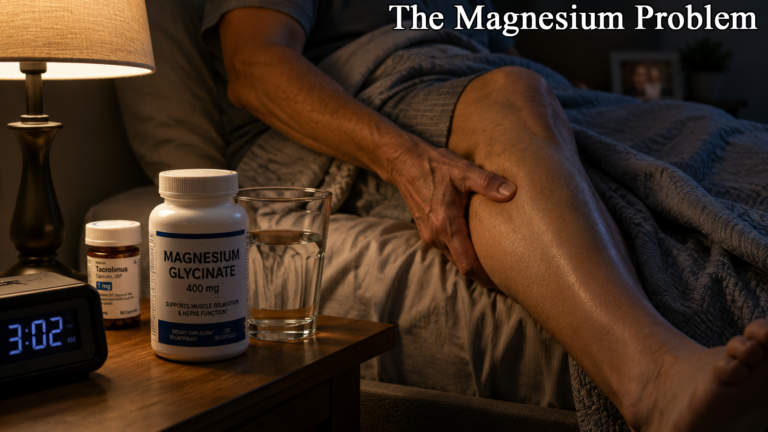
Then there is the magnesium. Tacrolimus depletes it, and low magnesium produces cramping—the kind that arrives in the legs at night, or in the hands, without warning. Managing the magnesium level becomes part of the daily calculus: supplementation timed carefully, dietary sources tracked, levels monitored in the regular bloodwork. When the magnesium is right, the cramping eases. When it slips, you know immediately.
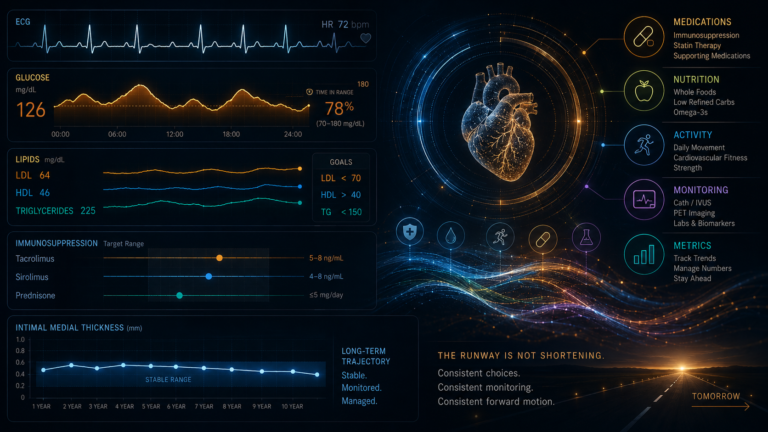
The serum level of tacrolimus itself requires constant vigilance. The target window is narrow. Too low and the immune system begins to act on the new heart; too high and the toxicity becomes its own problem. The levels fluctuate for reasons that are not always immediately apparent—a subject covered in more detail in the food and supplement section below.
Sirolimus
Added at one year, when the CAV diagnosis arrived—caught early, treated with the addition of sirolimus to the existing regimen. The drug works. It also reduces insulin sensitivity, which stacks directly on top of tacrolimus’s suppression of insulin production. The metabolic double-bind deepens. Mouth sores arrive, a known sirolimus side effect, periodic and uncomfortable. Intestinal upset. The body adjusting to yet another intervention, on top of everything already in motion.
The Taste Problem
For two months in the hospital, then three months at home, food tasted wrong. Not bad in the way bad food tastes bad—wrong in a more fundamental sense, flat and muted and stripped of the information it is supposed to carry. Prednisone does this. For someone whose relationship with food and cooking is central to who he is, this is not a minor inconvenience. It is a specific kind of loss.
What cut through: mixed-berry smoothies, strawberry shakes,
What cut through: mixed-berry smoothies, strawberry shakes, Barq’s Red Crème Soda. A narrow band of flavor that registered when everything else was flat. Filed away, leaned on heavily. As the prednisone stepped down, flavor returned—gradually, then more noticeably, then almost normal. “Almost” is the word that keeps appearing in the records from that period. It took five months to get there fully.
What to Avoid—and Why
The pharmacological sensitivity of the immunosuppressant regimen extends well beyond the medications themselves. Ordinary foods, beverages, and supplements can destabilize it in ways that are not intuitive and are not always covered in the discharge conversation.
The well-known prohibitions—grapefruit, pomegranate—are in the packet. What is less often explained is why: these fruits inhibit the CYP3A4 enzyme responsible for metabolizing tacrolimus, causing serum levels to rise unpredictably. The same mechanism operates with other foods and substances that receive less attention.
Tea is a significant one. Black, green, white, and brown teas all contain catechins that affect tacrolimus absorption and can cause serum levels to fluctuate. This includes teas that are generally considered healthy and that recipients may be actively choosing for their purported benefits. Herbal teas present a different problem: not only do many herbal preparations interact with immunosuppressant medications, but the contents of herbal products are not always reliably what the label states. The FDA does not regulate herbal supplements the way it regulates pharmaceuticals. There have been documented cases of supplements containing undisclosed ingredients or incorrect concentrations. The safest approach is to clear any supplement, herbal or otherwise, with the transplant team before use.
Magnesium timing is another non-obvious interaction. Magnesium supplements—which many recipients need, given tacrolimus’s depletion of it—can interfere with the absorption of other medications, including tacrolimus itself, when taken simultaneously. The solution is spacing: taking magnesium at a different time than the tacrolimus dose. It took time and attention to identify this as the source of fluctuating serum levels, and it was not information that arrived at discharge.
The general principle: anything that goes into the body has the potential to affect the regimen. Clear it first. Ask specifically, not generally.
The Body’s Other Complaints
Temperature
Always cold. Not occasionally, not when the weather warranted it—always. Umpteen blankets were not enough. The body’s thermoregulation, disrupted by the medications and the trauma and the ongoing adjustment, simply could not find its baseline. Night sweats on one end—waking drenched for no environmental reason—and chills that no amount of covering could fully address on the other. The body running its own temperature program on a schedule that did not consult anyone.
The Catheter Aftermath
Extended catheterization leaves a recovery of its own. The bladder, which managed itself automatically for decades, needs time to relearn reliability. The diuretics and stool softeners that are standard protocol in early recovery do not care about timing or convenience. Accidents happen. Dignity takes another hit, and then the body gradually remembers what it is supposed to do. This is not in the discharge packet in any useful detail. It should be.
Swelling
The ankles especially. Fluid accumulates in ways the body is not yet efficiently clearing. Elevation helps. Compression helps. Patience is required. It resolves, eventually, but the timeline is its own.
The Scar and What Comes With It
The sternotomy scar itches as it heals—sometimes intensely, the skin reknitting in ways that produce sensations that are hard to distinguish from pain. Phantom sensations in the chest arrive without warning: pressure, the feeling of something happening in there, signals the nervous system sends that may be nerves reconnecting or scar tissue settling or the body adjusting to hardware it did not previously contain. Each one requires assessment—is this real, or is this the phantom?—and the assessment happens in a nervous system trained over months to treat every chest sensation as potentially significant. Learning to read the difference is an ongoing project.
The Adhesive
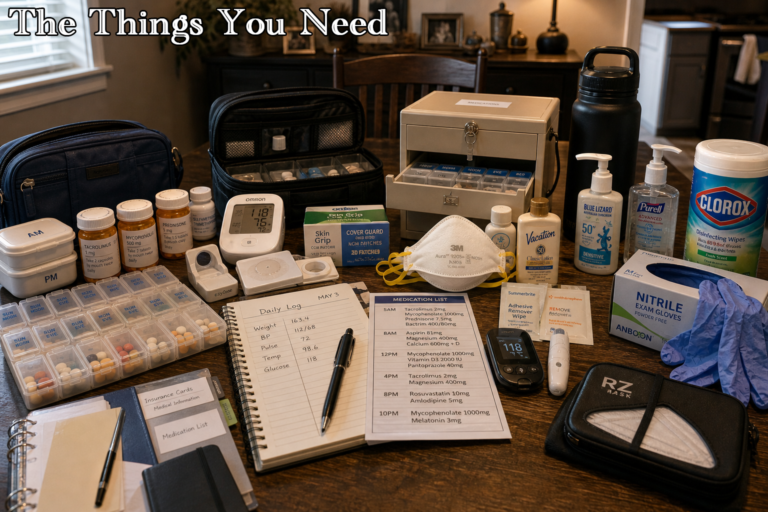
Every procedure, every blood draw, every IV line leaves adhesive behind. EKG stickers are particularly committed to the skin. The tegaderm from the biopsy site adheres until the following morning if you are lucky and longer if you are not. The residue from tape and stickers and dressings clings to hypersensitive post-trauma skin for days or weeks. There are products that help: Summerbrite Adhesive Remover Wipes are effective, as are the remover products from Smith & Nephew. Both are worth having on hand before the first procedure.
The CGM
Continuous glucose monitors are invaluable for managing the blood sugar chaos of early recovery—but they are expensive, the sensors have a tendency to catch on clothing or doorframes, and a lost sensor is a significant loss. Get an overpatch before the first sensor goes on. Skin Grip and Cover Guard are both effective; the Cover Guard patches without adhesive in the center are particularly useful, as they hold the edges without interfering with the sensor window.
Weight
The daily weigh-in tracks fluid retention as a rejection indicator. It also tracks the prednisone-driven fluctuation and the appetite dysregulation. As the medications step down, the weight stabilizes—but the process is slow and the number on the scale is not a simple reflection of anything simple.
Brain Fog and the Administrative Burden
The cognitive fog of early recovery arrives at precisely the wrong time.
The medical bills begin arriving while the brain is still operating at reduced capacity—dozens of separate statements from providers you have never heard of, each one requiring reconciliation against insurance explanations of benefits that are not designed for clarity, each one carrying a deadline that does not adjust for the fact that you recently had your chest opened. The pharmacy coordination requires sustained attention: refill timing cannot slip because the tacrolimus cannot be missed, but managing the schedule of which drugs come from which pharmacy on which cadence is its own administrative project. Insurance approvals for specific medications require follow-up. Lab scheduling requires planning around procedure schedules and medication timing.
All of this arrives while you are also managing the pill minder with shaking hands, the insulin injections, the daily vitals log, the dietary restrictions, and the cognitive overhead of assessing every chest sensation and every elevated temperature and every unusual reading. It is a great deal to hold simultaneously in a brain that is working its way back from months of reduced cardiac output.
The fog lifts. Gradually, then more quickly, then one day the work that was difficult is simply work again. But in the meantime, getting through the administrative reality of a heart transplant with a brain that is not yet fully online is one of the less-documented challenges of the experience, and it deserves to be named plainly.
The Emotional Freight
The pharmacological section covers the causes. This section covers what it actually feels like to carry them.
Crying at a commercial. Not metaphorically—literally, unexpectedly, with no particular provocation. Dread sitting in the chest on a Tuesday morning with nothing attached to it. The emotional response arriving faster than any intellectual framework can catch it, from a man whose primary instrument has always been the intellectual framework.
The PTSD thread running through all of it: the beeping appliance that maps to the ward, the blood draw that the skin is now hypervigilant about, the chest sensation that requires immediate assessment, the nervous system that has been trained over months to treat everything as potentially significant and has not been told the emergency is over.
You know it is chemical. That knowledge is accurate and insufficient. The emotion is real regardless of its origin, and it does not respond to the understanding that it is pharmacologically produced. What the intellect provides is containment, not elimination. For most recipients, professional support—a therapist with experience in medical trauma, or medication to address what the body’s chemistry is doing, or both—will serve better than containment alone. There is no weakness in that. The brain is not failing. It is responding, accurately, to everything that has happened to it.
What Immunosuppression Actually Means
The rules are in the discharge packet. What is not in the discharge packet is the cognitive and social weight of living by them continuously.
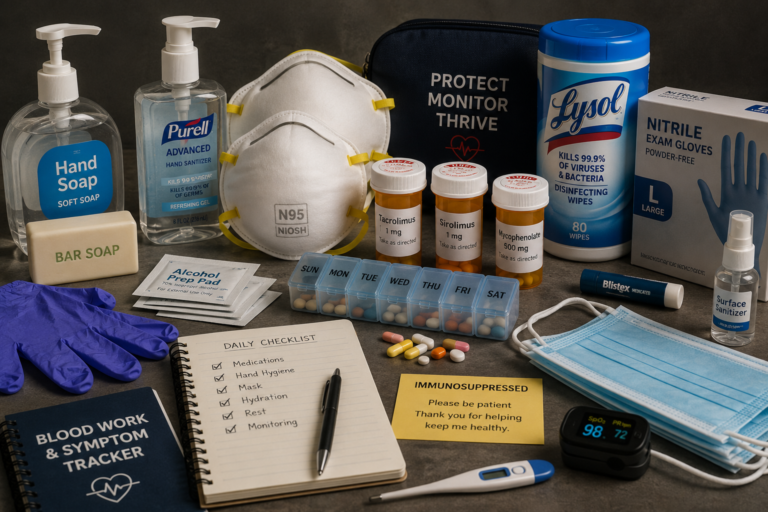
No swimming—standing water is a pathogen vector, and an immunosuppressed patient is not equipped to handle what standing water routinely carries. No crowded indoor spaces during infection season—which is cold and flu and COVID season, which is Thanksgiving through New Year’s, which is exactly when American social life concentrates indoors around communal meals. The mask requirement is specific: N95, NIOSH-tested, not KN95, not cloth, and yes they mean it. Bulk purchasing is the only way to make the economics work.
The immunosuppressed person at the summer cookout is scanning. Not obviously, not dramatically—but constantly. The potato salad that has been sitting in the heat. The person across the table who is clearly fighting something. The serving utensils handled by multiple people. The handshake from someone whose health status is unknown. This is not paranoia. It is the accurate assessment of risk by someone whose immune system cannot defend against normal exposure the way it once could.
The sun requires management it never required before. Long-term immunosuppression elevates skin cancer risk, and this changes the calculation about outdoor exposure permanently. SPF is not optional, and the formulation matters—the goal is high protection with minimal chemical irritation to already-sensitive skin. SPF 50 or higher. Blue Lizard and Vacation Classic are both solid options; the spray format is easier to apply consistently.
What accumulates, over weeks and months of all of this, is a low-level cognitive load that does not fully lift. Scanning the room. Noticing the cough across the restaurant. Calculating whether the gathering is worth the exposure risk. Explaining, again, to someone who means well, why you cannot simply relax about it. The vigilance is not chosen. It is the cost of remaining healthy in a body that cannot defend itself the way bodies are supposed to.
The Dotted Line
This is the fine print—not because the medical team is negligent, but because the list is long enough that covering it fully in a discharge conversation would be impossible, and some of it cannot be understood until you are living it anyway.
If you are in the early months and you are crying at commercials, losing your hair, always cold, managing a bladder that has forgotten its job, reconciling bills from people you have never heard of with a brain that is still finding its way back—you are not broken.
It is. Almost certainly, it is.
Discover more from One More Beat
Subscribe to get the latest posts sent to your email.


This is the best summation I’ve ever read regarding “everything” post transplant. High Praise! I’m forwarding a link to all family and friends since my med side effects apparently include the ability to string words together in a cohesive whole over a period of time. 🙂
Thanks, Andy! I hope they find it brings a greater understanding of the kinds of things we have to work through after an experience like this.