The Grand Parade
The Impella went in on October 3rd.
It is a small device—a catheter-mounted pump, surgically implanted through the chest into the left ventricle—and what it does is deceptively simple: it pulls blood from the heart and pushes it into the aorta, taking over a portion of the work the ventricle can no longer do on its own. In my case, the ventricle had been doing almost none of that work. Five percent ejection fraction. The heart was present; it was simply not, in any meaningful sense, pumping.
What happened in the hours after the Impella was implanted is difficult to describe with clinical precision because it was not primarily a clinical experience. Blood was reaching my brain again—real blood, in real volume—and the difference was immediate and startling. Not just clarity. The return of something I had not realized was gone. Niles, who had been visiting regularly, would later describe it as a day-and-night transformation. From the inside, it felt like a door opening in a room I hadn’t known was dark.
I had been running diminished for years. Possibly as much as a decade. I had no way of knowing how diminished until the deficit was corrected, and by then the baseline I’d been calling normal was so far below actual normal that the restoration felt less like recovery and more like becoming a different person. An earlier version, retrieved.
Arrival
Getting to that point required a few days of something considerably less inspiring.
I arrived at Christ Hospital on October 2nd, airlifted from Mercy West, and was moved into a room that established immediately that this was going to be a different kind of experience. No bathroom. The food options overnight—chips, pretzels, crackers, NutriGrain bars—suggested that whoever designed the nutritional protocols had never met a diabetic. The nurses were competent and professional. The physical infrastructure of the place felt like it had been built in a different era.
What TCH had, and Mercy West could not offer, was the infrastructure for what came next: advanced mechanical support, a transplant program, and a team that had seen cases like mine before. The transfer was the right call. I was not ungrateful. I was, however, in the blunt assessment of someone who had just been airlifted in a state of measurable system failure, deeply unimpressed by the snack selection.
The first morning, the room filled with doctors. This was the initial evaluation—team members cycling through, each with their own questions, their own observations, their own piece of the assessment. I did what I had done at Mercy West: established the terms of engagement immediately. Don’t manage me. Don’t simplify. I have been living with this for twenty-two years and I am reading the same chart you are. Speak to me directly or don’t speak to me at all.
Most of them got it. One didn’t; the correction was swift.
Also among the group that first day was a man who said relatively little but whose one comment landed with the weight of something he meant. Dr. Robert Dowling—surgical director of TCH’s heart transplant program, and someone who delivered exactly as much as he intended to deliver and no more—looked at me and said simply: “You’re not going to die.”
Not “we’re going to do everything we can.” Not “the odds are in your favor.” You’re not going to die. He said it the way you say a fact. Then the room moved on.
I held onto that sentence for weeks.
Thomas
The Impella surgery was still ahead. Before that, there was the matter of my blood glucose.
I had managed type 2 diabetes without insulin for years—diet, supplements, Jardiance. The hospital’s protocol required regular finger-stick glucose checks. Routine for most patients. For me, the skin on my fingertips has always been acutely sensitive; the stick itself is one thing, but the pain persists for hours afterward, sometimes days. After everything that had already been done to my body by that point—the IVs, the PICC line, the Swan catheter, the cardioversions—the finger stick was the thing that broke me.
I told the nurse it was not going to happen. He was taken aback.
His name was Thomas. Former Army—82nd Airborne—and he recognized what he was looking at within about thirty seconds. Not a difficult patient. A man who had hit a wall. He pulled back, assessed the situation, and then did something that turned out to matter considerably more than a glucose reading.
He talked to me.
Not about the finger stick. About what the team at TCH was actually watching for. In evaluating a transplant candidate, he explained, they weren’t only looking at the medical picture. They were looking at the person. What’s his mental state? Will he comply with the protocol? Is he going to fight us on every decision, or is he going to trust the process? Is this someone we can treat to a successful outcome?
The transplant isn’t just a surgery. It’s a covenant. You must be willing to hold up your end.
He didn’t phrase it quite that way. He was more direct—the kind of direct that comes from a background where clarity is not a courtesy, it’s a survival skill. The conversation was man to man; a level of straight talk uncommon in such settings. And something in the way he said it reached the part of me that had been pushing through the previous ten days on pure stubbornness and got through to a different part entirely.
I got in line.
I don’t know that I could have explained, in that moment, exactly what shifted. Only that it did. The intellectual decision to pursue the path of life had been made in my bedroom weeks earlier, and again at Mercy West. What Thomas did was something different—he got my head facing forward. The decision and the direction are not always the same thing.
The Grand Parade
What followed the Impella was the most comprehensive medical evaluation I have ever experienced or expect to experience. The transplant workup is not a checklist. It is a systematic dismantling of every system in the body, with the goal of answering a single question: is there anything here that would make a transplant fail, and if so, can we address it before we proceed?
They began with blood. Dozens of vials—more blood drawn in a week than I had given in the previous decade. The results shaped the agenda for everything that followed.
The colonoscopy required a full day of prep. Niles, who had been coming by every couple of days, was present for the early stages of that process and departed at a strategically wise moment. I kicked him out. He understood. The procedure itself found some irritation and a handful of polyps that were clipped and sent for testing—nothing that would hold anything up, results benign.
The endoscopy found similar minor irritation, likely from the Impella intubation. Same verdict.
The cystoscopy—a scope inserted through a passage that was never designed to accommodate one—was considerably less pleasant. They had seen something on the CT scan they wanted to identify. They found calcification on the bladder wall, likely caused by the Foley catheter from the Impella surgery. I was still losing blood from the procedure hours later. I had requested morphine. They had declined. I had suggested whisky. One of the doctors offered to have a drink in my honor. I was not satisfied with this arrangement.
The periodontist came and went—they had identified what they thought might be an infected tooth, a potential contraindication. He examined everything thoroughly, determined the situation was periodontal pockets rather than active infection, and decided nothing needed to come out. My insane obsession with oral hygiene, he suggested, had been a significant factor in this outcome. I was inordinately pleased about keeping my teeth.
They vaccinated me for everything. Pneumococcal. Hepatitis. COVID. Flu. Two shots a day for several days running, the arms increasingly sore with each addition. Post-transplant, I would be significantly immunosuppressed; the time to build whatever immunity was buildable was now, before the surgery, while my immune system still functioned normally.
They found a malformed upper palate—the bones in the roof of my mouth had apparently never fully fused, though the soft tissue had developed normally and there was no opening into the nasal cavity. This had been present my entire life. I had been entirely unaware of it. They noted it, determined it was not contraindicated for transplant, and moved on.
At some point during this stretch a specialist arrived with pamphlets to educate me on heart failure. I have been managing congestive heart failure for twenty-two years. I got the pamphlet anyway.
A cardiologist came to tell me what he’d found in my blood work and noted carefully, as though this might be a surprise, that I should watch my sodium intake.
I did not say what I was thinking.
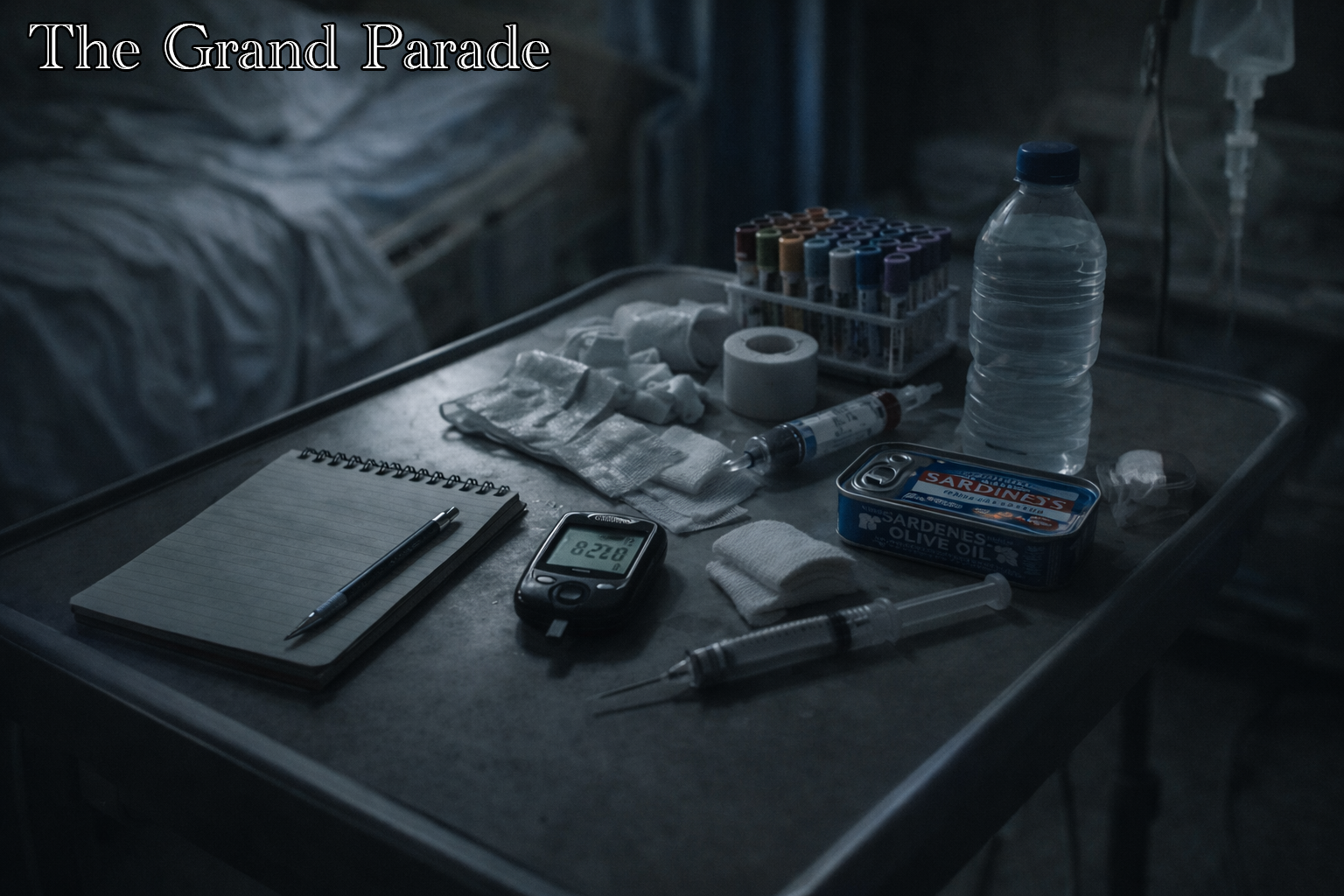
Through all of it—the procedures, the results, the parade of specialists—my mother was there every day. Niles came every couple of days, sometimes more. Eric was in and out. They brought things: notebooks and mechanical pencils in .05 lead, sodium-free bouillon ordered from Amazon, sardines and lightly salted pistachios because the hospital food was not keeping me adequately nourished and I was not going to eat another NutriGrain bar. My mother hunted through three Kroger locations for Bai drinks and Butterball turkey pastrami. These are not dramatic gestures. They are the texture of what showing up looks like, sustained over weeks, day after day, because someone they loved was in a hospital room and they were going to be there.
I was also, by that point, in a significant amount of constant pain. Not surgical pain—procedural pain, cumulative. Every line, every stick, every extraction and insertion. Tylenol, which does approximately nothing for me. I held the harder stuff in reserve for the surgery I knew was coming.
The Night Before
October 8th. The committee was presenting the next morning.
The formal transplant listing committee reviews every candidate and votes: list them, delay pending additional information, or decline. The vote is not a formality—it is the actual decision point. I could be listed, delayed, or denied. We would know sometime the following morning.
My mother was there that day. We talked through the logistics of what came next—which Kroger had the bouillon, whether the couch in her basement would work for my recovery visits once I was discharged, whether she could do the early-morning lab runs. Ordinary things held carefully.
That evening I texted her about sardines and the merits of lightly salted pistachios as a protein source. She asked if I wanted anything. I told her just to come up in the morning. Then, almost as an afterthought: just need my mommy.
I was fifty-five years old. I had been preparing to die for weeks. I had received last rites. I had looked at the data and assessed my own odds with the same detachment I’d applied to every other medical situation in my adult life.
And I needed my mom. Some things are not complicated.
The insurance company, it emerged that day, was contesting the transplant. Apparently, they were not convinced I needed one. My ejection fraction was ten percent—the Impella had bought some improvement from the five percent floor—and the insurance company had reviewed the file and arrived at the conclusion that a heart transplant seemed excessive. I have never been able to fully articulate my response to this information without using language I try to reserve for special occasions.
The committee met the morning of October 9th. They voted in favor. They wanted the tooth situation and the insurance situation resolved before making it official, but the decision had been made. We were close.
October 11th
The final day of the workup was a sustained exercise in controlled endurance.
Blood draws. The last two of six vaccines, the arms by now a map of injection sites. They pulled the Swan catheter from my neck. They pulled the arterial line. They removed the old PICC line and threaded a new one in. Four lines out, one in. The skin, by the end, felt raw.
By midday, the pain had gotten to me in a way I wasn’t accustomed to acknowledging. I texted my sister: the pain is starting to really get to me. She told me to suck it up. I told her not to call me a baby. She called me a baby. It was, under the circumstances, exactly the right response.
Niles arrived around three-thirty.
At 4:02 in the afternoon, the notification came through.
I had been officially listed on the heart transplant list. Status 2—the highest status available for a patient not on full mechanical circulatory support. I texted everyone I could reach. I posted to Facebook. I called, or tried to call—my voice was still mostly gone and the calls didn’t go through. Niles was in the room. My mother, who had been there all morning and had finally headed home, got the news and—I have every confidence—cried with joy.
Eric got the message and responded immediately: CONGRATULATIONS!! I think this is a Facebook worthy post.
It was already up.
At once terrifying and exciting, I wrote to him. But now I can breathe and enter the next stage of the whole ordeal.
The next stage was waiting.
Discover more from One More Beat
Subscribe to get the latest posts sent to your email.