Coming Home
And just like that, I was home.
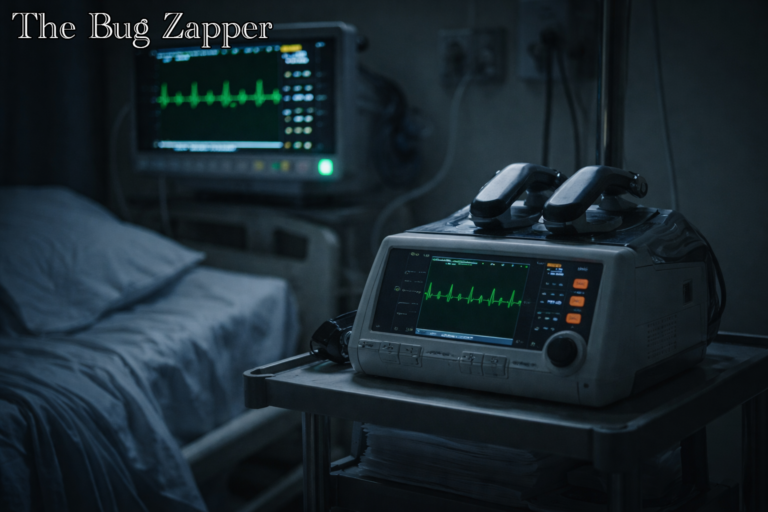
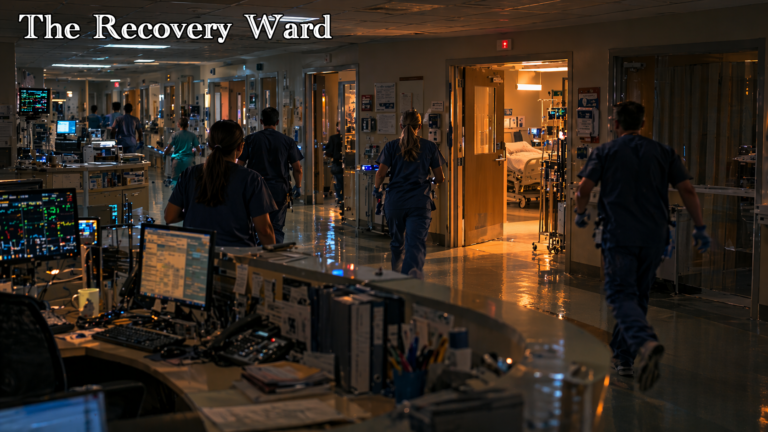
Nine days post-transplant. Sixty days in the hospital—first at Mercy West, then via Air Care flight to The Christ Hospital, where I would spend the better part of that time before anyone spoke seriously about discharge. The procedures, the alarms, the particular quality of institutional time that moves simultaneously too slowly and too fast. And then the discharge papers, the last IV lines pulled, and a car pulling away from the hospital with me inside.
The Stairs
The house is a bilevel—steps up from the driveway to the main living floor. Under normal circumstances, unremarkable. After months of bedrest, a different proposition entirely.
Muscle mass disappears quickly when you stop using it, and I had lost a significant amount. The PT/OT work had slowed the loss and begun the rebuilding, but nine days out from open-heart surgery is not enough time to rebuild much of anything. Standing was unsteady. Walking was shakier still. The stair drills from the recovery ward—the careful one-at-a-time protocol, hand on the rail—were not abstract preparation. They were practice for these specific stairs on this specific afternoon.
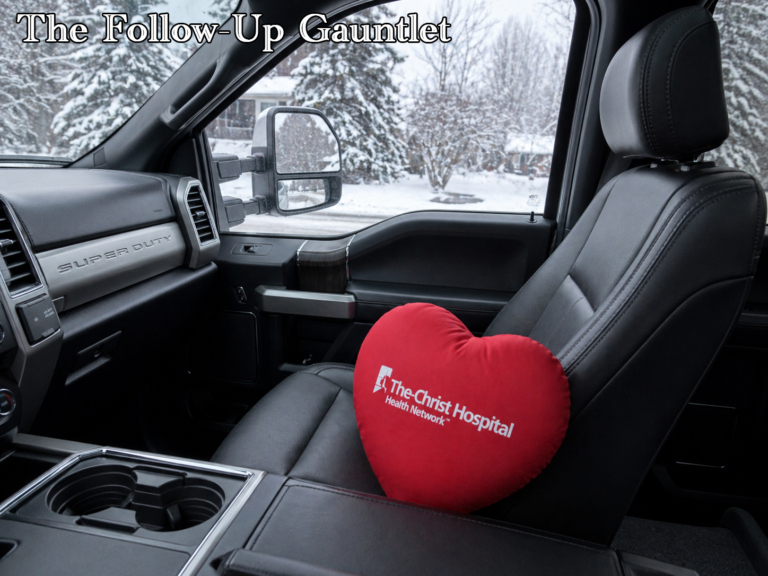
Someone walked behind me on the way up, close enough to intervene if needed. I held a heart-shaped pillow tight against my chest—standard issue for cardiac patients in the car and beyond, there to protect the incision site and absorb some of the impact when the road was less than cooperative. Every bump on the way home had announced itself. The stairs were gentler, at least.
I made it to the top. That is where the dog found me.
The Dog
He is an Australian Shepherd, a breed whose first instinct in virtually any situation is to herd.
Dogs are remarkably attuned to the people they live with. They register absence. They register return. They register illness, unfamiliar smells, changes in gait and movement, shifts in the chemistry of a person who has been through something significant. They do not require an explanation. They simply assess the situation and respond to what they find.
He approached me at the top of the stairs with a few careful, investigative sniffs before committing to a greeting. He knew who I was—it had only been two months—but he knew something was different. The hospital smell, perhaps, or the way I moved, or some shift in my chemistry that registered as requiring assessment before celebration. He was not exuberant in the way dogs sometimes are when someone they love comes home. He was deliberate. Careful. The greeting of an animal that understood, on whatever level dogs understand such things, that something had happened.
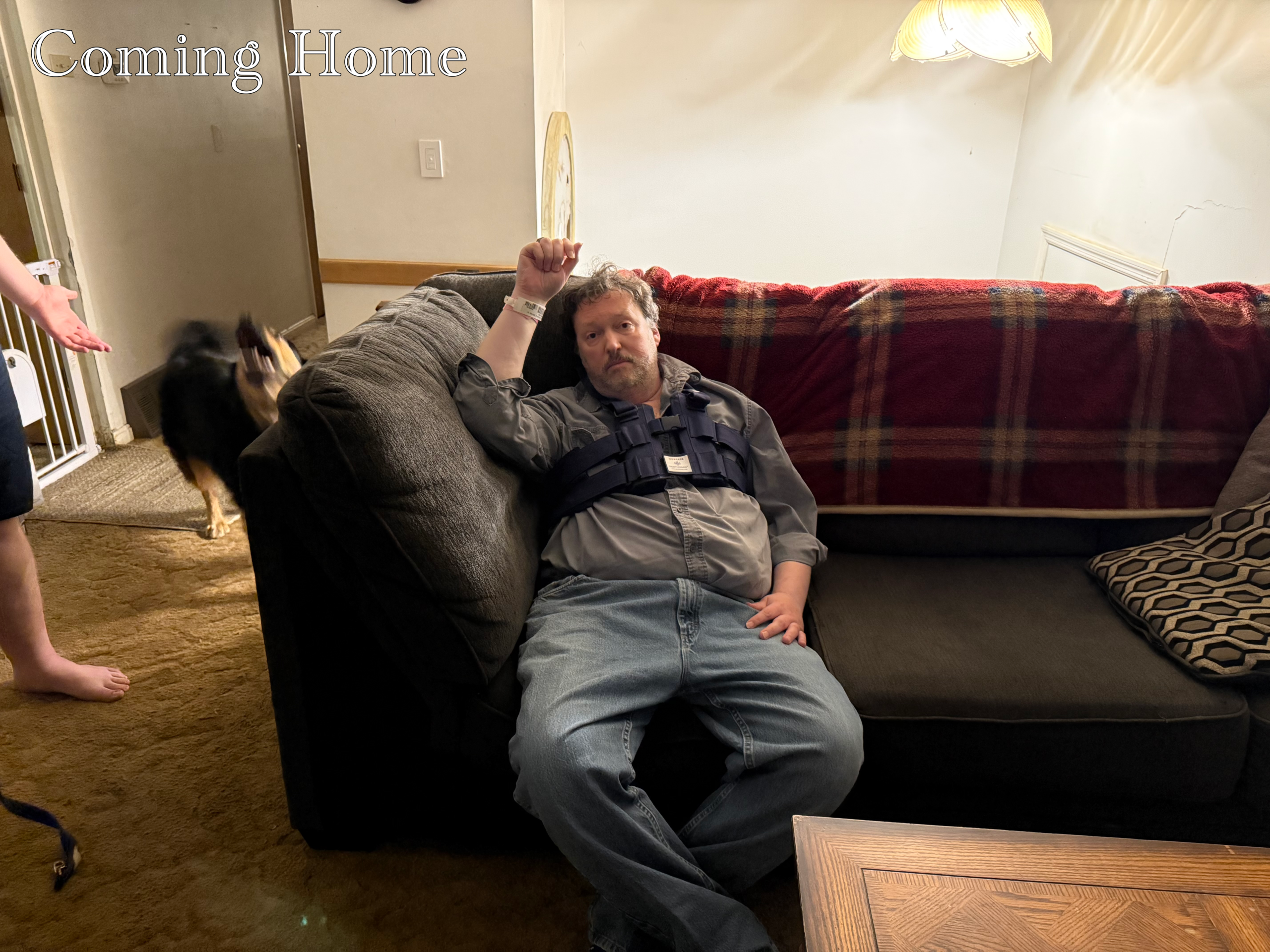
What he decided, apparently, was that I needed to be moved to the couch. He pressed against my legs and walked me there, doing what his instincts told him to do. Once I was settled, he stationed himself nearby, checking in periodically, until he was satisfied I was stable. Then he went about his business.
He was, in the days that followed, often the most attentive presence in the house.
The First Night
The first meal was Taco Bell—a beef burrito supreme and a beefy five-layer burrito, my standard order. It tasted acceptable—better than anything I had eaten in a long time. More importantly, it was not hospital food, a distinction difficult to convey to anyone who has not spent months eating institutional meals while losing the ability to taste them properly.
I watched The Legend of Vox Machina, season three. I used my own bathroom. I slept in my own bed without a single alarm going off through the night—no one entering the room to restock supplies, draw blood, or adjust a machine; no doctor on rounds at 5am wanting to discuss numbers. I could sleep as late as I wanted. After two months of monitored institutional sleep, that alone was extraordinary enough to mention.
By 8pm the pain medication had run out. The transplant centers wean you off opioids quickly, and I had been well down the taper before discharge. What remained was Tylenol, which has never had a meaningful effect on my pain at any dose. What I discovered, however, was that this mattered less than I had anticipated. Months of being poked, prodded, stuck, cut, and opened recalibrates the pain threshold considerably. You learn to incorporate pain into the structure of daily life because there is no alternative, and somewhere in the process you discover a capacity to tolerate it that you had not previously known you possessed. The pain was present when I arrived home. It simply was not in charge.
Sleep
The first night was glorious. What followed was considerably less so.
Prednisone is not a sleep aid. At the doses required in early post-transplant recovery, it is essentially the opposite—driving the system toward wakefulness, alertness, and a generalized state of agitation that does not care what time it is. You are up. Then you are down. Then you are up again. The idea of sleeping through the night in any conventional sense does not really apply.
The catheter that had been in place during the hospitalization leaves its own recovery, and for men that recovery involves its own set of adjustments and, in some cases, medications to help with them. The laxatives and stool softeners that are standard protocol post-transplant—necessary, but not exactly conducive to restful sleep—add another layer of logistical complexity to the night. And I still had the drainage collection ball from the chest tube attached, gathering fluid, requiring periodic attention, limiting how I could position myself in bed.
Sleep, in those first weeks at home, was something you assembled from whatever pieces were available rather than something that simply happened. You took what you could get and you counted it as sufficient.
Getting Dressed
Some mornings required help getting dressed. Not always, and not with everything, but enough that it was a reality that had to be acknowledged and navigated.
The compression socks were a particular challenge—essential for circulation, genuinely difficult to get on when your hands are shaky and your mobility is limited and bending is complicated by a chest that is still healing. The sternal vest presented a different problem: taking it off was straightforward enough, but putting it back on required a degree of coordination and upper-body engagement that was not reliably available. It was designed to provide additional support to the sternum while the bone finished knitting back together, and it did its job, but the process of getting into it each morning was its own small negotiation.
I told the kids that the vest was the only thing holding me together, and that if I popped it off, everything would come spilling out. They were old enough to appreciate the dark humor, which helped. You run this thing serious and you are finished.
The Meds
They tell you before discharge that medication management will be demanding. What they do not tell you is that your hands will shake badly enough that you cannot reliably open bottles or hold onto pills long enough to sort them into the large weekly minder they send you home with—which is large because you are on a lot of medications, and the schedule is not simple. I found myself reaching for a pair of tweezers to gain reliable purchase on the smallest pills. Some medications carry teratogenic warnings, meaning accidental skin contact poses risks to anyone of birthing age in the household, which adds another layer of deliberate care to an already demanding task.
You develop a system. The system takes time to become automatic, and in those first days nothing is automatic yet. Everything requires conscious, deliberate effort that will, eventually, become routine. Eventually does a great deal of work in the early weeks at home.
Home, in those first weeks, becomes something of a clinical workstation. The pill minder on the counter. The sharps container for the insulin syringes. The collection ball. The compression socks. The vest. The CGM on the arm. The blood pressure cuff. The daily weigh-in—weight fluctuation being a key indicator of fluid retention and potential rejection—and the daily temperature log, all of it recorded for the next clinic visit. Recorded with hands that cannot reliably hold a pen, which means finding other ways to capture the data—yet another system to develop and maintain. You are managing a small medical operation out of your own kitchen, without the staff that managed it for two months, and largely without help.
The Food
Everything tasted wrong, and it had since the first days in the ICU. Prednisone had stripped the taste receptors of their sensitivity and flattened the palate, turning food into a muted approximation of itself. The ultra-low-fat dietary requirement from the lymph node complication compounded the problem: ultra-low-fat and diabetic management are in direct structural conflict, because fat is precisely what you use to replace carbohydrates when managing blood glucose. The two requirements coexisted uncomfortably, and neither made meals easier to navigate.
The morning before discharge, a dietitian had arrived for the dietary consultation. The recommendation was the standard institutional position: 225 to 325 grams of carbohydrates per day as part of a 2,000-calorie diet, with additional protein to support healing. For context, 325 grams of carbohydrates is more than I had routinely consumed in an entire week before the transplant.
I waited for the inevitable conversation about eggs. It never came.
Blood glucose was its own sustained negotiation. Every day required four insulin injections—a long-acting dose and two or three hits of fast-acting insulin. No matter what I did, readings remained elevated, even with minimal carbohydrate intake. This is the pharmacological reality of the immunosuppressant regimen: tacrolimus suppresses insulin production while prednisone drives blood glucose upward, a combination necessary for keeping the transplanted heart viable and genuinely terrible for metabolic management. You manage it because there is no other option.
The taste deficit was its own separate problem, and it had no metabolic solution. Everything was flat, muted, arriving without the information food is supposed to carry. What cut through, within a narrow band: mixed-berry smoothies, strawberry shakes, Barq’s Red Crème Soda. Something about the berry flavors registered when everything else did not. I leaned on them heavily. When the options are genuinely limited, you work with what functions.
The PTSD Arrives
It was day one. The television was on—a high-octane action film, loud and fast-moving. Some of the kids were nearby, active, filling the room with noise and motion and the ordinary energy of a household in operation.
I had spent two months in an environment calibrated to the ward—controlled noise levels, predictable rhythms, stimulation managed and measured. What was ordinary in my own living room was, to a nervous system that had been running in crisis mode for two months, something closer to complete and utter chaos.
The anxiety rose before I could fully name it. I recognized what was happening and responded analytically, without outburst: a calm statement of what needed to happen. The television went off. The room cleared. It took time to return to something resembling baseline, and here is why that process cannot be shortcut.
When a heart is transplanted, the vagus nerve is severed. The heart no longer receives direct neural signals from the brain; it operates entirely on circulating hormones—primarily catecholamines and adrenaline. This means that the standard techniques for managing anxiety and stress response—deep breathing, meditation, biofeedback, the various methods that work by sending calming signals from the brain through the nervous system to the heart—do not reach the heart anymore. You can quiet the mind. The body remains in a stressed state until the hormones clear on their own schedule, which is not a schedule you control. A nervous system charged on the ward does not stand down because you have arrived home; it winds down slowly, over weeks and months.
Household appliances beeped—the microwave, the smoke detector, the washing machine at the end of its cycle. Sounds entirely ordinary in any other context—sounds the nervous system had spent months associating with the monitoring equipment of the ward. It registers the pattern and responds accordingly, regardless of the source.
The dishwasher was particularly bad. It is a Bosch, and when it finishes a cycle it signals completion with a beep that sounds, with remarkable fidelity, like the IV machines on the ward. Then it beeps again. And again. Periodically, over the course of what feels like an hour or more, until you turn the power off manually—the only way to make it stop. Every repetition triggers the same response.
The nervous system does not learn quickly that the dishwasher is not the ward. It takes time. In the meantime, you manage.
Prednisone compounded all of it, documented to produce mood dysregulation and heightened anxiety across the system. Some people respond with rage. Others with tears. In my case, the intellect served as containment—analysis, assessment, the refusal to allow the irrational to take full control. The emotion was real. What I had was a tool for managing it, and I used that tool.
Managed is not absent, and my approach is not a template. Most recipients benefit substantially from professional support—a therapist experienced with medical trauma, or medication to address what the body’s chemistry is doing, or both. There is no weakness in that. The nervous system does not respond to reprimand. It responds to care, and sometimes that care requires more than any single coping strategy can provide.
Reintegration
Here is something that does not get said often enough: the people around you had been adjusting to your absence for months. In some cases, they had been adjusting to the real possibility—or quiet expectation—that you might not return. They had reorganized routines and emotional landscapes around a household that did not include you. Grief, even anticipatory grief, changes things in ways that do not simply reverse when the situation changes. Then you walked back through the door, alive and requiring assistance, and everyone had to adjust again—this time in the other direction. No one was fully prepared on either side of it.
The kids had returned to school, work, and the forward motion of young adulthood. The house had found its rhythms without me. I came back unsteady on my feet, shaky-handed, managing a complex medication schedule, a restrictive diet, a nervous system that charged at appliances, and a body that needed help with tasks it had handled independently for decades. The family largely left me to myself—which was partly what I needed and partly not, and in practice meant I managed most of it alone.
All of this while working very hard, quietly and without much assistance, to reclaim some measure of capability. To sort the pills yourself rather than ask. To get the vest on without help if it was at all possible. To navigate the stairs alone when no one was watching. Independence, when it has been stripped away, is not something you wait to be handed back. You take it back in pieces, whatever pieces are available, on whatever timeline the body allows.
On November 28th—ten days home, seventeen days post-transplant—my youngest turned seventeen. I had not expected to be present for it. I wrote to him that morning that I was grateful to have found a way to his birthday just to tell him how proud I was of the man he was becoming. I meant every word, and I was aware, in a way I had not been capable of before, of exactly what it meant to be there to say it.
Home
Consider the full inventory of it: the stairs, the dog assessment, the heart pillow absorbing every road bump on the way home. The first night’s sleep—glorious—and then every subsequent night fractured by prednisone and catheters and laxatives and a collection ball on the chest. The vest that goes on with difficulty every morning. The compression socks. The tweezers for the pills. The four insulin injections. The daily weigh-in with hands that cannot hold a pen. The CGM. The blood pressure cuff. The dishwasher that beeps like the ward for an hour after every cycle.
All of it, simultaneously, from day one. With no staff. No call button. No one whose job it is to appear when something needs managing.
It is overwhelming. There is no more honest word for it. The breadth and weight of everything that has to be managed, relearned, or simply endured lands on you all at once, and it does not particularly care how recently you had your chest opened. If you have a strong support system around you, it is still a great deal. If you do not, you carry it largely yourself, and that is a different and harder thing.
What happens, in that circumstance, is that you push. You sort the pills yourself rather than ask. You work the vest on alone even when it takes three attempts. You navigate the stairs without waiting for someone to walk behind you. Not to perform self-sufficiency and not because you do not want to be a bother—but because relying on anyone else for anything has become something you are no longer willing to do. The independence you are reclaiming is not incidental. It is the point. You push yourself harder and harder toward it, in whatever increments the body allows, because the alternative is a kind of dependence that, once you have looked at it clearly, you find you cannot accept.
You were gone for two months. You came back.
Now you are here, doing the work.
Discover more from One More Beat
Subscribe to get the latest posts sent to your email.