Return
A heart transplant is not a recovery. That distinction matters, and it takes time to understand it fully.
Recovery implies a baseline to return to. There is no baseline. The years of decline that preceded the surgery didn’t pause while the transplant happened—they accumulated, and what they accumulated was loss. Physical capacity, yes, but also cognitive function that had been quietly eroding for longer than anyone fully recognized, the career that the illness had already ended, the finances that followed the career into the ground, the relationships that revealed themselves under pressure to be something other than what they had appeared.
A heart transplant is different from other transplants in a way that matters here. A failing kidney, a failing liver—these are serious, sometimes catastrophic, but their impact is contained to the systems they directly serve. The heart is different. It is one of two organs whose failure touches everything, because everything runs on what it pumps. When it goes, it takes everything downstream with it: cognitive function, physical capacity, energy, stamina, the ability to work, the ability to sustain relationships, the ability to be present in the ordinary ways that a life requires. The decline is total in a way that no other organ failure quite replicates.
What the transplant restored was the platform. What gets built on it is a different project—not reconstruction of what was, but construction of something new. You will not be who you were. Not the version of yourself from a few months before the surgery, not the version from years before. That self is still present somewhere in the wiring, but the experience has changed the wiring itself. What emerges is genuinely different.
Those willing to look closely enough will see it.
The Body First
The first weeks were a negotiation between ambition and reality, and reality won most of the early rounds.
Unsteady on the stairs in November. Compression socks that required help and sometimes more than one attempt. The sternal vest—straightforward to remove, its own small project to put back on. Showering with the chair, following the instructions about water angle and incision sites, moving carefully in spaces that had always been automatic. The hands shaking enough that pills required tweezers, that holding a pen was unreliable enough to require finding other solutions. Just putting on a shirt began as a challenge.
By December, the mobility was returning in the way these things return—not dramatically, but incrementally, the body adding a little more each week without announcing it. By January, movement around the house had stopped requiring conscious management. By February, the energy was there for something more than the immediate and the necessary.
The PT/OT protocols from the ward—stairs one at a time, weight distributed deliberately, no arms above the head—had given way to something that resembled normal movement. Not the normal of before the transplant, which had been managed and compensated and operating at a deficit for years. Something closer to actually normal, running on actual cardiac output for the first time in years.
The Small Wins
On February 24th—Day 107—I filled up my gas tank.
My car. By myself. At a gas station I had driven to alone. A task that takes four minutes and requires nothing beyond basic coordination and the ability to stand at a pump.
I noted it. I wrote about it. I sent it to the support group because I knew they would understand what it meant in a way that nobody outside that community fully could. No one watching would have noticed anything. From the outside, it was a man pumping gas. From the inside, it was the first time in months that a task had required only me—no one else’s schedule, no one else’s car, no one else’s time.
That same day: Sam’s Club and Kroger, alone. Dropped my youngest at school, picked him up. Dinner started in the slow cooker before noon. Forty minutes straight on the NuStep seated cross-trainer.
None of these things are large. All of them required, at some point in the preceding months, either assistance or avoidance. Each one reclaimed was a data point in a larger calculation—the slow arithmetic of a life being reassembled, one ordinary task at a time.
The gas tank is the one I remember most clearly. The click of the nozzle. Standing there in the February cold, watching the numbers turn. Thinking: this is what it looks like. This is what it feels like. Not triumph. Just Tuesday.
Back in the Kitchen
The food had been wrong since November 9th.
Prednisone does what prednisone does—strips the taste receptors of their sensitivity, flattens the palate, turns food into a muted approximation of itself. For the first two months, almost nothing worked. The narrow band that cut through: mixed-berry smoothies, strawberry shakes, Barq’s Red Crème Soda. Everything else was flat. Two months of hospital food followed by two months of wrong food, in a house where the cooking had always been mine and where the circumstances of recovery had made it someone else’s problem.
By late January, as the prednisone stepped down, flavor began returning. By February 21st—Day 104—I was back in the kitchen. Chicken corn chowder. Pork with potatoes, green beans, carrots. Baked chicken thighs. The kitchen doing what kitchens do when someone is paying attention to them.
This was not about eating. Cooking had always been a passion—someone who had spent years building a kitchen practice, who understood flavor and technique and the satisfaction of a meal built from scratch. The illness had taken that away incrementally, the way it had taken everything else: first the energy for anything ambitious, then the energy to cook at all. The prednisone had then taken the ability to taste what was produced.
Getting back in the kitchen was not a recovery task. It was him returning.
The Cognitive Return
The lights had been dimming for years before anyone fully understood what was happening.
Cognitive function in heart failure patients declines as cardiac output declines—the brain, like everything else, runs on blood. The decline is gradual enough that it becomes the new normal. You don’t know how diminished you are until you are no longer diminished. What returned after the transplant was not a simple, general mental clarity. It was the specific faculty that had suffered most: the analytical intellect. The ability to hold a complex algorithm in working memory. To reason through a multi-step problem without losing the thread. To build something that required sustained logical rigor and come back to it the next day and pick up exactly where it had been left. That capacity had been quietly unavailable for years, eroding alongside the cardiac output that sustained it.
The first indication came with the Impella, before the transplant, in October. Niles noticed it before I fully understood it—the difference between the day before the device and the day after, the return of something that had been absent long enough to seem gone. He told me, “I feel like I’ve gotten my friend back.”
The transplant accelerated what the Impella had started.
By April—Day 155—the first iOS app was submitted to the App Store and a new business website, Deep Dark Abyss Productions, so named for an expression my late father had used. By June, two games were live. A few months later, the first entries to the Many Lamps One Flame blog. The technical work that followed was not a hobby picked up in recovery. It was a capacity restored, applied to something that had always mattered and had simply never had the hardware to run. A year later, several apps for both iOS and macOS, the launch of multi-platform apps on the Android platform in the Google Play Store, and a second blog (One More Beat).
This was not inspiration. It was hardware.
What Can’t Be Rebuilt
The years are gone.
The career trajectory is gone. The financial ground lost during the decline does not return because the platform returns. Some relationships are exactly what the hospitalization revealed them to be.
There is grief in this, and it deserves to be named as such.
Not the grief of losing a person, but the grief of losing a life—the years that were spent managing decline instead of building, the work that was never done because the energy wasn’t there, the version of yourself that existed before the illness took hold and will not be coming back. Just as we mourn the loss of a loved one, there is a mourning here too. A mourning for what once was and will never be again.
What grief requires, when it runs its course, is not a return to what existed before. It requires new goals, new directions, a new orientation toward what comes next. The old self is still present in the wiring. What gets built going forward is something genuinely different—shaped by the loss, informed by it, but not defined by it.
These things belong to a different piece, and that piece is coming. For now: named, acknowledged, not resolved. The foundation being built here is real. It is also incomplete, and anyone building it should know that going in—the process underway and continuous.
The Realignment
Something else happens in all of this that is harder to name but worth attempting.
When you have been to the edge and come back, the things that used to command attention simply fall into the background. Not through effort or intention—through recalibration. The conflicts that once felt urgent become optional. The noise that filled the available space finds that the available space has been reorganized.
Someone ate your leftovers. You’ll just make more. The daily annoyances that once registered as problems simply don’t anymore, not because you’ve practiced equanimity or read the right books, but because the lens has been permanently recalibrated by proximity to something that actually mattered. The math is not difficult. You nearly died. Someone ate your leftovers. These are not equivalent events, and the nervous system, once it has experienced the genuine article, tends to stop treating them as if they were.
What the realignment produced here was straightforward: the things that had always mattered—the kitchen, relationships, the writing, the building of things—finally had room. The things that had crowded them out for decades were gone. What remained was time, and a brain that could use it, and a clarity about how.
The New Norm
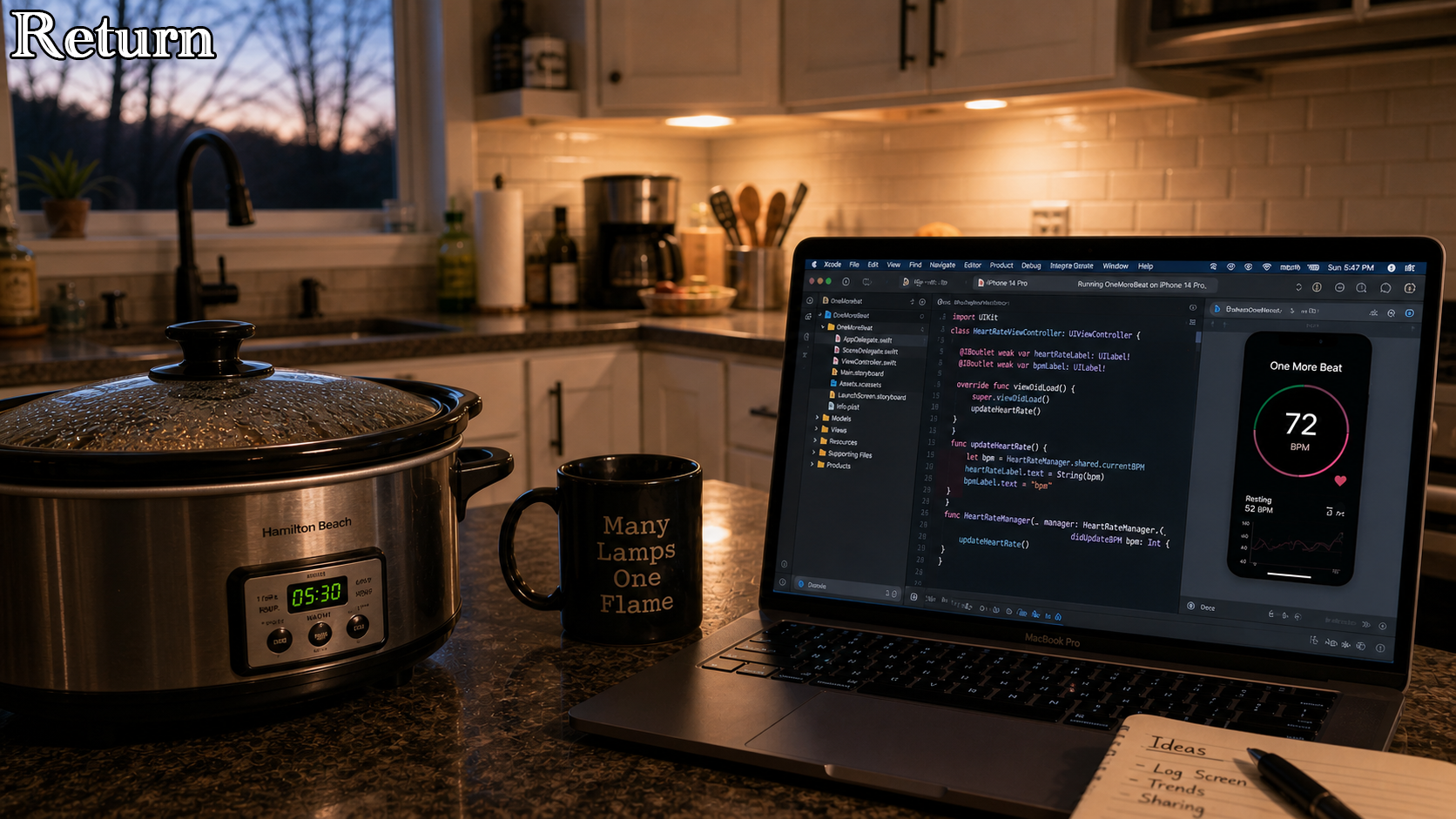
On an afternoon in the spring, dinner was in the slow cooker and Xcode was open on the laptop.
The chicken had gone in at noon—thighs, low and slow, the kitchen doing what kitchens do when someone is paying attention to them. On the screen, a function that wasn’t quite right, a logic problem requiring the specific kind of focused attention that had come back with the hardware and had not left.
Two things that had always been there. Two things that had never had space at the same time, in the same afternoon, without something more urgent demanding priority.
This is what return looks like. Not the dramatic version—not the surgery, not the first steps, not the moment the breathing tube came out. The quiet version. Dinner on. Code running. The afternoon belonging entirely to the work of building what comes next.
Not recovery. Construction.
And it is ongoing.
Discover more from One More Beat
Subscribe to get the latest posts sent to your email.

My husband had a heart transplant in January (68). He was very sick for years before being considered for a transplant.
Surgery went well, but he had numerous complications that prolonged his hospitalization and his short term memory. As his wife and 24/7 caregiver, I must say that I appreciate your ability to put in words the things I’m sure he thinks about but doesn’t verbalize. I almost lost him, but he is making his way back a day at a time. Thank you!
I’m glad to hear he is on the mend. It’s a tough road, especially those first 6 months, but it does start to turn around after that. Some folks come back swinging–a fellow transplant patient here in Cincy was literally out bow hunting just 6 months post, and there are others with similar stories. I took it a bit slower myself. LOL I had heart failure for 22 years, and I started to decline around 15-18 years into that before I took the big dip around the time of covid. The cognitive return after the transplant is very real though; I am still amazed at how much sharper I am now, just 18 months post, compared to where I was when I went into the hospital. The more I push my mind, the better it seems to get. Believe me–you guys will see it too!