Glucose Management After Transplant
Nearly every heart transplant recipient encounters insulin management in the immediate post-transplant period. The only question is whether you come home on it—and whether you can eventually come off it.
That is not a prediction about individual outcomes. It is a pharmacological reality. The immunosuppression deployed in the immediate post-transplant period produces a glucose load that no oral agent can adequately manage. Insulin is not the last resort after other options fail. It is the starting point, because the biology demands it.
What happens after is where individual pictures diverge.
What PTDM Is and Why It Happens
Post-transplant diabetes mellitus—PTDM—is diabetes that develops or significantly worsens as a direct consequence of organ transplantation and the immunosuppression required to sustain it. It is not the same as ordinary type 2 diabetes, even when it looks similar on paper. The mechanisms are specific, pharmacological, and continuous. [7]
Tacrolimus is the primary driver. It is a permanent fixture in standard heart transplant regimens. And it attacks glucose metabolism at the source.
Tacrolimus suppresses insulin secretion directly. The calcineurin pathway it blocks in T-cells is also active in pancreatic beta cells—the cells responsible for producing insulin. Tacrolimus-treated recipients produce less insulin in response to rising glucose than they did before transplant. [1] This is not a side effect that resolves with adjustment periods or dose stabilization. It is a continuous pharmacological consequence that persists for as long as tacrolimus is in the regimen. Which is for life.
Tacrolimus also affects appetite regulation through calcineurin’s role in neuroendocrine signaling. Calcineurin is active in the central nervous system, not only in immune tissue and the pancreas, and its inhibition produces documented disturbances in neuroendocrine axes that govern hunger and satiety. [1] The result in practice is appetite dysregulation—hunger that does not accurately track caloric need, satiety signals that arrive late or imprecisely. The hunger pangs that post-transplant recipients experience when their glucose is already running high are not weakness or poor discipline. They are pharmacologically mediated signals from a system that tacrolimus has chemically altered. This distinction matters—practically, emotionally, and in terms of how recipients relate to the dietary challenge they are navigating.
When additional immunosuppressants are present, the picture compounds.
Corticosteroids—prednisone in the maintenance regimen—drive glucose up through two mechanisms: stimulating the liver to produce glucose through gluconeogenesis, and causing peripheral insulin resistance. [2] They also drive appetite through a central mechanism independent of tacrolimus. The effect is dose-dependent; high-dose induction prednisone is dramatically more diabetogenic than low-dose maintenance, and glucose management often becomes meaningfully easier as the prednisone taper progresses.
Sirolimus, when present, compounds the picture further. mTOR inhibition causes insulin resistance independently, contributes to appetite and weight dysregulation, and—a distinct additional problem—drives hypertriglyceridemia. [8] [9]Elevated triglycerides are an independent cardiovascular risk factor. Sirolimus enters the regimen partly to manage cardiac allograft vasculopathy, and its dyslipidemic effects work against that vascular goal unless actively managed.
The central tension underlying all of this: tight glycemic control is specifically important for slowing CAV progression. Chronic hyperglycemia is an independent driver of vascular inflammation and endothelial damage—the substrate on which CAV develops and accelerates. See The Diagnosis Nobody Prepares You For for the full CAV picture. The medications protecting the organ are actively undermining the glycemic control that would slow the vascular disease the organ is most vulnerable to. That is not a side effect. It is a structural conflict at the center of post-transplant management.
Who Gets It
Clinical literature puts PTDM incidence in heart transplant recipients at 20–40%, with cumulative incidence approaching 48% at one year in some cohorts depending on diagnostic criteria and follow-up duration. [3] [4] The honest number is probably at the higher end when the early post-transplant period is included and when pre-existing glucose abnormalities are counted.
Recipients who enter transplant with pre-existing type 2 diabetes do not get PTDM in the new-onset sense—they get a pharmacological acceleration of what was already present. Their glucose control, whatever it was before transplant, becomes significantly harder to maintain. The tools that were working—metformin, careful diet, an oral agent or two—face a pharmacological headwind most of them were not designed to manage.
Risk factors beyond the medications themselves include older age, higher BMI, family history of diabetes, and elevated pre-transplant HbA1c even within the normal range. Higher pre-transplant HbA1c values—even within the normal range—are independently associated with greater PTDM risk and worse post-transplant glucose outcomes. The pharmacological burden arrives on top of whatever baseline exists.
Insulin First
In the immediate post-transplant period, glucose management means insulin management. The induction corticosteroid doses produce glucose levels that oral agents cannot control. The team manages this directly in the hospital. But understanding why insulin is present, and what it is managing, matters.
The characteristic pattern of steroid-induced hyperglycemia is worth knowing: glucose tends to run lower in the early morning and climb through the afternoon and evening, tracking the metabolic effects of corticosteroids. A 7am reading that looks acceptable can coexist with readings above 200 by 3pm. This is not random variation. It is a predictable consequence of how corticosteroids affect glucose metabolism throughout the day, and it has implications for both monitoring and medication timing.
As the prednisone taper progresses, insulin requirements typically drop. For some recipients, they drop enough that transitioning to oral agents becomes possible. For many, they do not—the tacrolimus contribution to glucose elevation is independent of the prednisone taper and does not diminish as steroids come down.
The Transition Question—Honestly
Some recipients do transition off insulin to oral agents. The data is sobering about how many. Tacrolimus prescribing information from Phase III studies reported insulin dependence reversible in approximately 15% of PTDM patients at one year and 50% at two years—and that is in kidney transplant populations, where the immunosuppression burden is typically lower. [5] A study of pediatric thoracic organ recipients found that despite significant reductions in tacrolimus and steroid dosage, only 13% successfully came off insulin. [6] Adult heart transplant data shows PTDM prevalence decreasing from roughly 44% at six months to 17% at three years—but that improvement includes recipients who transitioned to oral agents, not exclusively those who achieved glucose normalization without pharmacological management. [3]
The real-world picture is less optimistic than clinical trial numbers suggest. Transitioning off insulin requires sustained dietary discipline—specifically, meaningful carbohydrate moderation—against a backdrop of pharmacologically mediated appetite dysregulation, fatigue, and the general demands of post-transplant life. The pharmacological burden does not disappear; it merely decreases enough, in some recipients, that oral agents can manage what remains. Whether that threshold is reached depends on the taper, individual beta-cell reserve, and what someone is willing and able to do with diet over the long term.
This is not a judgment. It is the context for why continuous glucose monitoring matters as much as it does.
The CGM as the Cornerstone Tool
A fasting glucose drawn monthly at clinic tells you one number at one moment. An HbA1c tells you a three-month average that obscures everything that happened between the highs and lows—including the hours spent above 180 while the fasting number looks acceptable. Neither tells you what happened two hours after a meal. Neither tells you that glucose is spending four hours daily in a range that matters clinically while the morning draw looks fine.
A continuous glucose monitor does all of this.
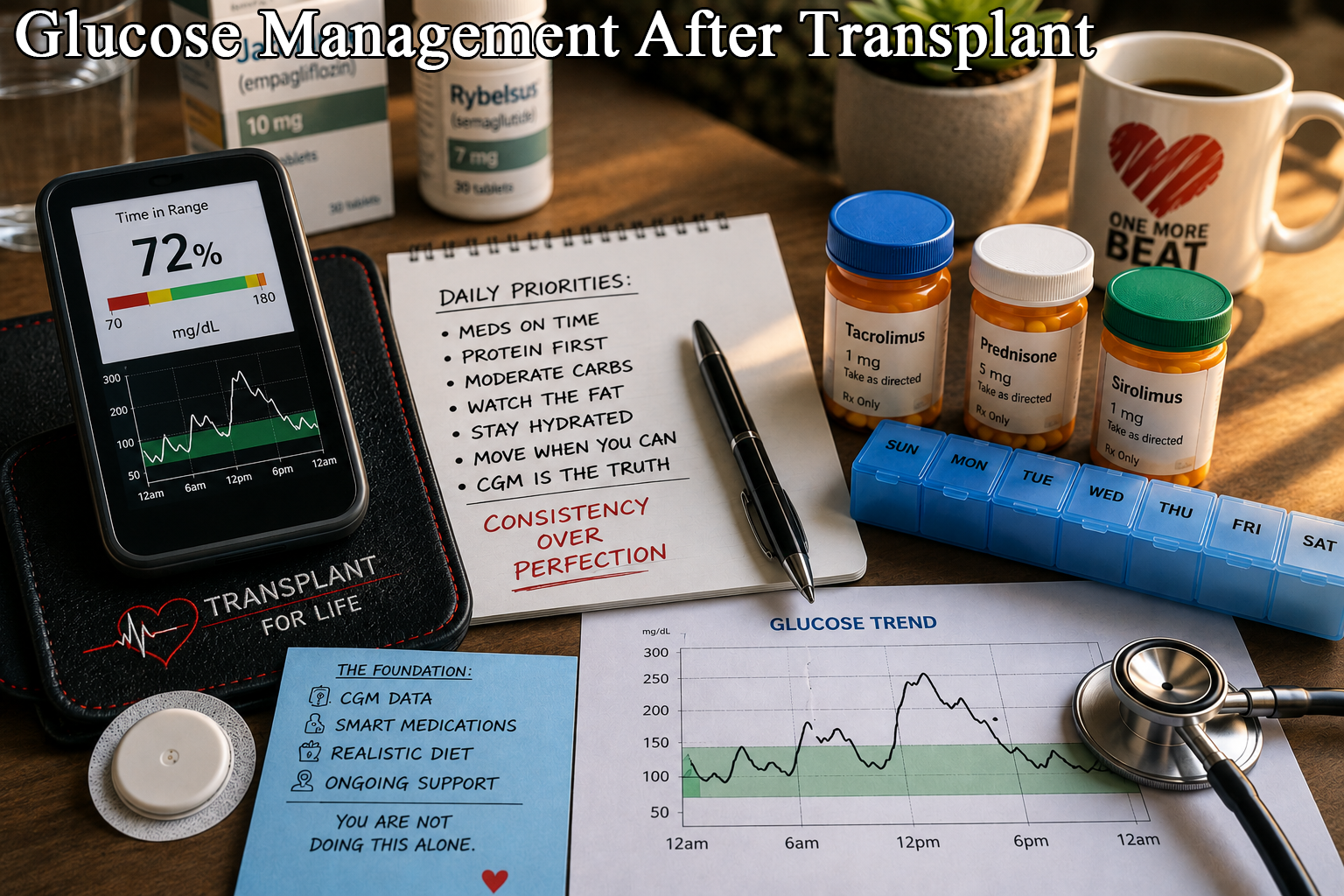
Time in range—the percentage of readings within the target range, typically 70–180mg/dL—is the metric that matters clinically, and it is invisible without continuous monitoring. [15] A recipient whose HbA1c looks acceptable but who spends three hours daily above 200 after meals is accumulating vascular risk that the HbA1c does not capture.
For recipients with pre-existing type 2 diabetes, the CGM is particularly critical. The pharmacological changes after transplant can render a previously stable management approach inadequate almost overnight, and the drift will not be visible in monthly lab draws until damage has accumulated. The CGM catches it in real time.
For recipients with new-onset PTDM, the CGM often makes the diagnosis meaningful in a way that abstract lab values cannot. Watching glucose rise from 110 to 220 in ninety minutes because of three slices of pizza is information that lands differently than being told to moderate carbohydrates. The CGM also exposes the steroid timing pattern—reliably elevated afternoon readings that a recipient can work around by adjusting medication timing or meal composition, in collaboration with the team.
If there is one tool that a post-transplant recipient managing PTDM should prioritize, it is this one.
The Oral Agent Options
When transition off insulin is possible, or when a recipient’s glucose burden is manageable without insulin, the oral agent landscape for PTDM is different from standard type 2 diabetes management—because the mechanisms driving it are different.
Metformin is the first-line agent in general type 2 diabetes. In the transplant population it is complicated by renal considerations: metformin carries a risk of lactic acidosis when the estimated glomerular filtration rate (eGFR) drops below 30–45, a threshold many heart transplant recipients approach due to the long-term nephrotoxic drag of calcineurin inhibitors. Many recipients cannot use metformin at standard doses or at all.
GLP-1 receptor agonists—semaglutide (Rybelsus orally, Ozempic or Wegovy as injectables), liraglutide, and others in the class—stimulate insulin secretion in a glucose-dependent manner, suppress glucagon, and slow gastric emptying. [10] In the transplant context they have particular relevance: they may partially offset the insulin secretion deficit that tacrolimus creates, they have weight-neutral or weight-reducing effects that counter steroid-driven and appetite-dysregulation-driven weight gain, and they can be used in patients with moderate renal impairment where metformin cannot. The sharp postprandial spikes that characterize PTDM are exactly what GLP-1 agonists are designed to address—gastric slowing blunts the postprandial glucose curve. The GI side effect profile in this population warrants its own section below.
SGLT2 inhibitors—empagliflozin (Jardiance), dapagliflozin (Farxiga)—block glucose reabsorption in the kidney, causing excess glucose to be excreted in urine. Beyond glucose control, the cardiovascular and renal protective data for this class is directly relevant to heart transplant recipients: the EMPEROR-Reduced and DAPA-HF trials demonstrated significant reductions in cardiovascular death and hospitalization, making this class particularly attractive in heart transplant recipients managing long-term cardiac risk. [12] SGLT2 inhibitors do not rely on pancreatic beta-cell function—a meaningful advantage in a population where tacrolimus has specifically impaired it.
Insulin—ongoing. Some recipients remain on insulin long-term. This is not a failure of management. It reflects the pharmacological burden they are carrying. Long-acting basal insulin provides background glucose lowering; rapid-acting insulin at meals addresses postprandial spikes. Recipients on long-term insulin with a CGM have a substantially better management picture than those without.
The GI Burden: GLP-1 Agonists, Magnesium, and Competing Effects
GLP-1 agonists cause GI side effects. The incidence is significant: nausea occurs in approximately 44% of semaglutide users, diarrhea in 31%, and vomiting in 25% at higher doses. [10] In most patients this is the titration discomfort of a new medication. In a post-transplant recipient already managing mycophenolate-associated GI effects and magnesium supplementation osmotic effects (draws water into the GI tract, loosens stool), adding GLP-1-associated nausea and gastric slowing creates a genuinely complicated picture.
Nausea is the most common GLP-1 side effect, dose-dependent, typically worst in the first weeks and improving over time. In a recipient already dealing with mycophenolate nausea, this compounds rather than simply adds.
Vomiting is less common but clinically significant in this population specifically: if vomiting occurs after a tacrolimus dose, the question of whether that dose was absorbed is a real clinical concern. A single episode of post-dose vomiting can produce an unexplained trough level. [11] This is not something GLP-1 prescribing information addresses for the transplant population. If vomiting occurs within an hour of an immunosuppressant dose, prompt contact with the transplant coordinator is required to determine whether a dose needs to be repeated or an extra trough drawn.
Delayed gastric emptying is the mechanism that blunts postprandial glucose spikes. It also slows everything else through the stomach—including oral tacrolimus, which is absorbed in the small intestine and whose absorption timeline depends on normal gastric motility. The transplant literature notes this as a concern requiring monitoring of immunosuppressant levels during GLP-1 titration. [11]
The magnesium compounding problem: magnesium supplementation causes loose stool when doses exceed the gut’s absorption capacity or the form is poorly chosen. GLP-1 agonists cause GI distress through an entirely different mechanism. Together, in a recipient also on mycophenolate, the GI picture can become difficult to untangle. Practically, if GI symptoms cause a recipient to reduce or skip magnesium doses, the resulting hypomagnesemia adds its own symptoms—cramping, tremors, sleep disruption—compounding the clinical picture. See The Magnesium Problem for the full treatment.
The Fat Problem on GLP-1 Agonists
The most important dietary interaction with GLP-1 agonists is fat—and it is one that most prescribing materials do not address clearly.
GLP-1 agonists already slow gastric emptying. Fat independently slows gastric emptying further. High-fat meals are consistently among the meal components most likely to worsen GLP-1-related nausea, reflux, bloating, abdominal pain, and diarrhea — a pattern documented across the clinical literature and reflected in standard prescribing guidance for this drug class.
GLP-1 agonists also affect gallbladder function and biliary tract health. Acute gallbladder disease — including cholelithiasis and cholecystitis — is a documented adverse effect listed in the prescribing information for semaglutide across all formulations (typical incidence range of 1%-1.5%), and the drug’s effects on bile and gallbladder motility are an established part of its pharmacological profile. The exact mechanism is not fully characterized, but the clinical consequence is real and warrants awareness.
In practice, high-fat meals can sit heavily, move unpredictably through a slowed GI system, and trigger a response that feels very different from ordinary loose stool. For some recipients — especially those already dealing with mycophenolate and magnesium-related GI effects — the result can be urgent, burning diarrhea consistent with bile acid irritation rather than simple osmotic looseness. The bile contacts the rectal and perianal tissue on the way out, and that tissue bears the chemical consequences. In an immunosuppressed recipient whose wound healing is already compromised, perianal tissue irritation is not a minor inconvenience — it is a potential infection entry point in someone whose immune system cannot mount a normal response.
This has a specific dietary implication: a ketogenic, or low-carbohydrate high-fat (LCHF), diet is generally poorly tolerated in recipients on GLP-1 agonist therapy, and the risk of attempting it warrants explicit discussion with the transplant team before proceeding.
Keto diets are commonly recommended in diabetes management communities and widely attempted by people trying to control blood sugar. In a recipient on tacrolimus with PTDM, the appeal is obvious — reducing carbohydrates is exactly what the glucose data demands. The problem is that keto replaces carbohydrate calories with fat calories, and fat in large quantities is exactly the meal pattern most likely to aggravate the GI side effects of GLP-1 therapy.
Some recipients tolerate one formulation better than another, but the core mechanism — GLP-1-mediated slowing of gastric emptying — remains present across the class. The fat ceiling exists regardless of delivery route.
The Ketoacidosis Risk on SGLT2 Inhibitors
There is a second documented dietary danger for recipients on SGLT2 inhibitors that is less commonly known: ketogenic diets combined with SGLT2 inhibitors create a documented risk of euglycemic diabetic ketoacidosis (euDKA). [13] [14]
Ordinary DKA announces itself with dramatically elevated glucose. Euglycemic DKA presents with normal or only mildly elevated glucose—the glucose number looks acceptable—while the blood accumulates dangerous levels of ketones and acid. It is a serious condition that is frequently missed precisely because the glucose that usually signals DKA is not elevated.
The mechanism: SGLT2 inhibitors increase glucagon levels through action on pancreatic alpha cells, promoting hepatic ketone production. A ketogenic diet drives ketone production through the same pathway. Together, they can push ketone levels high enough to produce acidosis even when glucose appears normal. This risk carries an FDA label warning added to SGLT2 inhibitor prescribing information in 2020. The published literature specifically states that physicians prescribing SGLT2 inhibitors should inform patients to avoid ketogenic diets—and many do not, because the risk is not yet widely known. [13]
A recipient on both Jardiance and Rybelsus who attempts a ketogenic diet is running both risks simultaneously—GI distress from the fat load on the GLP-1 side, and euglycemic DKA risk from ketone production on the SGLT2 side. Both are preventable with the right information before the dietary decision is made.
What Actually Works Dietarily
The two obvious dietary interventions for PTDM—reducing carbohydrates and increasing fat to compensate—are both constrained by the medication picture. Carbohydrate reduction alone isn’t sufficient because something has to replace the calories, and high fat triggers the GLP-1 problem. Extreme carbohydrate restriction combined with SGLT2 inhibition carries the euglycemic DKA risk. The standard dietary escape hatch for diabetes management does not apply cleanly here.
What works is protein-first, moderate fat, light carbohydrate. Protein provides caloric density without the glucose spike of carbohydrates and without the gastric emptying problem of large fat loads. But the fat content of protein sources matters more than most dietary guidance acknowledges. A 75/25 ground beef carries enough fat to trigger GI distress in a recipient on a GLP-1 agonist. A 96/4 ground beef does not. The choice is not about calories or cholesterol—it is about the fat load the GI system can process given what the GLP-1 is already doing to gastric motility. Sirloin rather than ribeye. Chicken breast rather than thighs. Grilled or baked rather than pan-fried in oil. These are clinical considerations, not aesthetic ones.
Carbohydrates are moderated rather than eliminated. The CGM identifies which specific carbohydrates in which quantities produce manageable postprandial responses versus dramatic spikes. That picture is individual—one recipient’s tolerance for rice differs from another’s—and the CGM is the only tool that generates the data to make those distinctions.
Lower-glycemic-index choices, smaller portions of carbohydrate-dense foods, pairing carbohydrates with lean protein to slow absorption, and timing larger carbohydrate loads away from the afternoon steroid-effect window all contribute. None of this is novel nutritional science. The difference is the urgency, the specificity of the constraints, and the pharmacological context that makes it non-negotiable rather than aspirational.
Standard dietary advice from a general diabetes educator may be actively unhelpful or counterproductive for this population. Keto advice in particular is common in diabetes management communities and potentially dangerous in a recipient on Jardiance.
The Ongoing Picture
PTDM does not resolve the way some post-transplant complications resolve. The tacrolimus contribution is permanent; the drug does not leave the regimen. The prednisone contribution diminishes as the dose tapers, which is real and meaningful—glucose management often becomes measurably easier at year two than at month one—but even low-dose maintenance prednisone maintains a background contribution. And if sirolimus enters the regimen, its additional effects on insulin sensitivity, appetite regulation, and triglycerides can further complicate management.
Management is not a destination. It is an ongoing adjustment to a moving target: immunosuppression doses change, infections arrive and require temporary adjustments, rejection episodes may bring steroid pulses that dramatically and temporarily worsen glucose control. Each of these is a reason that continuous monitoring matters more than periodic monitoring, and that the relationship with the glucose management team needs to remain active.
The hunger pangs that accompany high glucose in this population are not a discipline problem. The appetite dysregulation is pharmacological. The carbohydrate sensitivity is pharmacological. The difficulty of standard dietary interventions is pharmacological. Understanding that changes the internal experience of the management effort, even when the effort itself remains hard.
The CGM, Rybelsus, Jardiance—none of these solve PTDM. What they do, together with careful dietary practice and continuous monitoring, is make a permanent management problem visible and manageable. That is the realistic picture.
And the realistic picture, held clearly, is more useful than an optimistic one. Management begins with seeing what is actually happening.
References
[1] Diker Cohen, Talia, et al. “Endocrine Effects of Long-Term Calcineurin Inhibitor Use in Solid Organ Transplant Recipients.” European Journal of Endocrinology 193, no. 3 (2025): R1–R16. https://doi.org/10.1093/ejendo/lvaf182
[2] Hauner, Hans. “Diabetogenic Mechanisms of Immunosuppressive Agents.” Transplantation Reviews (2006). https://pmc.ncbi.nlm.nih.gov/articles/PMC4838515/
[3] Mazzone, et al. “Post-Heart Transplant Diabetes Mellitus: Incidence, Prevalence and Outcomes.” Journal of Heart and Lung Transplantation (2020). https://www.sciencedirect.com/science/article/abs/pii/S1053249820306446
[4] Bouchard-Mercier, et al. “Temporal Changes on the Risks and Complications of Posttransplantation Diabetes Mellitus Following Cardiac Transplantation.” PubMed Central (2018). https://www.ncbi.nlm.nih.gov/pmc/articles/PMC6250037/
[5] Astellas Pharma US. “Prograf (Tacrolimus)—Prescribing Information.” DailyMed / NIH. https://dailymed.nlm.nih.gov/dailymed/drugInfo.cfm?setid=6a9767de-1540-4a40-ae2d-81ea5e0d4be5
[6] Hathout, et al. “Posttransplant Diabetes Mellitus in Pediatric Thoracic Organ Recipients Receiving Tacrolimus-Based Immunosuppression.” Transplantation (2001). https://pubmed.ncbi.nlm.nih.gov/11213069/
[7] Hecking, et al. “Management of Post-Transplant Diabetes: Immunosuppression, Early Prevention, and Novel Antidiabetics.” Transplant International (2021). https://onlinelibrary.wiley.com/doi/10.1111/tri.13783
[8] Kittleson, et al. “Hyperlipidemia from Sirolimus: Adverse Impact on Development of Cardiac Allograft Vasculopathy.” Journal of Heart and Lung Transplantation (2011). https://www.jhltonline.org/article/S1053-2498(11)00021-0/abstract
[9] Kaplan, et al. “Strategies for the Management of Adverse Events Associated with mTOR Inhibitors.” Transplantation Reviews (2014). https://www.sciencedirect.com/science/article/pii/S0955470X14000238
[10] Nakashima, et al. “A Comprehensive Review on the Pharmacokinetics and Drug-Drug Interactions of GLP-1 Receptor Agonists.” Drug Design, Development and Therapy (2025). https://pmc.ncbi.nlm.nih.gov/articles/PMC12052016/
[11] González-Molina, et al. “Use of GLP-1 Type 1 Receptor Agonists in Kidney Transplant Recipients.” Nefrología(2024). https://www.revistanefrologia.com/en-use-glucagon-like-peptide-type-1-articulo-S2013251424002062
[12] McMurray, et al. “Dapagliflozin in Patients with Heart Failure and Reduced Ejection Fraction.” The Lancet (2020). https://www.thelancet.com/article/S0140-6736(20)31824-9/fulltext
[13] Mitten, et al. “Euglycemic Diabetic Ketoacidosis Caused by SGLT2 Inhibitors and a Ketogenic Diet: A Case Series and Review of Literature.” AACE Clinical Case Reports (2021). https://pubmed.ncbi.nlm.nih.gov/33851013/
[14] Blau, et al. “Risk of Diabetic Ketoacidosis after Initiation of an SGLT2 Inhibitor.” New England Journal of Medicine(2017). https://www.nejm.org/doi/full/10.1056/NEJMc1701990
[15] Battelino, Tadej, et al. “Clinical Targets for Continuous Glucose Monitoring Data Interpretation: Recommendations From the International Consensus on Time in Range.” Diabetes Care 42, no. 8 (2019): 1593–1603. https://diabetesjournals.org/care/article/42/8/1593/36184/
[16] Packer, Milton, et al. “Cardiovascular and Renal Outcomes with Empagliflozin in Heart Failure.” New England Journal of Medicine 383 (2020): 1413–1424. https://www.nejm.org/doi/full/10.1056/NEJMoa2022190
[17] McMurray, John J. V., et al. “Dapagliflozin in Patients with Heart Failure and Reduced Ejection Fraction.” New England Journal of Medicine 381 (2019): 1995–2008. https://www.nejm.org/doi/full/10.1056/NEJMoa1911303
Discover more from One More Beat
Subscribe to get the latest posts sent to your email.