
All About Prednisone
Most people have taken prednisone at some point. A five-day dose pack for a bad allergic reaction. A short course after an orthopedic procedure. A week’s worth to quiet a flare. It works fast, the side effects are manageable, and then it’s done.
That experience creates a frame of reference that does not apply after a transplant.
The prednisone a transplant recipient takes is the same molecule. The doses, the duration, and the consequences are in a different category entirely.
What Prednisone Is and What It Does
Prednisone is a synthetic corticosteroid—a man-made version of cortisol, the hormone the adrenal glands produce in response to stress. Cortisol’s job, among other things, is to suppress inflammation. Prednisone does that same job, but at doses and with a persistence that the body’s own cortisol production cannot match.
In the immune system, prednisone operates broadly. It does not target a specific pathway the way tacrolimus targets calcineurin or mycophenolate targets lymphocyte proliferation. It suppresses immune activity across multiple fronts simultaneously—reducing the production of inflammatory cytokines, inhibiting the migration of immune cells, and dampening the overall inflammatory response. This is why it is so useful in the early post-transplant period, when the goal is to hit the immune system hard and fast across every available pathway at once. It is also why the side effects are so wide-ranging. A drug that affects immune and inflammatory signaling broadly does not leave the rest of the body untouched.
How It Is Used in General Medicine
In general medicine, prednisone is typically used in short courses. A dose pack runs five to six days. Treatment for a severe allergic reaction might last a week. A flare of an autoimmune condition might call for two or three weeks at a moderate dose before tapering off. At these durations and doses, the side effects are real but transient—some fluid retention, elevated blood sugar, disrupted sleep, a heightened sense of energy that tips into irritability. They pass when the course ends.
People who have had this experience often feel they know what prednisone is like. They have a data point. What they have is a data point about a sprint. Transplant prednisone is a different event.
How It Is Used After Transplant
In heart transplantation, prednisone begins in the operating room. Intravenous methylprednisolone—the IV form of the same drug—is administered during the procedure itself as part of the induction immunosuppression strategy, alongside basiliximab or antithymocyte globulin. The dose at this stage is substantial: the goal is immediate, aggressive, broad-spectrum immune suppression at the moment of highest rejection risk.
Once the recipient is in the ICU and transitioning to oral medications, prednisone continues at high doses—often in the range of 1mg per kilogram of body weight daily in the early post-operative period, depending on center protocol and the recipient’s clinical picture. For most recipients that means somewhere between 60 and 100mg per day.
To put that in context: a typical short-course dose pack delivers roughly 24mg on the first day and steps down from there. A newly transplanted recipient may be taking three to four times the starting dose of that pack, every day, for weeks.
From there, the taper begins. Most programs reduce the dose in steps over the following months—from 60–100mg down toward 20mg, then toward 10mg, then toward 5mg or lower. Some programs pursue steroid withdrawal—getting recipients off prednisone entirely within the first year. Others maintain recipients on a low maintenance dose of 5mg indefinitely. Neither approach is universally correct; the decision reflects the center’s clinical philosophy, the recipient’s rejection history, and individual risk factors.
There is no standard taper timeline. Some recipients are off prednisone within the first several months. Others are still on it a year or two later. The trajectory is real and consistent—doses come down—but the pace varies considerably from person to person and program to program.
The Physical Side Effects
The body notices high-dose prednisone quickly, and it notices it in multiple systems simultaneously.
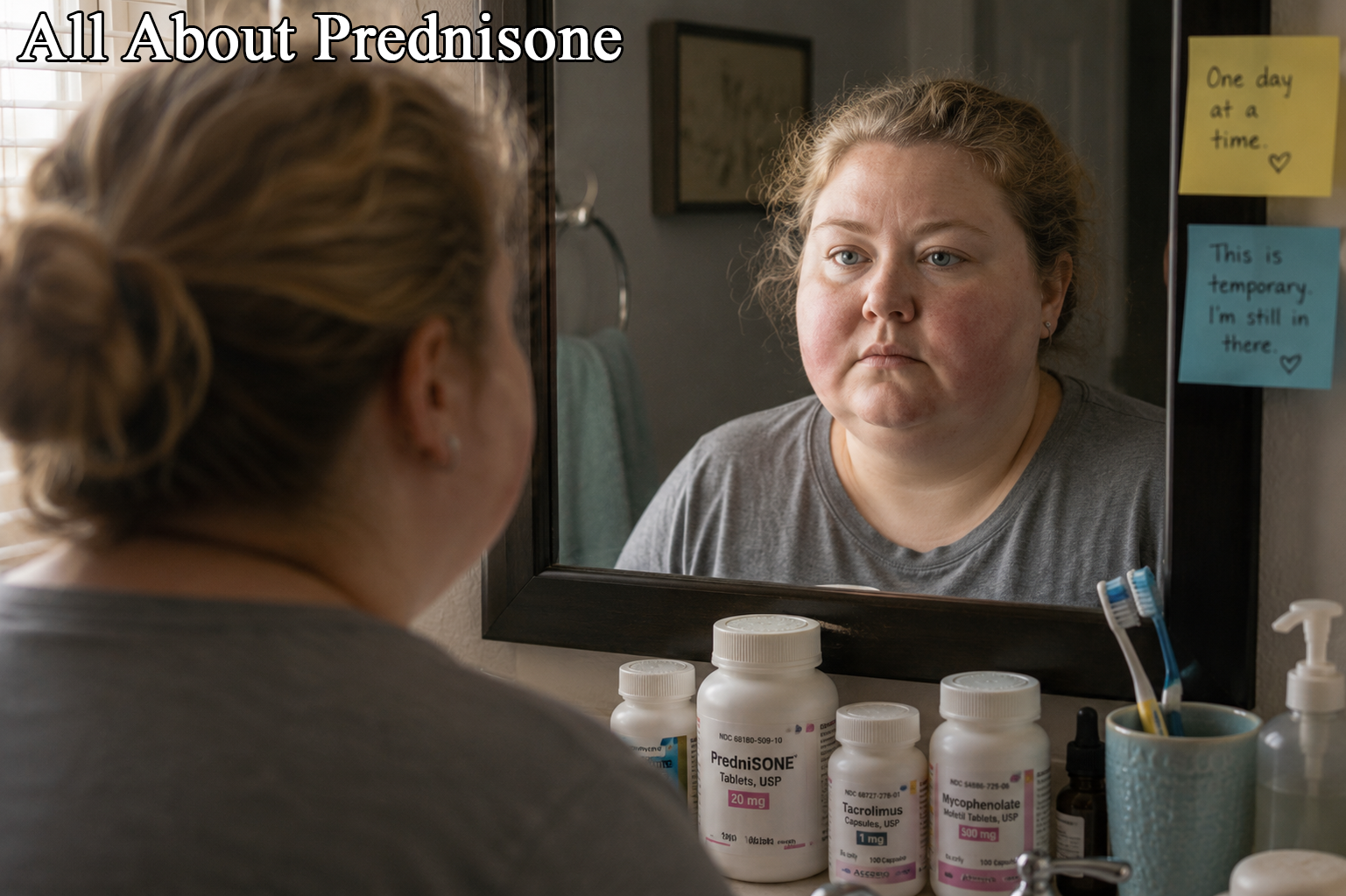
Weight and fluid retention. Prednisone causes sodium retention and fluid accumulation, producing rapid weight gain in the early weeks that is initially largely fluid rather than fat. The face changes—the characteristic rounding and fullness that recipients sometimes call “moon face” is a well-documented effect of high-dose corticosteroids. These effects diminish as the dose comes down, but the timeline varies.
Blood sugar. Prednisone raises blood glucose directly, both by increasing gluconeogenesis in the liver and by causing peripheral insulin resistance. Post-transplant diabetes is common in part because the immunosuppression regimen as a whole is diabetogenic—tacrolimus impairs insulin secretion, sirolimus causes insulin resistance—and prednisone adds to that burden, particularly at higher doses. Recipients already managing glucose face a more complex picture. Recipients who were not diabetic before transplant may find themselves managing blood sugar for the first time.
Bone density. Prednisone impairs calcium absorption and interferes with vitamin D metabolism, accelerating bone loss over time. Long-term corticosteroid use is one of the leading causes of glucocorticoid-induced osteoporosis. This is why calcium and vitamin D supplementation is standard in the transplant regimen from the beginning, and why bone density monitoring is part of long-term follow-up.
Sleep. Prednisone disrupts sleep architecture. Recipients on high doses frequently describe a wired, agitated quality at night—exhausted but unable to rest, or waking repeatedly. This compounds the sleep disruption from tacrolimus and from the general stress of early recovery. The sleep effects improve as the dose comes down.
Wound healing. Prednisone impairs the inflammatory response that initiates tissue repair, which means wounds and incisions heal more slowly under high-dose corticosteroid therapy. This is clinically managed—surgical teams are aware of it—but recipients sometimes notice that minor cuts and abrasions take longer to resolve than they used to.
Appetite and metabolism. Appetite increases, often substantially. Combined with reduced mobility in early recovery, the weight gain from prednisone can include both fluid retention and actual fat accumulation, particularly around the abdomen. The metabolic effects normalize as the dose tapers.
The Emotional and Psychological Side
This is the part that does not appear prominently in discharge paperwork. It should.
Prednisone crosses the blood-brain barrier. Corticosteroids act on glucocorticoid receptors throughout the brain, including in the hippocampus, the amygdala, and the prefrontal cortex—regions involved in memory, emotional regulation, and executive function. The neuropsychiatric effects are not side effects in the peripheral sense; they are central effects of a drug that is pharmacologically active in the brain.
What this looks like in practice ranges widely. At high doses, the most common experiences include:
Emotional lability. The threshold for emotional response drops. Things that would normally produce mild irritation produce sharp anger. Things that would produce mild sadness produce something closer to grief. The emotional signal is amplified while the filter that usually moderates response is impaired. Recipients who are accustomed to managing their emotional responses—who consider themselves patient, measured, even-tempered—may find themselves reacting in ways that feel foreign and afterward recognize as not their own.
Irritability and agitation. A persistent, low-grade edginess that has no clear source. Not sadness, not anxiety exactly—more like a constant state of being slightly too activated, too easily provoked, too close to the surface.
Anxiety. Unprovoked, sourceless unease. The transplant period carries genuine anxiety-producing circumstances, which makes it difficult to distinguish pharmacological anxiety from situational anxiety. Both are real. Prednisone adds to the load.
Mood disturbance. At higher doses and in some recipients, prednisone can produce more significant mood dysregulation—depression, euphoria, or rapid swings between the two. Steroid psychosis is rare but documented; it typically occurs at very high doses and resolves with dose reduction.
Cognitive effects. Difficulty concentrating, memory disruption, a sense of mental fog or difficulty organizing thought. These are particularly disorienting for recipients who are accustomed to intellectual sharpness and find themselves struggling to track a conversation or remember what they were doing.
The critical variable in navigating all of this is awareness. Recipients who were told what prednisone might do—who were warned that the irritability is pharmacological, that the emotional amplification is the drug and not a new version of themselves—are generally able to observe it happening and maintain some distance from it. The drug can be watched, managed, compensated for.
Recipients who were not warned often interpret what is happening as something else entirely. A change in personality. A sign that something is wrong beyond the medication. Or, most damaging to relationships: just the way they are now.
It is not unusual for a recipient to lose patience in ways that feel entirely uncharacteristic—to find a normally manageable frustration suddenly producing a sharper response than the situation warrants. The recognition that this is the prednisone at work, not a deterioration of character, makes it possible to course-correct: to apologize, to explain, to watch more carefully. That recognition is only available if someone provides the information in the first place.
For a full account of what this period looks and feels like from the inside, see When the Dam Leaks.
The Caregiver Dimension
The people most blindsided by prednisone are often not the recipients themselves—it is the people caring for them.
A caregiver who has watched their person undergo major surgery, survive, and begin to recover may be wholly unprepared for the person who comes home on high-dose prednisone. The impatience. The volatility. The reactions that seem disproportionate. The person who was grateful and warm in the hospital and has now, seemingly, become someone difficult to be around.
What the caregiver is experiencing is a pharmacological effect. What it often feels like is something more personal—a change in the relationship, a rejection of the care being offered, a sign that the recipient is struggling in ways they are not acknowledging.
The transplant community’s support groups are full of these stories. Caregivers who were not warned. Recipients who do not fully remember the worst of it, or who remember it with embarrassment. Families who absorbed the damage and rebuilt afterward, and some that did not.
Preparation does not eliminate the prednisone effects. They are pharmacological and they will happen. But a caregiver who knows that the volatility is temporary, that it reflects the drug and not the person, and that it will improve as the dose comes down is in a fundamentally different position than one who does not. The difference is information.
The caregiver experience of the transplant period is covered more fully in The Other Side of the Bed.
Monitoring and Management
The team watches prednisone’s effects through the same monitoring system used for everything else in the regimen. Blood sugar receives particular attention given the diabetogenic burden of the full medication stack. Blood pressure is monitored, as prednisone contributes to hypertension. Bone density is assessed at intervals in recipients on long-term corticosteroid therapy.
Dose reduction is the primary management strategy for side effects—the faster the taper allows, the faster the effects diminish. Calcium and vitamin D supplementation addresses the bone loss risk. Glucose management protocols are adjusted as needed.
The psychological and emotional effects are not typically managed pharmacologically in the transplant context. They are managed by reducing the dose as quickly as the clinical situation allows, and by providing recipients and caregivers with the information they need to understand what is happening.
The side effect that causes the most damage to the most relationships in the post-transplant period is not the weight gain or the insomnia or the elevated blood sugar. It is the emotional volatility that arrives without explanation and is interpreted as something it is not.
What Gets Better
As the dose comes down, things change. The fluid weight moves. The face normalizes. Sleep improves. The emotional amplification quiets. The blood sugar picture often improves substantially. Recipients at 5mg who remember what 60mg felt like frequently describe the low-dose experience as essentially invisible—taking a pill once a day that produces no noticeable effect.
The taper is real. The destination is real. The side effects are not permanent features of post-transplant life; they are features of a specific, necessary phase of it.
Knowing that the phase has a direction is itself useful information.
Discover more from One More Beat
Subscribe to get the latest posts sent to your email.