The Mortality Clause
There is a clause in the contract of being alive that everyone carries and almost no one reads. It is not hidden exactly—it is simply located where fine print tends to live, in the back of the document, in language nobody reaches for until they have to. The clause is straightforward: this arrangement is temporary. It will end. The terms are non-negotiable and the timeline is undisclosed. You signed it the moment you arrived, without reading it, because you had no choice and no alternative and no idea what you were agreeing to.
Most people go their whole lives without reading it. This is not stupidity or denial. It is simply that the clause has never been invoked, and unexecuted fine print has a way of becoming theoretical.
The Unread Fine Print
There is a version of mortality that belongs to the healthy, the young, the fortunate—the people for whom death is a concept rather than a proximity. They know it exists the way they know the terms of service exist on every app they’ve ever downloaded. Technically agreed to. Never actually read.
This is not a failure of imagination. It is a reasonable allocation of cognitive resources. When the clause has not been invoked, there is no particular urgency to study it. Life is immediate. The traffic is real. The deadline is real. The mortgage payment is real. Death is, for now, a philosophical condition—the kind of thing one thinks about occasionally, fleetingly, and then sets aside because dinner needs making and the game is on.
I eat right. I exercise. There’s no reason to think about these things yet.
These are not lies. They are simply readings of a document that hasn’t yet demanded to be read.
Front Page
For those who live with serious chronic illness, the clause migrates. It does not stay in the fine print. It moves—gradually, then suddenly, the way most things that cannot be stopped tend to move—until it occupies the front page of every document in the stack.
Twenty-two years of congestive heart failure is a long time to live with death at the next traffic light. Not dramatic death—not the movie version with the swelling score and the meaningful final words. The mundane, administrative version. The version that shows up in lab results and ejection fraction numbers and the particular exhaustion that is different from ordinary tiredness in a way that is difficult to explain to someone who hasn’t felt it. You learn to read the signals. You develop a working relationship with the thing that is trying to end you. It becomes, in its way, familiar.
Familiar is not comfortable. But it is knowable. The chronically ill person has read the clause. They know what it says. They have made, consciously or not, some kind of peace with its existence—not with dying, but with the fact that the clause is there and active and will eventually be invoked.
This is a different way of being alive than the person who has never had occasion to find the document.
Executed and Vacated
And then there is a third condition, which is not simply a more intense version of the second.
There is a night—specific, unrepeatable, mine—when the clause was not merely on the front page but invoked. Executed. The terms were being called in. I knew it when I went into that hospital. Twenty-two years of congestive heart failure had run its course. The math was complete. The battle had not been fought poorly—it had simply been fought to its conclusion. I was not afraid of this in the way people imagine. I was done. I understood what was happening and I had made, somewhere in the exhaustion of that understanding, a kind of peace with it.
I did not want to suffer. That was the primary concern—not the dying, but the manner of it. In my writing discussing that period you can see it clearly: the orientation was toward a decent exit, not a continuation.
And then the transplant appeared. Not as part of any plan. Not as the expected next chapter. A donor heart became available—a man had died, as people do every day, and had chosen, at some earlier moment, that even in death, what remained of him might be used in service of another life. The gift was real. The timing was not anything I had engineered. It simply appeared, the way things appear when the current has a different idea than you do.
I said yes.
Some time before that—in the hospital, facing what had every appearance of being the end—I had made a different kind of decision. Not about the transplant, which was not yet on the table, but about the fighting itself. Decades of rowing upstream, forcing outcomes, making my own waves regardless of where the current was actually going. In that bed, in that particular exhaustion, something released. The decision was made, quietly and without ceremony, to stop fighting the river and let it carry me wherever it was going. To read the current rather than override it. To treat what unfolded next—whatever that was—as information rather than obstacle.
That orientation is what I brought to the moment the transplant appeared. And that is why, when I say yes, I mean something more than a medical consent form. I mean: the river has a direction. I am no longer rowing against it.
What I cannot tell you with complete certainty is whether the yes came from purpose or from the simpler, more animal fact of not being ready to stop. I do not think I was clinging to life for life’s sake. I am not Philipp Mainländer, the philosopher who argued so comprehensively that non-existence is preferable to existence that he proved the point the day his masterwork was published. I have stared at the void—genuinely stared at it, not as an intellectual exercise but as an imminent destination—and I did not find it preferable. But whether the deeper motivator was purpose or some form of primal fear—I cannot give you a clean answer. Difficult though it may be to believe, I am still human after all.
What I can tell you is this: it was the correct answer. Not because I reasoned my way to it. Because it has the quality, in retrospect, of something recognized rather than chosen.
The clause was executed. And then, somehow, vacated.
The Loophole
A loophole is not a flaw in the contract. It is a provision that was always there, unnoticed, until someone found it. It changes nothing about the original terms—the clause is still in the document, still active, still non-negotiable in the long run. The loophole does not void the contract. It defers the execution.
This is the condition I live in now. Not rescued. Not restored. Deferred.
The deferment has a daily maintenance requirement: tacrolimus, sirolimus, the particular discipline of an immunosuppressed life managed with enough precision to keep the new arrangement from collapsing. Every morning the choice is made again, quietly, without ceremony. Not dramatically. Just: yes, again. Still here. Still in.
The bonus time is not free. It arrives with weight that has no single adequate name. Gratitude is part of it—but gratitude to whom, and how? A man died. He had agreed, at some point before that, to let what remained of him be used by whoever needed it. There is no transaction adequate to that. There is no gesture that closes it. What remains is something more like obligation—not debt, because debt implies a creditor and a repayment schedule, and there is neither—but the particular weight of having been given something that cost everything to give.
What does one do with that?
What Was Almost Lost
Here is where the question underneath the question lives.
The void is not abstract to me. It was a real option on a specific night, and I looked at it with reasonable clarity. And what I found myself looking at—the thing that was about to cease—was not merely a biological system or a collection of memories or a social identity. It was this: a specific, unrepeatable configuration of consciousness that has never existed before and will never exist again. The particular thing that wonders what the void is. The thing that asks the question.
What happens to that? If there is nothing—and I hold that possibility honestly, without flinching from it—then what I am will simply stop. The question will stop with it. The wondering will cease. And whatever the wondering was, whatever this specific quality of being alive and aware and unable to stop asking why—it will be as though it never was.
I do not find this comforting. I do not find it terrifying either. I find it vast. I find it the most serious thing there is.
And I find that it changes the weight of the loophole considerably. Because what was deferred that night was not just a life in the biographical sense. It was a question still in progress. A consciousness still mid-sentence. The river still in motion.
Whether there is something beyond the void—whether the question continues in some form, in some register I cannot currently access—I do not know. The traditions I have spent my life studying point in that direction with varying degrees of confidence and varying metaphysical frameworks. I find them more convincing than their absence. But I hold that with humility and awe, because the honest answer is that I do not know, and certainty in either direction is a failure of nerve masquerading as conviction.
The Open Clause
The Mortality Clause remains in the contract. The loophole was real and is being maintained, daily, one yes at a time. What it was for—what the deferment is in service of—is not a question I can answer cleanly, because I am inside the answer, trying to read the question from within it.
This much I can say: the time since that night has not felt like continuation. It has felt like a different kind of time entirely. Not more of what came before. Something that operates by different rules, with a different relationship to urgency, to purpose, to the particular pressure of knowing that the clause is still there, still active, simply deferred.
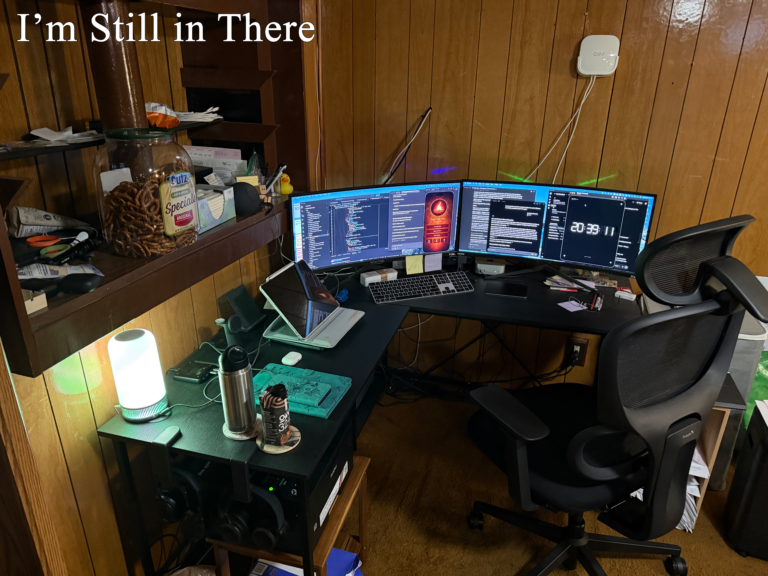
I write from inside that. The blogs, the road, the borrowed heart beating in a chest it was never meant to occupy—all of it is the answer to a question I cannot fully frame. What I was supposed to do with the yes I gave that night, I am still finding out.
What I know is that the finding out matters. Not because anyone is watching. Not because the audience is large or the work is recognized or the river has posted signs explaining where it goes.
Because the question is still in progress. Because the consciousness that almost ceased is still mid-sentence. Because whatever this is—this specific, unrepeatable configuration of wondering—it is still here.
And it has more to say.
Discover more from One More Beat
Subscribe to get the latest posts sent to your email.