
Am I Still Me?
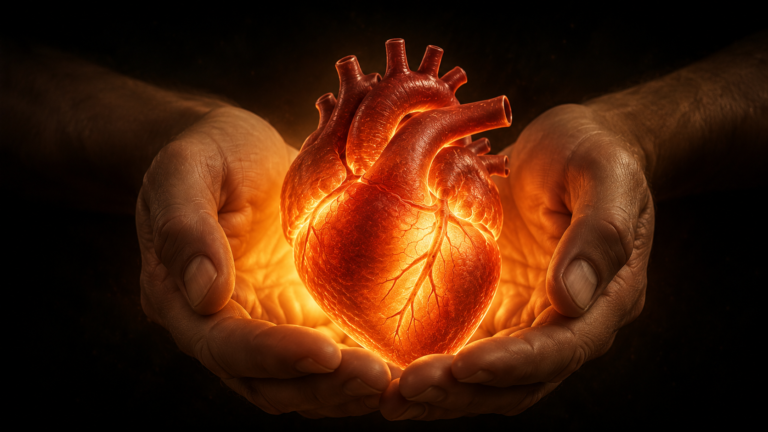
When the ancient Egyptians prepared a body for the afterlife, they pulled the brain out through the nose with a hooked instrument and threw it away. It was waste. The heart they left exactly where it was, because the heart was where the person lived—where judgment would happen, where the self would be weighed against the feather of Ma’at to decide whether it could pass into what came next. The brain was packing material. The heart was you.
They were not eccentric in this, and they were not alone. For most of human history, in most of the places humans have lived, the heart was understood to be the seat of the soul. The Hebrew lev is not a pump but the place where a person wills and understands and decides. Aristotle located thought itself in the heart and demoted the brain to a kind of radiator for cooling the blood. Catholic devotion gave us the Sacred Heart, divine love made anatomical. In Chinese, xīn means heart and mind at once—one word, because the distinction would not have made sense. The idea that the heart is merely a muscle that moves blood, and that the self is housed entirely in the gray tissue we discard on the embalming table, is the recent idea. It is the local one. It belongs to us, and it is a few centuries old at most.
I raise all of this because in November of 2024 a surgeon removed my heart and put a stranger’s heart in its place, and the question every civilization before mine would have thought obvious arrived in my chest as a surgical fact. If the heart is where the self is kept, then what, exactly, did I receive? A pump? A piece of someone? Something between the two that we don’t yet have language for?
This is not a small question, and it is not a frivolous one. Underneath it sits something older and larger than any worry about borrowed habits: the question of how much of a person can be exchanged before the person stops being himself. We carry an intuition, however unexamined, that there is a core to us that is not negotiable—and a transplant puts that intuition to the test in the most literal way imaginable. Someone died. Part of him is now load-bearing inside me. The civilizations that placed the soul in the heart would have understood immediately why a man in my position might wonder whether he was entirely his own.
I was already turning it over before my own surgery. From a hospital bed, weeks before the transplant, I read an article on the heart’s cellular biology and sent it to a friend, and I was careful to tell him which part had caught me. Not the stories about recipients waking up with their donors’ tastes—I had little patience for those. What held me was the real science underneath: the discovery that the heart has a nervous system of its own, a dense network of neurons embedded in the muscle, and that this little network reorganizes itself after a transplant. That was worth thinking about. The rest I set aside. I was waiting for a heart that hadn’t arrived yet, and I was already trying to sort the substance from the folklore.
The Stories
There is a great deal of folklore, and some of it is hard to put down.
Heart recipients have reported, for decades, waking up changed in oddly specific ways. A woman who received the heart of a vegetarian found she could no longer stand the smell of meat. A man developed a sudden craving for foods his donor had loved. People describe new tastes in music, new aversions, new affections, arriving without explanation and then lining up—once they learn anything at all about the donor—with the life of the person whose heart they carry. A foundry worker who had always hated classical music began sitting for hours with it after receiving the heart of a young musician killed on his way to violin class.
The largest collection of these accounts comes from Paul Pearsall’s 1998 book The Heart’s Code and the paper he published the following year with Gary Schwartz and Linda Russek. The cases are vivid, and where adults are concerned, they are also fairly easy to hold at arm’s length. An adult knows he received a transplant. He may know, or guess, that his donor died young or died violently or lived a certain kind of life, and he has read the same magazines I have. More to the point, a person who has nearly died and been saved by a stranger’s death is under enormous pressure to make that death mean something—to find the donor somewhere inside himself, because the alternative is to have been rescued by an anonymous catastrophe and nothing more. The mind resists that. The mind builds. Give it the disorientation of major surgery and a regimen of drugs that genuinely alter mood and perception, and it can assemble an entire inherited personality out of coincidence and need without anyone telling a single lie. The adult cases interest me. They do not trouble me.
The Children
The children are another matter.
In the best-known case, a five-year-old boy received the heart of a three-year-old. No one had told him his donor’s age or how the child had died. After the surgery the boy began calling his donor by name—he settled on “Timmy.” The donor’s name was Thomas; his family had called him Tim. The boy described him as a smaller child, said he had been “hurt bad when he fell down,” and stopped wanting to touch his Power Rangers, which had been his favorite toys. The donor had died falling from a window, reaching for a Power Ranger toy that had landed on the ledge.
In another account, a nine-year-old boy who received the heart of a three-year-old girl had loved the water before his transplant and became frightened of it afterward, and spoke of his donor as sad and afraid—details that happened to match a child who had drowned.
I want to be careful here, because this is precisely the kind of material that gets passed around breathlessly and almost never gets examined. But the reason the children’s accounts sit differently than the adults’ is real, and it is simple. A five-year-old has not read The Heart’s Code. A small child does not possess the elaborate machinery an adult uses to manufacture meaning from a brush with death, and has no motive to construct a donor out of gratitude and guilt. The defense I can mount against the grown recipients—suggestion, narrative-building, the hunger to make a death matter—does not work nearly so cleanly against a child who names a stranger he was never told about and describes how that stranger died. That is the honest difficulty of this subject, and I am not going to reason my way around it for the sake of a tidy essay.
The Catch
Here is what almost no one passes along with these stories.
The man who gathered them, Paul Pearsall, also held that the heart is a sentient, thinking, feeling organ that communicates through a form of energy moving faster than light, and that a donor’s cells stay “energetically and nonlocally connected” to him after his death. This is not careful research that turned up a few strange results at the edges. It is, in the judgment of most of the medical community, magical thinking dressed in the vocabulary of physics, and the Skeptic’s Dictionary catalogs it as such. So I do not get to keep the uncanny child and quietly discard the auras and the light-speed soul. They came out of the same notebook, in the same hand. The most arresting anecdote and the least credible theory share an author—and that, more than any single case, is what should make a person slow down before deciding what he believes.
There is also the harder matter of evidence, and on that front the cupboard is nearly bare. The cases are uncontrolled and unverifiable: interviews collected after the fact, with no way to rule out coincidence, leading questions, or a memory quietly reshaping itself to fit what was learned later.
The one piece of sturdier data points away from the romantic reading entirely. A 2024 cross-sectional study in Transplantology surveyed organ recipients and found that 89 percent reported some change in personality after their surgery—but heart recipients were no more likely to report it than people who had received a kidney or a liver or a lung. If something specific rode in with the heart, the heart recipients should have stood apart from the rest. They didn’t. The likeliest explanation for what people feel is not the donor at all. It is the experience: nearly dying, being saved, taking the drugs, and becoming a somewhat different person because something enormous happened to you.
What Actually Changes
And something enormous does change—measurably, in the brain, for reasons that have nothing to do with the donor and everything to do with your own restored body.
I felt it before I ever reached the transplant. When the team stabilized me with an Impella—a small pump threaded into the heart to do the work my own heart could no longer manage—more than one person remarked on how much sharper I had become almost overnight. I knew exactly why. For a long time my failing heart had not been moving enough blood, and a brain starved of blood and oxygen does not think well; attention, memory, and the speed of one’s own mind all sink under a circulation that can no longer keep up. The Impella restored the flow, and the fog lifted. Things I had lost came back. I could feel my own mind working again in a way it had not for longer than I wanted to admit.
A transplant does this on a larger scale, and the effect is documented rather than imagined. Writing in Stroke in 2001, Gruhn and colleagues measured cerebral blood flow in patients before and after heart transplantation and found it rose once a working heart restored cardiac output, with cognition improving alongside it. The change is real, and it is profound, and it is yours—your own brain coming back online, not a stranger’s mind moving into the spare room.
Restored blood flow was the largest change, but it was not the only ordinary explanation, and between them they cover nearly everything the folklore claims. The medications rebuild your palate from the ground up; tacrolimus and prednisone and the rest can make familiar food taste wrong, turn coffee metallic, kill an appetite or unleash one, so that a recipient swears his preferences changed when what changed was his chemistry. Trauma does its own work—come that close to dying and something in your temperament resets, and people who knew you before will say you are different now, calmer or shorter-tempered or harder to read. And there is the plain weight of what you have been through, which rearranges what you want out of a day. You may find you prefer things slower now, that crowds wear on you, that you have lost patience for what used to fill your time. None of that arrived from a donor. It arrived from the experience of nearly losing everything and being handed it back.
This is the explanation the romantic accounts skip, and it matters, because it accounts for why so many recipients honestly feel transformed while pointing at the wrong cause. They are changed. They have simply been changed by their own returning physiology, by the trauma, and by the medications—not by an inheritance from the dead.
What the Doctors Said
Not one member of the team that saved me ever entertained the idea that I had received anything but an organ. Not as a courtesy, not with a knowing wink—they simply do not see evidence for it, and they are right that the evidence isn’t there. When I raised it with my surgeon, Dr. Dowling, he neither humored me nor lectured me. He said it plainly: This heart is yours. Period. There’s no evidence that supports any of that. And then, because he has always treated me as a person rather than a case to be managed, he added: I’ll tell you what—you come back and tell me what you find. He didn’t argue me out of the question. He handed me an assignment.
But I owe the science one more piece of honesty, because the materialist account is not as airtight as “it’s just a pump” makes it sound—and the gap is exactly where this whole subject gets its oxygen. The heart genuinely does have a nervous system of its own. The intrinsic cardiac nervous system, which researchers have taken to calling the heart’s “little brain,” is a real and mapped web of neurons living in the muscle, hundreds to a thousand of them clustered in each of its ganglia. It does not make the heart beat—the heart manages that on its own, through the pacemaker cells of the sinoatrial node, and a heart will beat in a dish of saline with no nerves attached to anything. What this network does is modulate the beat: sensing, adjusting, fine-tuning the organ’s behavior from the inside, and doing it locally enough that a transplanted heart, severed from the brain’s nerves for months or years after surgery, can still regulate itself. Some of those neurons govern rhythm. That much we know. What the rest of them do, we largely do not; the literature itself admits how little is understood about how this system shapes the heart’s work.
Here is where the distinction has to be kept clean, because it is the precise seam the believers paper over. There are memory cells in the heart—real ones, in the literal biological sense. The cardiac neurons exist. So do other genuine forms of cellular information storage: the immune system remembers pathogens, the epigenome records a body’s history, RNA has been shown to carry certain learned responses between animals. All of that is real science. None of it is evidence that a dead man’s biography—his name, his fear of falling, his fondness for green peppers—rides into a recipient on the cells of a donated organ. That second claim is cellular memory, the hypothesis, and it is a different animal entirely from the memory cells that actually exist. The move that makes the folklore feel respectable is to point at the real thing and let its credibility bleed onto the fantasy: the neurons are there, the epigenome is real, therefore perhaps a personality travels with a heart. The first half is true. The second does not follow from it. The neurons being uncharted is an invitation to study them, not a license to fill the blank space with a soul.
That gap is real. It is also narrow. “The heart contains neurons whose function we have not finished mapping” is a long way from “you inherit a stranger’s love of green peppers,” and the honest position is to keep the gap open without driving a dead man through it.
The Report
It has been eighteen months. I have Dowling’s assignment, and I have my answer.
I don’t feel any different. I have not picked up a single new habit. There is no food I crave that I didn’t crave before and nothing I have turned against, no musical talent that arrived from nowhere, no skill I woke up possessing. I still can’t play the piano. Whatever those uncharted neurons are doing in there, they did not turn me into someone else. The romantic version—the one every civilization before mine would have expected, the one the children’s cases make so tempting—simply did not happen to me.
The change I did undergo was the one the science predicted: my own mind, restored, doing what it could not do while my heart was failing. That is not nothing. It is, in fact, most of what “feeling like myself again” has meant. But it was myself I got back, not a passenger I took on.
So—am I still me?
By every measure I can apply to my preferences, my habits, my appetites, the ordinary contents of an ordinary day: yes, unmistakably. The pump was a pump. I am the same difficult, curious, stubborn man I was before, now running on an engine that works.
There is one place this account does not reach, and I will name it honestly rather than pretend the picture is seamless. It was not in my tastes or my memories or any of the rooms the cellular-memory stories go searching. It was somewhere the medical chart has no column for—a register only a small number of people pay much attention to, and fewer still can feel. For a long while after the surgery, something there was out of true, and it took real work to understand what it was and to set it right. But that is a different question, with a different kind of answer, and it belongs to a different story than this one.
This inquiry ends where it began. I am the man I was, not another. The improvements are my own and represent a restoration of something lost, not the acquisition of something new.
Discover more from One More Beat
Subscribe to get the latest posts sent to your email.