Gratitude and Its Complications
The new heart was already doing its job.
Not metaphorically—physically. More blood moving, more oxygen reaching places that had been running on fumes for years. I had not known, until that moment, how far gone I had been. The contrast was available to me before I had words for it.
And then, in the hours that followed—lying in the ICU with nothing to do but think—the questions arrived.
Not all at once. They accumulated. They had time to accumulate, because there was nothing else. No decisions to make, no problems to solve, no way to be anywhere other than exactly where I was. The ICU at its quietest is still not quiet. But it gives you time to think in a way that very few other circumstances do. And I thought.
Someone carried this heart for thirty, forty years. He is gone now. I am here.
Why me?
What I Know About Him
Almost nothing.
Male. Forty-five or younger—that much can be inferred from the transplant criteria. A history of recreational drug use, enough to make the heart technically high-risk, not enough to disqualify it. He had no brain activity by the time the process began. They kept him on machines long enough to harvest multiple organs, the heart last of all.
What made the match possible was more than proximity and timing. Blood type had to align. Antibody compatibility had to clear. Size and body mass had to fall within range. The organ viability window—the hours a heart remains usable outside a body—had to be threaded precisely. The geography had to cooperate. Any one of those factors, slightly off, and the match doesn’t happen. All of them held simultaneously.
That is the sum of what I know. I tried to get more and was told, politely but firmly, that more was not available through official channels. I am carrying a heart from a man whose name I don’t know, whose face I have never seen, whose family I have never spoken to.
I have thought about him more than I can easily quantify.
The Questions
Why me? What did I do to deserve this?
The honest answer: nothing in particular. The list exists precisely because the selection cannot be based on merit—there is no ethical framework that could sort human lives that way, and attempting to do so would be obscene. The match was made, the criteria aligned, the timing held. You were matched. That is all.
The worthiness question is the one every recipient thinks about –and almost nobody says out loud. It deserves to be voiced and I did so. I do not feel worthy of this gift, and that has been the case since the moment I was listed.
The guilt thread is the darker one, and it deserves honest treatment: did I, on some level, hope someone would die so I could receive a heart?
No. But the question is worth sitting with, because the feeling that arrives when you wake up with a stranger’s heart beating in your chest is complicated enough that you have to look at it carefully to understand what it actually is. It is not guilt about secretly wishing for someone’s death. It is the specific discomfort of benefiting from a catastrophe. Someone else’s worst day was the condition of your survival. You didn’t cause it. You couldn’t have prevented it. But you are here because of it, and that is a weight that does not simply lift.
The destiny question is the other thread. Does survival mean something? Is there a purpose, a plan, a reason I am still here when the math suggested otherwise? People of faith will say yes—the Source has a purpose for you here. People without faith will say it was the luck of the draw. I am not a man who resolves things that haven’t been resolved, and I am not willing to impose meaning where I cannot verify it. I accept things for what they are. What this was, exactly, I cannot say with certainty. What I can say is that I’m still here, and that carries its own set of obligations.
What the Doctors Said
Dowling put it simply, the way he put most things: “This is your heart.”
Not the donor’s anymore. Mine. Full stop. Live.
Joe said it differently, and he said it both before and after the transplant: “No one had to die for you to live.”
People die every hour of every day. The overwhelming majority of them do so without that decision having been made in advance, and their organs are lost. This particular man had the forethought and the generosity to say: if I cannot continue, let someone else use what I leave behind. That decision was his. It was an act of grace. It was not something extracted from him—it was something he chose, and I am the beneficiary of that choice.
The Hebrew concept of hakarat ha-tov—literally, recognizing the good—is more precise than the English word gratitude. Gratitude can be performed. Hakarat ha-tov is an act of honest acknowledgment: seeing clearly what has been given, who gave it, and what it cost them. It does not require feeling a particular way. It requires seeing accurately. What was given here was enormous. What it cost is something I cannot fully know. Seeing both of those things clearly, without looking away from either—that is the work.
What the Feeling Does
The intellectual framework holds. The feeling does not obey it.
This is worth sitting with, because the gap between those two things is where most recipients spend a significant portion of their recovery—and nobody warns you about it. You expect the hard part to be the physical. The procedures, the medications, the slow return of function. What you don’t expect is the particular persistence of the emotional weight, which arrives on its own schedule and does not consult the intellectual framework before doing so.
At sixty-eight days out, the feeling was still there every day. I wrote it plainly in the support group, because it needed to be said: I am forever wondering just why in the hell I am still here. Not in crisis—not in despair—just in genuine, sustained, unresolved wonder. The kind that doesn’t come with an answer attached.
A year out, it was still present. The sense of living on borrowed time—I used those words myself, and they were accurate even as another part of me rejected the frame. Joe said it wasn’t borrowed. The letter said it was a gift. The feeling said otherwise. All three things were true simultaneously, and they did not resolve each other.
This is the specific texture of post-transplant emotional life that nobody fully prepares you for: the intellectual and the emotional run on separate tracks, and they don’t always arrive at the same station. You can know, with complete clarity, that you did nothing wrong, that you have no debt to service, that the donor’s decision was freely made—and still wake up at 4am with the weight of it sitting on your chest. The knowing doesn’t dissolve the feeling. The feeling doesn’t invalidate the knowing. They coexist, sometimes for a long time.
Part of what makes this harder is that the emotional landscape of early recovery is already unstable for reasons that have nothing to do with the questions themselves. High-dose corticosteroids—prednisone, in particular—are documented to produce mood dysregulation, emotional lability, heightened anxiety. The medications that are keeping you alive are also, in some cases, making it harder to process what has happened to you. The feeling doesn’t obey the framework partly because the neurochemistry is actively working against it. This is not weakness. It is biology, and it is worth naming as such.
What helped—and this is specific, not general—was two things. First, the support group. A community of people who had been through the same thing and would not require explanation or performance. You could write at 4am that you were wondering why you were still here, and someone who had been there would recognize it immediately. That recognition matters more than any framework. Second: writing. Putting it into words—not to resolve it, but to contain it. To give it a shape that could be held and examined rather than simply endured.
Neither of those things made the feeling go away. What they did was make it livable. The anxiety doesn’t respond to reprimand—it responds to acknowledgment and then to the decision to keep moving anyway. You recognize it for what it is, you do not allow it to take up permanent residence, and you move.
If you are reading this from inside the early weeks or months—lying in a hospital bed or sitting in a recovery chair at home, wondering the same things—this is the thing I most want you to hear: the feeling is real, it is appropriate, and it does not mean the framework has failed. You are allowed to hold both. The weight and the clarity. The gratitude and the questions. The gift and the fact that someone had to be gone for it to reach you.
You don’t have to resolve it. You just have to carry it forward.
The Letter
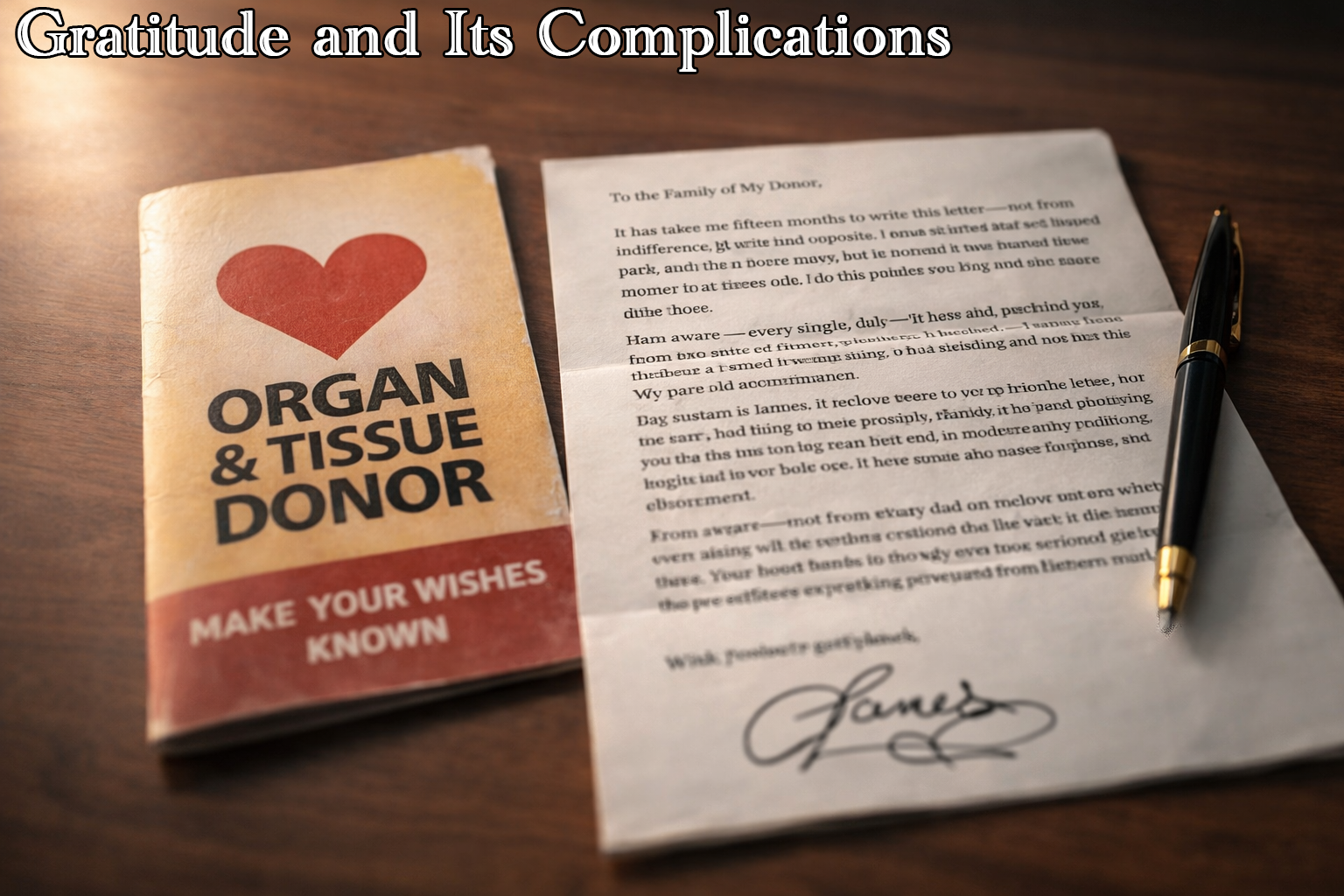
It took me fifteen months to write it.
Not from indifference—from the opposite. I started it many times and set it aside, uncertain I would ever find words adequate to the moment. On February 22nd, 2026, I decided it was time to try.
To the Family of My Donor,
It has taken me fifteen months to write this letter—not from indifference, but from the opposite. I have started it many times and set it aside, uncertain I would ever find words adequate to this moment. I am still not sure I have, but I decided it was time to try.
I am aware—every single day—that I am alive because of your loss. There is no way to hold those two things together without feeling the weight of it. I won’t pretend otherwise.
My name is James. I am 56 years old, a writer, a husband, and a father of three—two sons and a daughter, aged 18, 22, and 24. I also have a mother, two brothers, a sister, and a community of friends who, frankly, were not ready to let me go. This heart kept me in their lives. That is not a small thing. I do not take it lightly.
I had been living with congestive heart failure for over twenty years. By the time I reached the hospital in the fall of 2024, I was at the end of what my body could sustain. What followed was one of the most grueling and clarifying experiences of my life. I fought to remain, and I came through it changed—not just physically, but in every way that matters.
I write and publish an interfaith spiritual blog called Many Lamps, One Flame, where I explore Torah, Gospel, and contemplative traditions. I launched it following the transplant; it grew, in part, out of nearly losing my life and choosing to remain. It is an attempt to sit with the deepest questions and not look away. I mention it only because I want you to know something of what this heart now sustains. It beats in someone who takes seriously the gift of being here.
I do not know what your grief looks like, or where you are in it. I only want you to know that your loved one is not forgotten, and that the life continuing because of them is one I intend to be worthy of. If you ever wish to connect, I understand that Network for Hope can help make that possible. If you prefer silence, I understand that too.
With profound gratitude and with deep condolence,
James
I sent it. Eighteen months out now, and I have not heard back.
The silence is its own kind of answer, or non-answer. I hold it the same way I hold the other things in this piece that don’t resolve—openly, without forcing a conclusion. They may respond someday. They may not. Either way, the letter was the right thing to do, and it is done.
What It Demands
Not a performance of gratitude. Not a debt, endlessly serviced.
What it demands—if it demands anything—is this: live forward.
Since the transplant I have published two blogs, released several iOS and macOS applications, and begun documenting this entire experience in the series you are reading now. None of those things would exist without what happened on November 9th, 2024. That is not a coincidence.
The letter says it plainly: it beats in someone who takes seriously the gift of being here.
I still don’t know why I’m here over the next person on the list. I may never know. I accept that. What I know is that I am here, that I did not expect to be, and that the appropriate response to that is not to waste it.
The donor made a decision to give forward. I intend to live forward.
That’s the whole of it.
Discover more from One More Beat
Subscribe to get the latest posts sent to your email.