The Follow-Up Gauntlet
On the morning of December 2nd, twenty-three days post-transplant, I needed a ride to The Christ Hospital for my first post-discharge biopsy.
Mom was sick. Exposing an immunosuppressed transplant patient to whatever she had picked up was not an option, and she knew it before I said anything. Teresa was otherwise occupied—my youngest son had woken that morning with severe abdominal pain, and by the time the morning was fully underway, she was at Cincinnati Children’s with him while the ER worked through the differential. It turned out to be appendicitis. He went into surgery that morning.
I texted Niles.
He responded shortly after waking, and that was that. Two procedures at two different hospitals, on the same morning, in two different parts of the city. My youngest son’s appendix and my biopsy, running in parallel. By the time I was done at TCH and headed home, he was out of surgery and doing well.
The world does not pause for your recovery. It never did. Everyone else’s emergencies continue on schedule.
What the Gauntlet Actually Is
Most people, when they think about a heart transplant, think about the surgery. The dramatic part. What they do not think about—because nobody tells them—is what comes after.
Weekly blood draws. Biweekly right heart catheterizations with endomyocardial biopsy. Medication adjustments calibrated to each result. Then, if things go well, monthly procedures. Then less frequent. The rhythm of it: show up, get accessed, wait for results, adjust the medications, repeat. For months. This is not a brief follow-up period and it is not optional. The transplant requires sustained surveillance. The immune system does not simply accept the new heart and move on. It has to be watched, continuously, for signs that it is mounting a response. The procedures are how you watch.
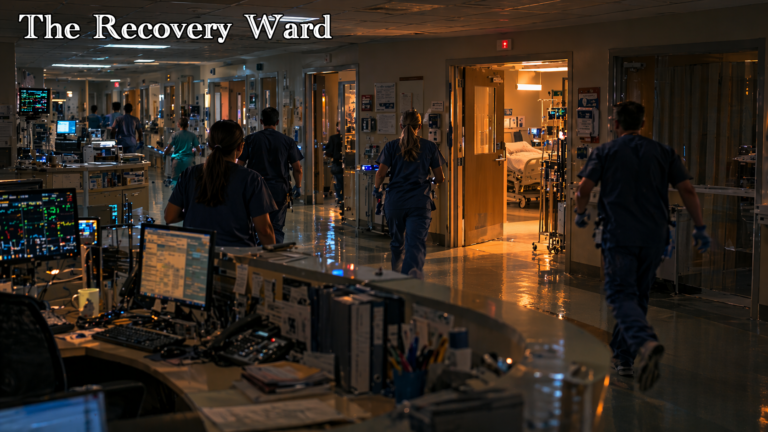
What this means practically is that the hospital, which you left with considerable relief on November 18th, is now a place you return to on a schedule that does not much care how you feel about returning to it.
The Weather
It was the height of winter in Cincinnati.
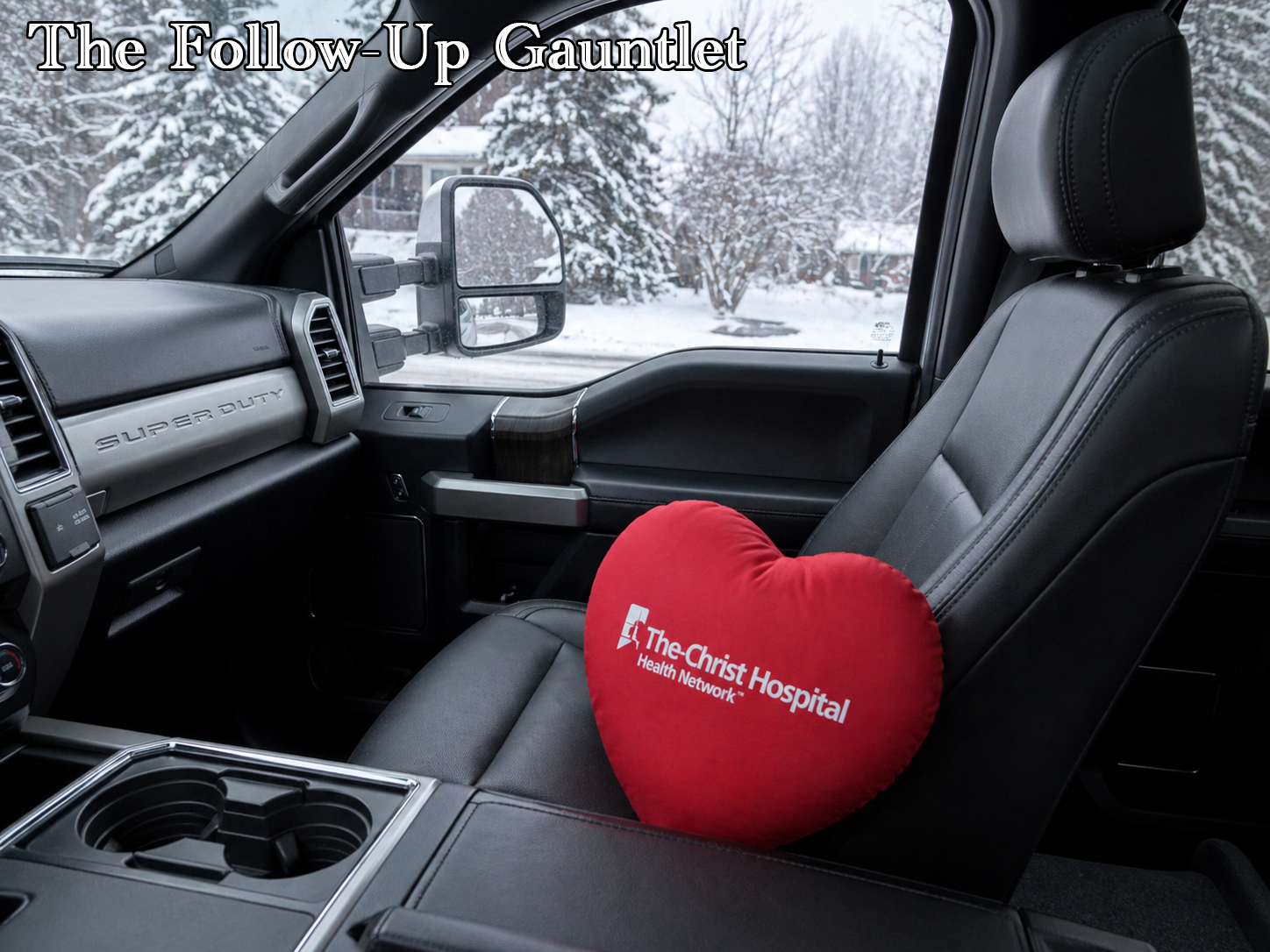
Twenty degrees, sometimes less. Several inches of snow on the ground through much of January and February. The roads were in terrible shape—ongoing construction compounded by potholes, the kind that open up every winter and go unaddressed for months. In a car, every one of them announced itself through the chassis and into the chest, the heart-shaped pillow doing what it could to absorb the impact.
The outdoor cement stairs at home—the ones someone had walked behind me on in November—now navigated in ice and cold, by a man whose immune system had been deliberately suppressed to the point where a respiratory infection was a genuine clinical threat.
The world adjusted nothing on my behalf. The weather was no exception.
The Procedure Itself
For anyone who has not been through a right heart catheterization with endomyocardial biopsy—and eventually you will be, if you are a transplant recipient—here is what it actually involves.
They prep the access site: for men with facial hair, that means shaving the neck. Then the orange antiseptic, applied liberally. A paper drape positioned over your head to protect the field, leaving the neck exposed. You are positioned for maximum access to the jugular, and then the lidocaine begins.
The lidocaine is not gentle. It is a yellow jacket sting—multiple times, in sequence—before anything else happens. People who tell you the local is the worst part are not exaggerating. It is brief, but it is sharp, and it is repeated, and there is no way around it.
After that, it is, in a genuinely strange way, routine. The sheath goes in. They run an echocardiogram and an X-ray alongside the procedure. A small piece of heart muscle is taken for the biopsy—you do not feel this. Pressure measurements are recorded throughout. The whole thing moves with the particular efficiency of a procedure that the team has performed hundreds of times, which is both reassuring and mildly surreal.
When it is over, they apply pressure until the site closes sufficiently, and then comes the tegaderm—a large adhesive dressing that adheres like a second skin and stays that way until the following morning. Getting it off is its own experience. It sticks for the ages, almost never with a folded corner to start from, and removing it feels precisely like peeling your own skin away. Once it is off, it is fine. The getting there is the thing.
And then the blood draws afterward—the vampires in the basement, as I came to think of them, waiting for their portion of the morning’s work.
One additional note for the record: I could not drive myself to or from these procedures while sedated. Even fully awake and coherent on the way out, that is not a risk anyone takes. For months, getting to and from TCH required someone else’s schedule and someone else’s car. That dependency, like all the others, wore on me in its particular way.
The Right Jugular
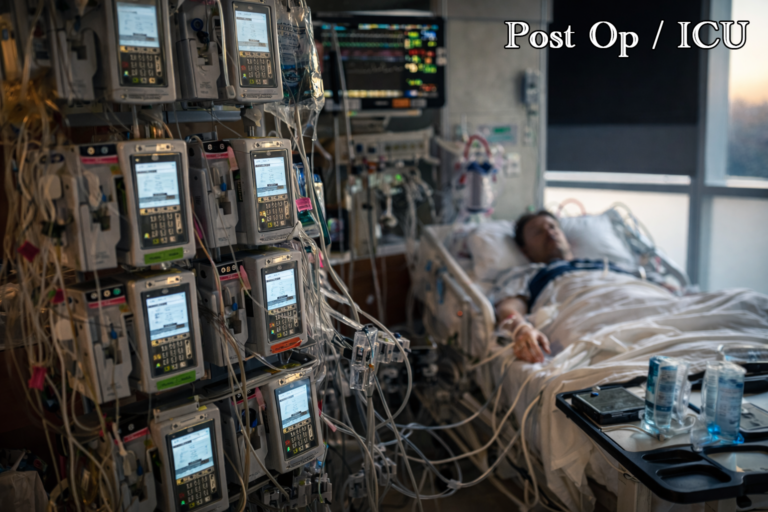
The right jugular took the brunt of it—and I suspect the damage began at Mercy West, well before the transplant itself. Every couple of days throughout the hospitalization, something had gone in or come out of that site. It was the primary access point for most of the monitoring and intervention during the two months at TCH, and it showed. By the time the post-discharge follow-up was underway, the vein had sustained enough damage that it was no longer reliably open. The team switched to the left jugular, and I watched that one with the particular quiet dread of a man who had seen what sustained intrusion does to a vein and was now counting down to the same result on the other side.
The repeated intrusion into the right jugular also cost me my voice—a loss that lasted months and deserves more than a passing mention here. It will get its own piece. For now: it happened, it was significant, and it was a long time coming back.
Months after the switch to the left side, an ultrasound of the right confirmed it was not recovering. Eliquis—a blood thinner prescribed to manage the occlusion—was discontinued. The right jugular was simply done, and that chapter closed without drama or ceremony, which is how most of these things close.
The Medication Chemistry
The follow-up period is not only about the procedures. It is also about the ongoing, iterative work of figuring out how the new medication regimen actually behaves in your specific body—which turns out to be something nobody can fully tell you in advance.
The doctors have dozens, even hundreds, of patients. I have just one. That makes it my responsibility to keep up on my own case.
Tacrolimus levels are among the most critical numbers in post-transplant management. Too low and the immune system attacks the heart; too high and the toxicity becomes its own problem. The target window is narrow, and the level in the blood fluctuates in ways that are not always immediately explicable. Mine were all over the place for a significant period, and it took time and attention to understand why.
The culprit, eventually identified: timing and diet. High-dose magnesium, taken at the same time as the tacrolimus, was interfering with absorption. Once I understood that, I restructured the entire medication schedule—spreading doses throughout the day rather than consolidating them, spacing everything around the specific absorption requirements of each drug. The serum levels stabilized. The solution was not a medication change. It was a scheduling change, arrived at through observation and trial and error rather than through anything anyone handed me at discharge. There are other interactions like this—tea, for instance, where catechins can affect tacrolimus absorption—but these are the kinds of things you learn by watching your own numbers over time.
The ongoing medication adjustments—prednisone stepping down, valsartan going up, amlodipine going down, hydralazine coming off entirely—followed the biopsy results and the pressure measurements and the bloodwork in a continuous feedback loop. It is not a static regimen. It is a living system, recalibrated repeatedly in response to what the body is actually doing, and learning to track it and understand it is part of what recovery actually requires.
The Anxiety Architecture
Every procedure, I was seriously worked up. Calling it anxiety is technically accurate but doesn’t quite capture the specific quality of it—the building dread in the days before, the particular flavor of it on the morning of, the way it sat with me in the car on the way there and in the waiting room and on the table before anything had even begun.
What it was not, I want to be clear, was fear of needles or fear of blood. I will watch the needle go in. I have been bloody as hell after a swan catheterization and it registered as nothing worth noting. What bothered me was the anticipation of pain—specifically the lidocaine, the yellow jacket sting of the local—and the hypersensitivity that sustained medical trauma produces in the skin and nervous system. Trauma recalibrates the body’s alarm system, making it hypervigilant about further intrusion in ways that are entirely disproportionate to the actual threat. The skin becomes more sensitive. The anticipation of pain becomes louder than the pain itself. Understanding this did not make it go away.
What I found genuinely frustrating—and frustrating is the precise word, not shame, not resignation, but irritation—was that the anxiety was there every single time regardless of what I knew. I knew the procedure. I had been through it many times. I knew that the anticipation was worse than the event, that the lidocaine was brief, that within a few minutes of lying down it would all be moving along efficiently and I would be fine. I knew all of this, and I was still worked up. Every time. The prednisone and the trauma were working in combination to ratchet the emotional response upward in ways that the intellect could contain but could not eliminate, and I was genuinely angry at the inability to simply override it. Control it, yes. Eliminate it, no. That gap between knowing and feeling was its own persistent frustration.
The sedation kept its own arc. Initially, Ativan shortly after arrival to take the edge off, followed by ketamine in the cath lab. Then a doctor who decided, reasonably, that ketamine was too strong for a procedure most patients underwent with nothing at all. The next iteration: fentanyl, Versed, and diphenhydramine—a combination that worked well. I was comfortable. I was, for practical purposes, elsewhere.
That same doctor who looked at me one day and said: “You know, Jim, I think you could do this without anything.”
Local Only
So I did.
I was nervous on the way there. Nervous in the waiting room. Nervous on the table before they began. What the staff offered, in place of sedation, was something more straightforward: we will be right here, and we will talk you through it.
They did. Music playing in the background. Conversation maintained throughout—the staff keeping my mind occupied, the doctor checking in at intervals, the ordinary talk of people who do this every day and understand that what a patient needs in that room is not always pharmacological. There was one moment when they needed to focus entirely on what they were doing, and the room went quiet for a couple of minutes. Then it was done, and things returned to normal. There was even the occasional joke cracked during the procedure.
The physical reality: pressure. Not pain in any meaningful sense—pressure, the awareness of a sheath being threaded through the neck and into the vein, present and noticeable and not unbearable. The lidocaine had done its work. The rest was sensation without suffering.
And then, afterward, I drove myself home.
That was the milestone. Not the procedure itself—the driving. Months of needing someone else’s schedule, someone else’s car, someone else’s time. And now: I drove myself there, I drove myself home. One more piece of independent living reclaimed, on a Tuesday morning in winter, through a city full of potholes.
Cardiac Rehab — A Digression
The transplant team referred me to cardiac rehabilitation. The concept is sound: structured, monitored exercise under clinical supervision, designed to rebuild cardiovascular capacity safely in the post-transplant period.
The execution was less than advertised. The standard experience consisted of the staff attaching a cardiac monitor, pointing at a few machines, and stepping back. They were pleasant people, but what they were not doing was working with me in any meaningful sense.
Some weeks in, I raised this with the manager. She acknowledged, without hesitation, that it was not how the program was meant to operate. That day, someone worked with me properly. It was excellent. It happened once more after that, and then stopped.
The other concern was environmental. This was a general rehabilitation facility, not a transplant-specific program. Transplant patients were the only ones wearing masks. Staff would put one on before standing next to me, then remove it when they moved elsewhere. Not all of the other patients were observing careful hygiene around the equipment. I wiped down every machine before and after each use. There was one patient in particular who spent most of his sessions coughing—openly, near the equipment, near other patients. When I mentioned it to the staff, they said they would speak with him. The more useful question was why it had required a patient to bring it to their attention at all. In the first months post-transplant, a respiratory infection is not a minor inconvenience. It is a serious clinical threat.
When the one person who had actually engaged with me stopped engaging, I left. They called about paperwork. I did not go back. They had not been able to make time for me; I had better uses for my own.
The Results — The Rhythm of Acceptable
The biopsy grading system is straightforward once you know it: 0R is no rejection, 1A or 1R is mild acute rejection that does not require intervention, and anything higher begins to demand a clinical response. Most recipients cycle between 0R and 1A in the early months. This is normal. The transplant team was not concerned by 1A results; what they were watching for was movement in the wrong direction.
My results through the early months: 0R, then 1A, then 1A/1R, holding there. The prednisone stepped down with each acceptable result—30mg, 20mg, 10mg, 5mg, 2.5mg, then gone entirely by early February. Coming off prednisone completely was its own milestone: the blood sugar chaos began to ease, the taste receptors began their slow return, the heightened emotion that had been running in the background since November began to quiet.
The March monthly cath was, paradoxically, the one I was most worked up about. The reasoning was straightforward if not entirely rational: I had finally had time to heal, to feel stronger, to build something resembling a routine. The prospect of a bad result undoing months of progress was more threatening than it had been when I was still in the early weeks and had less to lose. The results came back good. Pressures fine. No rejection. Keep going.
I kept going.
Moving On
The anxiety of the gauntlet is not irrational. It is the body’s alarm system doing what alarm systems do—registering the approach of something that has hurt before and preparing accordingly. That the preparation is often disproportionate to the actual event does not make it a failure of character. It makes it a documented response to documented circumstances.
What I learned, over the course of months of procedures, is that the anticipation was almost always the hard part. The procedure itself, when I was simply present for it and not running ahead of it in my mind, was manageable. Sometimes it was nothing.
You show up. You get through it. You go home and peel the tegaderm off the next morning and you move on. And then you go back and do it again, in the snow, in the cold, through the potholes, with the heart-shaped pillow pressed against your chest and the vampires waiting in the basement.
That is what sustained recovery actually looks like.
Not dramatic. Not inspiring.
Just the ongoing, unglamorous work of continuing.
Discover more from One More Beat
Subscribe to get the latest posts sent to your email.