
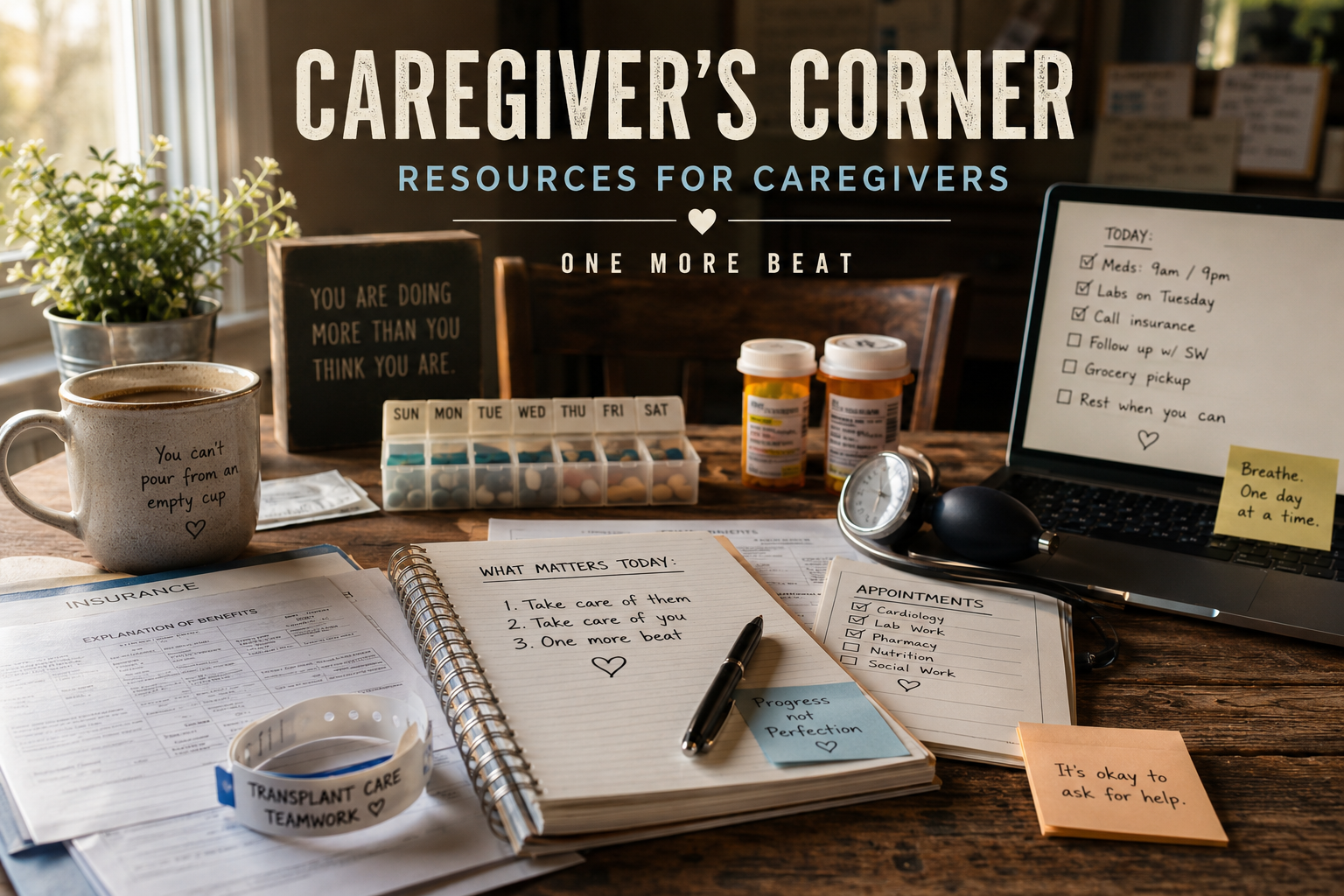
Resources for Caregivers
Caregiving through a heart transplant is one of the most demanding responsibilities modern medicine quietly places on ordinary people. The resources below are not a substitute for the support of people who understand this specific experience from the inside—but they are a starting point. Most caregivers discover them too late. If you are reading this before the transplant, that is the best possible time.
These resources are organized by what you are likely to need and when. Use them in whatever order makes sense for where you are.
Resources Already Inside the Hospital
Transplant centers provide resources that caregivers frequently never realize they can request. These are not perks or extras. They are services that exist for families, not just for patients—and they are available at most major transplant centers throughout the hospitalization and into the recovery period.
Ask directly for any of the following:
Transplant social worker
Financial counselor or financial navigator
Medication assistance coordinator
Chaplain services
Discharge planner
Child life specialist (for children in the household)
The transplant team is focused on keeping the patient alive. The caregiver often has to advocate for their own survival inside the same system.
Transplant Caregiver Communities
These are the rooms where the patient is not present—where a caregiver can say the terrifying thing, the resentful thing, the exhausted thing, without worrying about being overheard or causing harm to the person they love. Peer connection with people who have lived this specific experience is not a luxury. It is often the difference between a caregiver who survives the year intact and one who doesn’t.
TCH Caregiver’s Heart tchcaregiversheart.com
Founded by George Cecere after his wife Terri’s heart transplant at The Christ Hospital—she was the program’s first recipient. Virtual, peer-led, and confidential. Open to caregivers of any solid organ transplant recipient, with multiple meeting times per month at varying hours to accommodate different schedules. No agenda beyond what the people in the room need that day.
HeartBrothers Foundation Caregiver Support Group heartbrothers.org/caregiver
Built by heart failure and LVAD survivors who lived the gap firsthand and vowed to close it. A dedicated caregiver-only virtual group, focused on advanced heart failure, VADs, and transplant. Because the patient is not in the room, caregivers can speak without editing themselves.
Mended Hearts mendedhearts.org
The oldest and largest cardiac peer-to-peer support network in the country, with chapters at more than 460 hospitals plus virtual options. Open to patients, families, and caregivers. Long track record of trained visitors and structured support that includes the people who never get the gown.
Mayo Clinic Connect—Transplants connect.mayoclinic.org/group/transplants
A large, moderated online community with active transplant-specific threads. Not limited to Mayo patients. Caregivers post alongside recipients; the conversations are ongoing and searchable, which means the answer to a question you haven’t thought to ask yet is probably already there.
Clinical and Educational Resources
These resources provide practical guidance on what caregiving through transplant actually requires—the logistics, the medical realities, the legal and financial considerations, and what to expect before and after surgery.
AST Caregiver Toolkit myast.org/caregiver-toolkit
The most comprehensive clinical resource available, produced by the American Society of Transplantation. Covers before, during, and after transplant with practical guidance on responsibilities, legal and financial considerations, mental health, and self-care. Free and open to all. If you read one document before surgery, this is the one.
UNOS / OPTN unos.org
The United Network for Organ Sharing manages the nation’s transplant system. For caregivers who want to understand the transplant list, how matching works, wait times by blood type and status level, and the statistics that frame the experience. Authoritative data source.
Solace — solace.health/specialty/caregiver-support
Provides professional patient advocates—experienced physicians, nurses, and healthcare professionals—who work directly with caregivers to manage the logistical and administrative burden of a family medical crisis: coordinating appointments, handling insurance, communicating with providers, researching assistance programs, and reducing the operational weight that lands on the caregiver by default. Covered by Medicare; most patients pay nothing out of pocket. A dedicated caregiver support program is available specifically for family caregivers, separate from the patient advocacy service.
One More Beat—Health & Management onemorebeat.com/category/health-management
The Health & Management category on this site covers the medication regimen, tacrolimus, immunosuppression, glucose management, lab work interpretation, and the clinical realities of post-transplant life in plain language. Written for the informed patient and the caregiver who wants to understand what they’re managing.
Financial and Legal Survival
Financial strain is one of the most consistently underaddressed dimensions of transplant caregiving. Immunosuppressant medications alone can cost thousands of dollars per month without assistance. Employment disruption, insurance gaps, and disability paperwork arrive at exactly the moment when the caregiver has the least capacity to manage them. These resources exist specifically for this situation.
Family and Medical Leave Act (FMLA) dol.gov/agencies/whd/fmla
The U.S. Department of Labor’s FMLA guide. Eligible employees may take up to 12 weeks of unpaid, job-protected leave per year to care for a spouse, child, or parent with a serious health condition. Understanding eligibility and documentation requirements before the transplant protects the caregiver’s employment during the hospitalization and recovery period.
Social Security Disability Benefits ssa.gov/disability
Many transplant recipients and their families navigate disability systems for the first time after surgery. The Social Security Administration’s disability benefits guide covers SSDI and SSI eligibility, the application process, and what to expect. The process is slow; starting it early matters.
Help Hope Live helphopelive.org
A national nonprofit with decades of experience helping transplant families raise funds for uninsured and underinsured medical expenses. Well established in the transplant community. Provides fundraising infrastructure, fiscal sponsorship, and guidance for families navigating the financial gap between what insurance covers and what transplant actually costs.
NeedyMeds needymeds.org
A nonprofit database of patient assistance programs, drug discount cards, and disease-based financial assistance resources. Particularly useful for immunosuppressant medications, which carry significant out-of-pocket costs. Searchable by medication name or diagnosis. Free to use.
Manufacturer Patient Assistance Programs
Many immunosuppressant medications—including tacrolimus and sirolimus—have manufacturer-sponsored financial assistance programs that can significantly reduce or eliminate out-of-pocket costs when insurance changes or coverage gaps emerge. If a medication suddenly becomes unaffordable, ask the transplant pharmacist directly whether a manufacturer assistance program exists before assuming you are out of options. These programs are not widely advertised and are frequently the caregiver’s call to make.
Mental Health and Identity
The psychological toll of transplant caregiving is documented, serious, and almost universally underaddressed. Caregiver depression, anxiety, identity collapse after the crisis ends, and the grief that arrives in the middle of a good outcome are all real, named phenomena—not personal weakness. The resources below are for when the clinical logistics are handled but the person doing the handling is not.
Psychology Today Therapist Finder psychologytoday.com/us/therapists
Searchable database of licensed therapists, filterable by specialty including caregiver support, grief, trauma, and chronic illness. A starting point for finding professional support when peer connection isn’t enough and the caregiver’s own wellbeing requires dedicated attention.
Ambiguous Loss—Pauline Boss ambiguousloss.com
The framework developed by family therapist and researcher Pauline Boss for grief that lacks resolution or clarity—the kind that attaches to serious chronic illness, uncertain prognosis, and the loss of a person who is still physically present. Caregivers who find themselves grieving something they cannot name may find language here.
One More Beat—Caregivers Corner onemorebeat.com/category/caregivers-corner
The eight-piece series this document accompanies. Written to name the experiences that clinical literature documents but support programs rarely address directly: the emotional realities of caregiving, identity collapse after the crisis ends, what happens to children in the household, and the relational reckoning that follows survival.
When You Are Not Okay
Caregivers break more often than anyone likes to admit. The exhaustion, the grief, the identity loss, and the sustained psychological pressure of this experience can become genuinely overwhelming—sometimes during the crisis, sometimes months after it ends when everyone else has moved on. If you are in that place, these resources exist for you.
988 Suicide and Crisis Lifeline 988lifeline.org
Call or text 988. Available 24 hours a day, seven days a week. For anyone experiencing overwhelming distress, depression, panic, or emotional crisis—including caregivers who have reached the edge of what they can carry. Confidential. Free.
SAMHSA National Helpline samhsa.gov/find-help/national-helpline
1-800-662-4357. Free, confidential, 24/7. Mental health and substance use treatment referrals and information. For caregivers who need help finding the right professional support and don’t know where to start.
For the Children in the Household
Children are the most consistently overlooked participants in a family medical crisis. These resources are for caregivers who want to understand what is happening to the children in their household—and what they can do about it.
Child Life Specialists childlife.org
Child life specialists are healthcare professionals trained specifically to support children and families through medical experiences. They are available at most major transplant centers and children’s hospitals and can be requested. If you have children in the household and haven’t asked for a child life referral, ask.
UC Davis Children’s Hospital—Parenting Through Illness health.ucdavis.edu/children/patient-education/parenting-through-illness
Practical, developmental stage-specific guidance on how children at different ages process a parent’s serious illness—and what honest, age-appropriate communication looks like for each stage. What to say, what not to say, and why the silence adults use to protect children often produces more dread than the truth would.
Harvard Health—How to Talk to Children About Serious Illness health.harvard.edu
Written by Dr. Claire McCarthy, Faculty Editor at Harvard Health Publishing. Covers the specific mechanics of communicating with children about a parent’s serious illness, including developmental considerations, what children actually need to hear, and how to have these conversations more than once as circumstances change.
When the Emergency Ends
The end of the hospitalization is not the end of the caregiving burden. Many caregivers struggle more after the transplant than during the acute crisis—particularly when identity loss, emotional exhaustion, financial strain, and relationship changes begin surfacing after survival is no longer in question.
The Caregivers Corner series addresses this directly. Who Came Home covers the first weeks at home and why they are harder than anyone prepares caregivers for. Who Am I Now? addresses identity collapse after the crisis ends. A Child’s View examines what the experience did to the children in the household, including the deferred collapse that arrives months after everyone else has exhaled.
If you find yourself struggling after the patient is home and recovering, return to this document. The crisis may be over. Your recovery may just be beginning.
One More Beat as a Resource
One More Beat (onemorebeat.com) is written by a heart transplant recipient and documents the full arc of the experience: twenty-two years of congestive heart failure, hospitalization, surgery, and ongoing post-transplant life. It is written with transplant recipients in mind. It is also, whether it was designed that way or not, essential reading for the people around them.
Understanding what the patient is going through—the medications, the labs, the physical and psychological reality of recovery—makes a caregiver a more effective advocate and a less frightened bystander. The categories below are worth knowing.
Caregivers Corner — The eight-piece series written specifically for caregivers. Addresses the emotional realities, identity questions, and what happens to children in the household.
Health & Management — The clinical side: medications, labs, immunosuppression, glucose management, CAV. Written in plain language for the caregiver who needs to understand what they’re managing.
The Journey — The chronological story from diagnosis through transplant and recovery. For the caregiver who wants to understand what the patient lived through from the inside.
Life After Transplant — Post-transplant living: the ongoing medical reality, recovery milestones, and the psychological dimensions of survival.
Reflections — Essays on the interior experience of survival: identity, gratitude, the psychological and emotional dimensions of living with a transplanted heart. For the caregiver who wants to understand not just what happened, but what it did to the person who lived through it.
The patient had a transplant team.
This corner is for the person who didn’t.
Discover more from One More Beat
Subscribe to get the latest posts sent to your email.