
Testing My Limits
Before my health declined, I regularly worked 110 hours in a week. Sometimes more. People told me I was working myself to death. One person, only half joking, said the company would send flowers to my funeral same as anyone else’s.
What they didn’t understand is that I’m one of those strange creatures who actually thrives on hours like that. It wasn’t stress. I was in my element. I loved every minute of it.
This isn’t a story about overwork breaking a body, and I want to be direct about that before going any further. During those years of insane hours, my ejection fraction actually normalized and the size of my heart decreased. The decline that eventually put me on a transplant list came much later, on its own timeline, and was not attributed by my physicians to the hours I had been working. The two things happened to the same body. They were not the same story.
Seven Years of Non-Productive Hell
That’s what I call the stretch that came after, even though it isn’t entirely fair to call it that. Most of it went into my studies—that continued, slowly and steadily, even when almost everything else in life had to wait. Seven years of sustained study while progressively ill is not nothing. My old measurement system just never learned how to count it. I had other things planned during those years too, including work I wanted to do on the house, but the exhaustion that came with the decline made it impossible to get to most of it. I just didn’t have it in me for anything beyond the studying.
Then amiodarone toxicity finally hit levels that affected my thyroid, and I ended up in the hospital. That’s when I actually came to something close to a full stop—and that’s when even the studies had to go. For someone built the way I’m built, losing that was maddening. It had been the one thing I could still turn to when everything else was unavailable, and now even that was gone.
Opening the Throttle Again
Now I’m well past the first year of recovery—nine months into the second, twenty-one months out from the transplant on November 9th, 2024. I gave myself something like six months of genuine down time before I started easing back into anything. Classes came first. Then mobile development tools. Then digging into AI. Then the writing.
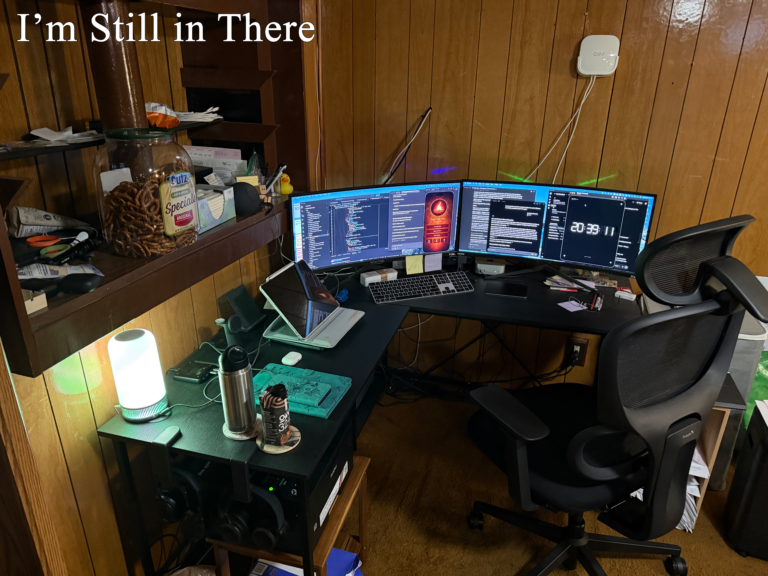
I’m back to mental activity levels close to where I was before things went off the rails. I keep slowly, deliberately ramping things up, testing what I can actually sustain.
And sometimes I get tired. Real tired. Nap-level tired. I let myself take the nap.
Well…sometimes.
But I keep pushing at the edges anyway, because I want to know where they actually are now. Not where I assume they are. Where they are.
The Question That’s Already Answered
Here’s the thing I have to be honest about: I’m not wondering anymore whether the old drive is still in me. It’s not a hypothetical. Most days right now, between the writing and the coding, I’m putting in something close to twelve hours. The appetite came back a while ago. That part of the experiment is over.
But I want to be precise about what that actually looks like, because it isn’t the same twelve hours it used to be. There are breaks built into those days now—something I never did before, not once, not in twenty years of hundred-hour weeks. I’m kicking ass and taking names again, make no mistake. I’m just not Superman again. Not yet, anyway.
The real question is narrower, and it’s the one I don’t have an answer to yet: does that appetite have a ceiling now that it didn’t have before.
A Different Heart, A Different Number
The 110-hour weeks belonged to a body that was already carrying two decades of congestive heart failure underneath everything I was accomplishing—a diagnosis I knew about and managed the entire time, even while the numbers on paper looked good. That heart had a very specific, very long history behind it, one that held up under that load for years, until it eventually didn’t, for reasons my physicians never attributed to the hours themselves.
The body doing the work now has only twenty-one months of post-transplant history behind it. It has no twenty-year track record to draw on, no established sense of what it can absorb under sustained pressure. Using 110 as a benchmark for what this body can handle isn’t unreasonable exactly, but it’s a strange thing to reach for. It’s a number that belongs to a different chapter, measured on a different instrument.
I also can’t pretend relationships are outside the equation anymore. There are people in my life—some new, some old—who’ve told me plainly that I’m working too hard, both for my heart’s sake and because a twelve-hour writing-and-coding day doesn’t leave much of me left over for them. They’re not wrong. Testing limits isn’t only a physical question. It’s also a question of what the people who matter to you are asking you to hold back, and whether you’re willing to actually hear it.
Still In Here
I wrote a different piece once asking “Am I Still Me?” The question shows up here too, just wearing different clothes.
The drive to succeed, to work, to produce, to earn—that hasn’t gone anywhere. If anything, it’s one of the clearest signs that whoever was running the show before is still running it now. I want a decent home. Maybe a fun car. A few toys, if I’m honest. And travel—real travel, not a long weekend once a year, but actually going places, seeing the country, maybe more than that. Nothing extravagant. Just the ordinary human wanting to have something to show for the hours, and somewhere to spend them once they’re earned.
That’s a different thing than loving the work itself, and worth being precise about. The 110-hour weeks were never about what they earned me—they were about the work being where I was most myself. But somewhere in weighing whether to go back to something formal, this other thing has crept in too: not just “do I miss that state of flow,” but “do I want the paycheck, the security, the tangible proof of it, enough to reorganize a recovering life around earning them again.” That’s not a small distinction. It changes what the actual decision is about.
Maybe I’ll Just Ease Into It
I haven’t gone back to formal employment, and I genuinely don’t know if I will. I’m ten years removed from my career in IT, which is a lot of time to make up. My mind is sharp. My leadership instincts never left. The technical side is rustier than I’d like, though I’m closing that gap quickly. None of that tells me whether I actually want to go back to a formal 7-to-6 grind.
Or do I?
There’s real satisfaction in a career—in productivity, in purpose. Those things matter to me, probably more than they should. I was at the absolute top of my game managing an internationally impacting outage across time zones, start to service restoration, running on thirty and forty straight hours without it feeling like sacrifice.
So maybe I’ll just start slow. Ease into something like a 50-hour week. That’s conservative, right?
I don’t actually know. That’s the honest answer, and I’m not going to pretend otherwise by the end of this the way these pieces sometimes want to. The drive is back. The heart is new. I don’t yet know what the second thing will actually let the first thing do, long-term, and I won’t know until I keep testing it—carefully, a little at a time, paying attention to what my own body and the people around me are telling me, rather than what a twenty-year-old number says I used to be capable of.
There’s another possibility I haven’t entirely accounted for yet, and it’s the harder one: that I may eventually discover I can do everything I used to do, and still decide not to. If the body permits it, the question stops being physiological and becomes something else entirely—not can I, but should I, and whether being capable of living exactly as I once did means I actually want to. I don’t have that answer either.
In the end, I’ll follow the river; the current will carry me to where I’m supposed to go. I survived to live—no plan, no mission. Just one more minute, one more breath, one more beat.
Discover more from One More Beat
Subscribe to get the latest posts sent to your email.