The Skin You’re In
There is a particular kind of appointment that arrives without fanfare and leaves you with more to think about than you expected. My first post-transplant dermatology visit was that kind of appointment.
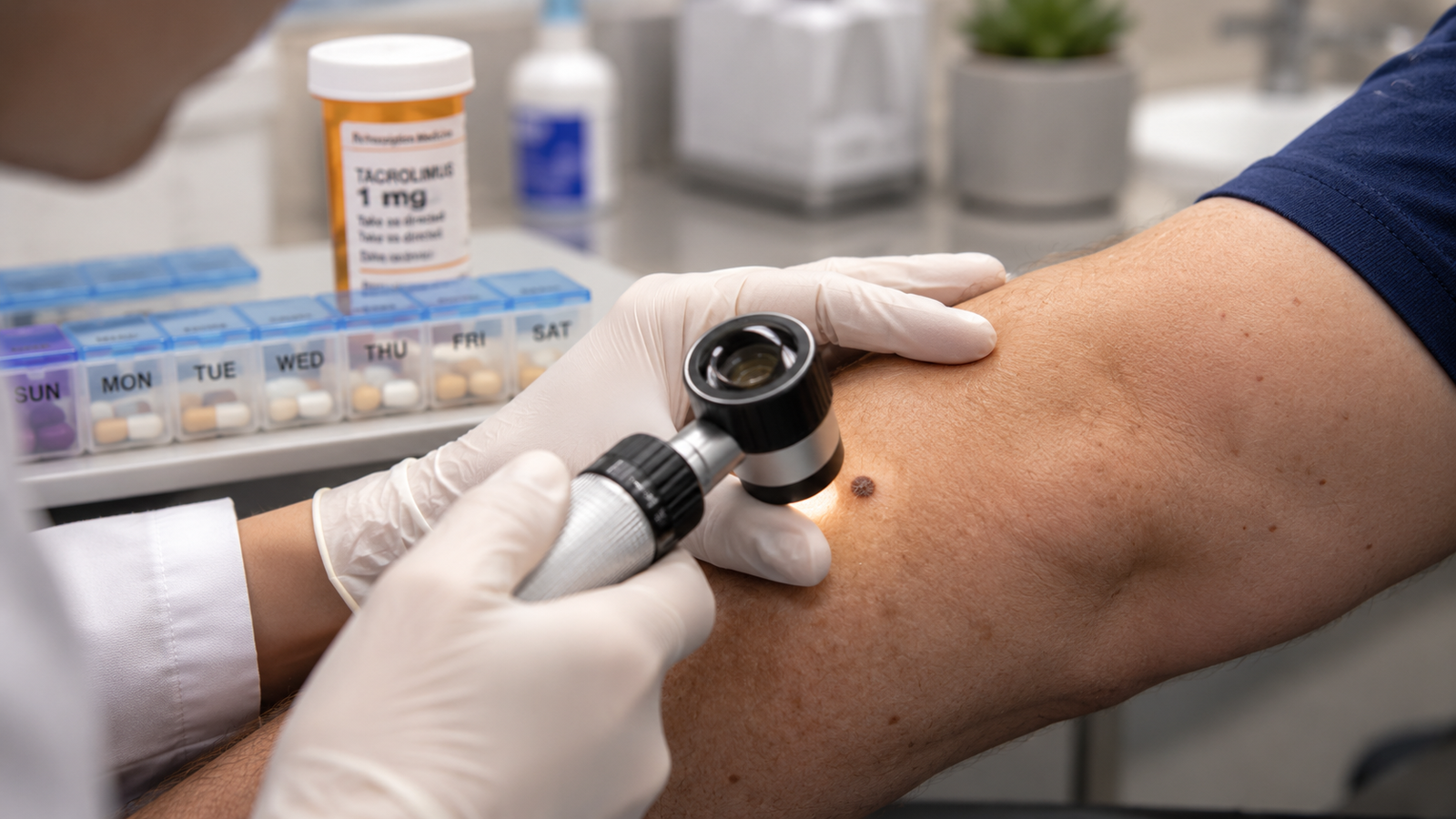
Head to toe. Literally. The dermatologist worked methodically—scalp, face, neck, chest, arms, back, legs—the kind of systematic attention that makes you realize how rarely anyone looks at you that carefully. He removed a skin tag from my back that had been there long before the transplant, mildly annoying but never worth dealing with until it recently became persistently irritated. He found a spot on my arm that warranted a closer look and took a biopsy. He explained what to watch for: new brown spots, anything flat and smooth that wasn’t there before. He recommended I get someone to give my back a thorough once-over regularly, since it’s not territory most of us can monitor on our own. Assuming the biopsy comes back clean, he wants to see me annually.
Straightforward. Professional. Completely routine, from his perspective.
From mine, it landed differently.
Still. Seriously.
I knew this was coming. The transplant team mentions it. The literature covers it. The support groups talk about it. You are told, at some point in the process, that immunosuppression carries an elevated skin cancer risk and that dermatology surveillance is part of post-transplant life.
Knowing it and sitting in the exam room while someone takes a biopsy from your arm are two different things.
The indignation is real. Twenty-two years of congestive heart failure. An Impella. A transplant and ICU and recovery and the first year of learning to live inside a new set of rules. And now you’re having skin removed and waiting a week for results. The transplant saved your life. It also changed the terms under which you live it, in ways that keep presenting themselves in the exam room, the pharmacy, the lab, the places you now go regularly that you didn’t before.
This is one of those places.
Why the Math Changes
The short version: immunosuppression keeps your immune system from attacking your new heart. It also dials down the immune surveillance that normally catches and clears damaged skin cells before they establish as something worse. UV radiation does what it always does—causes DNA damage in skin cells. The difference is that the cleanup crew is working at reduced capacity, and that damage accumulates differently than it does in people with intact immune systems.
The numbers are worth understanding. Heart transplant recipients face meaningfully elevated skin cancer risk compared to the general population, and the nature of that risk shifts in a specific way—the rarer, more aggressive form becomes more common than the more common, less aggressive form. That’s not a marginal difference.
The full picture—mechanisms, statistics, what the research actually shows—is covered in Living with Immunosuppression: What the Science Actually Says. What matters here is the practical reality: sun exposure is no longer background noise. It’s a managed variable.
The Biopsy
The spot on my arm may be nothing. The dermatologist didn’t express alarm—he expressed appropriate clinical caution, which is exactly what you want from someone in that role. Nothing else flagged during the full-body scan, which is genuinely reassuring. The result comes back within seven days.
The wait sits with me. I’m not going to pretend otherwise. But I’m also not crippled by it. If it comes back positive, there will be a process to follow. If it comes back clean—which I expect—I’ll have a baseline established and a dermatologist in my corner going forward. Either way, the visit accomplished what it was supposed to accomplish.
Elevated risk is not a diagnosis. It simply means vigilance matters more than it used to.
That’s what this phase looks like: not crisis, not crisis, not crisis—and then something that makes you stop and pay attention.
What You Actually Do
The strange thing is not that these precautions are burdensome. It’s realizing that something as ordinary as sunlight now belongs on the list of things you think about differently.
SPF 50 or higher, every day, regardless of whether you’re planning to be outside. UV exposure doesn’t require a beach trip—it accumulates on the drive to the clinic, the walk to the car, twenty minutes on the patio. Broad-spectrum sunscreen with zinc oxide or titanium dioxide is the standard recommendation. Reapply every two hours of actual outdoor exposure.
UPF-rated clothing for extended time outside. A hat with real coverage, not a baseball cap that leaves your ears and neck exposed.
Annual full-body skin surveillance with a dermatologist. A standing appointment, every year.
Watch for changes: new spots, anything that grows, bleeds, changes color, or doesn’t heal the way it should. Don’t wait for the annual visit if something flags between appointments.
And get someone to check your back. Regularly. It’s not reachable on your own, and it’s real estate.
None of this is heroic. It’s the new baseline.
The Wait
As I write this, the result isn’t in. I don’t know yet what that spot on my arm is going to turn out to be. I’m nervous—I’d be lying if I said otherwise—but nervous and functional are not mutually exclusive.
The result will be what it is. If it’s nothing, I simply add an annual dermatology visit to the growing list of medical routines that define post-transplant life. If it’s something, I deal with it.
Either way, this is now part of the landscape. One more thing to monitor.
Apparently, not dying comes with paperwork.
For now, I wait.
UPDATE….
What Came Back
The skin tag was nothing. Years on my back, mildly annoying, biopsied out of an abundance of caution and confirmed benign. One down.
The mole on my inner upper arm was not nothing. Pathology came back as a compound dysplastic nevus with moderate atypia—a pre-cancerous mole with cells that had not crossed into melanoma but had moved past the point where “wait and see” was the right call. The dermatologist went back in, removed additional tissue to secure clean margins, and sent it out again.
That second wait was worse than the first. Not because anyone suggested a different outcome was likely—the initial procedure had already addressed the concerning tissue—but because “pre-cancerous” is a word that sits with you differently than “biopsy pending.” It carries weight the first result didn’t. The wait was awful. It’s also, at this point, just part of the life. Post-transplant existence runs on intervals of not knowing, followed by results, followed by the next interval. This was one more of those, longer and heavier than most, but the same basic shape.
The follow-up pathology came back clean. Scar tissue. Nothing left. Confirmed gone.
Worth noting: the mole was on the inner upper arm, a spot that rarely sees daylight. This had nothing to do with sunscreen habits or time outdoors. It is exactly the kind of thing surveillance catches and vigilance alone would not—which is the argument this whole piece has been making, now with a result attached to it.
The routine going forward is simple. Annual skin checks, every year. Catch it early, deal with it, move on.
Both spots are gone. I’m still here.
Discover more from One More Beat
Subscribe to get the latest posts sent to your email.