It Looks Like Food
One of the harder parts of staying alive after a transplant is not avoiding the things that look dangerous. Those at least come with a warning. The bottle behind the pharmacy counter, the warning label, the prescription that arrives with a pharmacist’s short speech—they announce themselves. The harder part is the coffee. The comfort tea. The gummy on the nightstand. The sparkling water in the checkout cooler. It is the part of the store that has learned to sell pharmacology without looking like pharmacology at all.
Modern medicine trained people to expect powerful compounds to announce themselves: an amber vial, a childproof cap, a warning read aloud at the counter. The wellness marketplace has learned to do the opposite. The same class of compounds that once sat behind that counter now arrives as a latte, a soft drink, a wellness shot, a bag of powder stirred into a smoothie. The packaging got friendlier. The chemistry did not. And for a transplant recipient—whose survival depends in part on keeping powerful immunosuppressants within carefully managed ranges—the friendly packaging is precisely the problem, because it removes the one cue that used to signal caution.
A word before going further. None of what follows is a substitute for a transplant team, and none of it is meant to turn a patient into their own pharmacist. The purpose is the opposite: to make the recipient a sharper participant in their own care—someone who can recognize when a product deserves a question, and who knows to bring that question to the people who manage the regimen. This is about learning to notice. It is not about deciding alone.
How Hard, and How Long It Stays
Not every mistake carries the same weight, and treating them as equal is its own error. The useful distinction is not natural versus artificial. It is magnitude and persistence—how hard a substance hits, and how long it stays.
At the low end, a single ordinary exposure to many products produces little or no clinically meaningful effect. A gram of vitamin C does not overpower tacrolimus, and no immune system becomes a threat because it was handed some ascorbic acid on a Tuesday. But “many” and “ordinary” are carrying real weight in that sentence. Whether a single exposure matters depends on dose, concentration, individual metabolism, kidney function, and timing, and some single exposures matter a great deal. Which is exactly why the next category exists.
Some substances hit hard and linger. Grapefruit is the textbook case. Its furanocoumarins do not merely compete with the enzyme that clears many drugs—they bind to it and inactivate it, shutting down intestinal CYP3A4 until the body synthesizes replacement enzyme, a process measured in days rather than hours.[1]Because the damage is done to the enzyme itself, spacing the grapefruit away from the medication does not solve it. In one documented liver-transplant case, a patient’s tacrolimus trough concentration rose roughly tenfold, and the surge appeared about a week after the last glass of juice—well after the patient would have assumed the coast was clear.[2] A substance that has dismantled the machinery cannot be timed around.
Others work in the opposite direction, building over repeated use and receding only gradually after they are stopped. St. John’s Wort does not block the clearing enzyme; it induces the body to produce more of it, so drug levels fall rather than rise. In transplant patients the effect is large and well documented—calcineurin-inhibitor exposure dropping substantially, with dose increases required within days—and the surplus enzyme does not disappear on command.[3]
This is also where the word “natural” earns its skepticism. Natural is not the safety variable. Two of the drugs at the center of transplant medicine are themselves natural in origin: tacrolimus and sirolimus were both first isolated from soil-dwelling Streptomyces bacteria.[4] The most pharmaceutical-seeming compounds in a recipient’s regimen were, not long ago, growing in the dirt. A substance’s origin says almost nothing about what it will do to a drug regimen. Its activity does.
The Reason Is Not on the Label
Vitamin C illustrates the whole problem in miniature. It reads as harmless—water-soluble, familiar, associated in the popular mind with nothing worse than a bright citrus morning. But surplus vitamin C is converted in the body to oxalate, and oxalate is cleared through the kidneys—kidneys that may already be carrying the effects of calcineurin-inhibitor therapy. At ordinary dietary intake, this is generally not clinically consequential. At sustained high intake, and especially where kidney function is already reduced, the additional oxalate load may become clinically important; high-dose vitamin C has been associated with kidney stones and, in vulnerable patients, with oxalate nephropathy.[5][6] None of that appears anywhere on a product that presents itself as fizzy vitamin water.
That is the mechanism worth internalizing—not “vitamin C is dangerous,” and not “avoid everything,” but that the reason a product warrants caution is usually invisible from the outside. The reliable response is not to research it into submission; it is to bring the specific product, at the specific dose, to the people who track the levels. The label is written to sell. It is not written to tell a transplant recipient what the product will do to their regimen.
What’s in the Glass
Start with the mug, because that is where the disguise is densest.
Mushroom coffee reads as coffee—marketed as coffee, shelved near coffee, poured like coffee. But it exists for the functional mushrooms blended into it: reishi, chaga, lion’s mane, turkey tail. These are not interchangeable. They are different organisms containing different compounds, with very different and often poorly studied effects, and several are sold elsewhere explicitly as immune support. That uncertainty is the point—”coffee” is not enough information to know what a given blend is actually doing.
Tea is subtler, because it can wear two costumes at once: a comfort drink, and a delivery vehicle for something active. Green and white teas are generally less oxidized and often retain more catechins, particularly EGCG, than fully oxidized black tea.[7] In laboratory studies, green-tea extracts and catechins have affected several drug-metabolizing enzymes and transporters; human studies have been much less convincing, with the available clinical evidence showing no meaningful inhibition of the major CYP enzymes or P-glycoprotein, though questions remain around certain transporters and heavier exposure.[8] The clearer hazard sits in concentrated green tea extract supplements, which carry a documented liver-injury signal.[9] Ordinary brewed tea occupies genuinely uncertain ground, and transplant programs differ on it—which is exactly why it belongs in a conversation with the transplant team rather than being settled by a rule found online.
The same logic scales up in the shot. Wellness and immunity shots—Vive, Suja, the ginger-and-turmeric varieties—compress into two swallows many of the same ingredients already discussed: immune botanicals, concentrated vitamin C, turmeric, ginger. The problem is not that a shot differs from a drink. It is that the format invites a far larger dose than those ingredients would contribute across an ordinary meal, and magnitude is one of the things that decides whether an exposure becomes clinically meaningful. Energy shots such as 5-hour Energy raise a different set of questions—less about drug interactions than a concentrated stimulant load paired with megadose B vitamins. For someone managing blood pressure, the tiny bottle still deserves the same pause rather than being mistaken for the equivalent of a cup of coffee. In each case, the bottle disguises the dose. That is exactly why it belongs in front of the transplant team rather than being treated as the harmless pick-me-up it resembles.
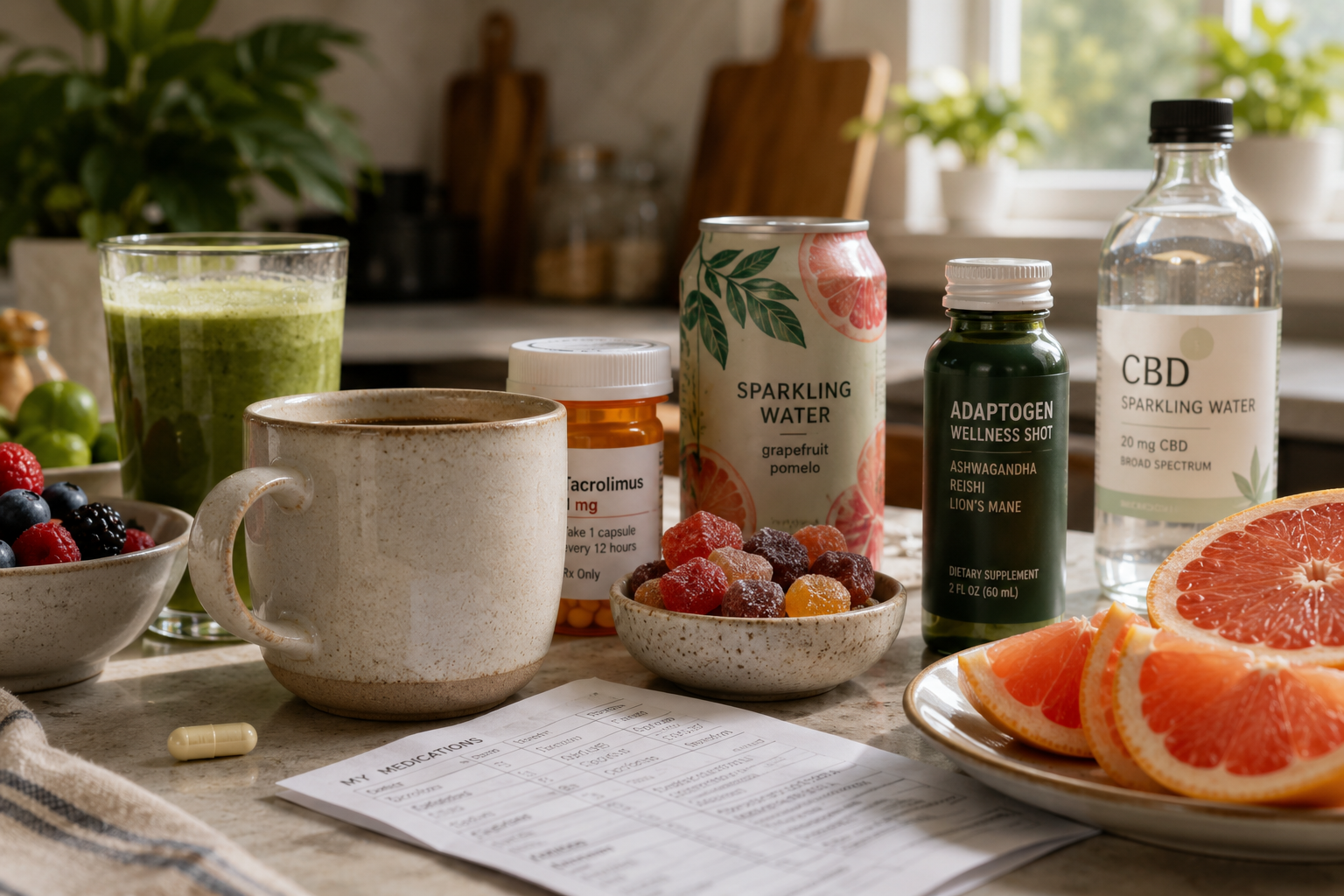
Then there is the newest costume, worth naming because it is culturally new: the functional beverage. Adaptogen sodas built on ashwagandha or reishi. Sparkling water infused with CBD. These are products sold for their physiological effects, engineered into the shape of a soft drink and shelved in the same cooler as the seltzer.
The Immunity Aisle
This is the aisle where a transplant recipient has the most at stake, and the reason is structural. Much of the category is built and marketed around pushing immune function up—which is the opposite of what a transplant regimen is designed to do.
Echinacea is promoted specifically on the premise that it stimulates immune response,[10] and in laboratory work, elderberry preparations have increased the production of inflammatory signaling molecules.[11] These products are marketed to stimulate or support the same immune system transplant pharmacology is meant to restrain, and some laboratory findings point that way. For most people, a livelier immune system during cold season is the goal. For someone whose survival depends on keeping that system deliberately quieted, it is the wrong lever. High-dose zinc, often shelved alongside, raises a separate set of questions—of dose and toxicity rather than immune activation—and is worth treating as its own matter.
Precision matters here, because overstating the case would be its own failure. There is no controlled trial, and no clear documented case, establishing that an elderberry gummy caused a transplant to reject. What exists is simpler: the intended effect of these products runs directly contrary to the purpose of the regimen, and many transplant programs therefore advise patients to avoid herbal immune-support products, or herbal supplements more broadly.[12] The defensible position is not “this will cause rejection.” It is that buying a product to do precisely what the regimen is designed to prevent is a poor bet, and when the potential downside includes graft injury or loss, avoidance is the reasonable course under uncertainty. Proof of a fire is not required to decline to store fuel beside the furnace.
Just Food
By now the dangerous things might be expected to at least look like supplements. Some of them are simply food.
Grapefruit is the standard example in transplant education, so the mechanism needs no repeating—but its hiding places do. It is not only the fruit and the juice. It appears in citrus sodas and grapefruit sparkling waters, and in grapefruit-related hybrids: pomelo, Seville (bitter) orange, and some tangelos, including the Minneola, may contain the same interacting furanocoumarins and are commonly included in transplant avoidance guidance. Pomegranate belongs in the same family of concern: its compounds inhibit the same CYP3A enzyme, and pomegranate has been shown to raise tacrolimus concentrations, though the human evidence is thinner than grapefruit’s and rests largely on a pharmacokinetic study and case reports.[13][14] It turns up in exactly the “heart-healthy” and “antioxidant” juice blends chosen by someone trying to do something good.
Then the register shifts, because one item here is not caution but genuine danger. Star fruit—carambola—contains both a neurotoxin, caramboxin, and a heavy load of oxalate. In people with reduced kidney function it can cause seizures, confusion, and acute kidney injury, and the neurotoxin accumulates precisely because impaired kidneys cannot clear it.[15][16] Large or concentrated amounts have harmed people with normal kidneys as well, so it is not a fringe worry—but it is especially dangerous with the reduced renal clearance present in many transplant recipients. It looks like ordinary produce. For anyone with impaired kidney function, it is not ordinary at all.
Licorice closes the section as the sweet-shelf outlier. Real licorice—the kind containing glycyrrhizin, found in some herbal teas and traditional licorice candy, not the artificial flavoring in most modern candy—blocks an enzyme that normally shields the body’s mineralocorticoid receptors from cortisol. The result is rising blood pressure and falling potassium,[17][18] a poor combination for a body already managing hypertension and a closely watched electrolyte balance. A candy and a cup of tea, doing the work of a drug.
Not Even Food
Here the section title above stops being true, because the hidden pharmacology does not even have to be edible.
CBD may be the clearest modern example of the disguise, precisely because the culture has decided it is the opposite of a drug—natural, gentle, unfairly maligned, the thing reached for instead of a prescription. The biochemistry disagrees. CBD can inhibit the CYP3A enzymes—both CYP3A4 and CYP3A5—as well as CYP2C19, and a published transplant case documented oral CBD driving a patient’s tacrolimus exposure up roughly two and a half fold, forcing the dose down to compensate; laboratory work confirms the mechanism directly on tacrolimus.[19][20] The boundaries matter: the documented interaction involves ingested CBD, and ordinary topical products have not been shown to produce the same effect, though formulation and absorption vary enough that the ingredient still belongs in the conversation. Purified cannabidiol is pharmacologically active enough to be sold as an FDA-approved antiseizure medication. The tacrolimus interaction is not cultural panic about cannabis. It is drug metabolism.
Ashwagandha is the same lesson in a quieter register—an adaptogen now folded into sleep gummies and stress blends. It has immune-modulating activity, which raises the familiar concern, but its better-documented hazard is the liver: it has been implicated in real cases of clinically apparent liver injury, classified by the NIH’s LiverTox as a likely cause.[21] That is a more concrete reason for caution than the immune question, and knowing which of the two is the sharper edge is part of reading these products accurately.
The rest of the shelf follows the pattern. Valerian, an herb widely promoted as a sleep aid and cautioned against combining with other sedatives, turns up in sleep blends, sometimes without prominent labeling[22]—the kind of unannounced active ingredient that makes a familiar product worth rechecking whenever its formula changes. Greens powders are botanical kitchen sinks, a dozen active ingredients in a scoop marketed as a vegetable. None of it looks like medicine. That is exactly why it warrants a second look.
The Difference Between an Emergency and a Habit
One hazard here is not in disguise at all, and that is its own kind of trap.
Over-the-counter anti-inflammatories—ibuprofen, naproxen—look exactly like what they are. No costume, no wellness framing, nothing hidden. The risk is familiarity. They are so ordinary, so long a fixture of the medicine cabinet, that they are easily taken the way the label suggests: routinely, for days, as a matter of course. The mechanism is unforgiving. Calcineurin inhibitors such as tacrolimus can reduce renal blood flow through vasoconstriction, while anti-inflammatories block the prostaglandins the body uses to preserve kidney perfusion, particularly when circulation is already stressed. Used together, the two have been associated with greater deterioration in renal function than either exposure alone—reason enough that the combination is generally considered inadvisable.[23]
There is a difference between an emergency and a habit. There is also a difference between recognizing that distinction and granting oneself the exception. For a transplant recipient, that exception belongs to the team as much as the rule does. Isolated use is generally a lesser hazard than a daily routine—but “only one” is not a safety rule, because kidney function, hydration, other medications, and the reason for reaching for it all change the calculation.
Read the Small Print
None of this requires becoming a pharmacologist, and no amount of label reading will identify every interaction. But there is a smaller, usable skill: learning to notice a handful of phrases. Proprietary blend. Botanical complex. Immune support. Adaptogenic. Detox. Antioxidant complex. These are marketing language, not ingredient lists, engineered to signal benefit while disclosing as little as possible about what is actually inside. Noticing them does not require knowing what the interaction is. The phrase only has to trigger a different reflex than it once did.
Recognition is the patient’s job. Adjudication is not. The goal is to convert one automatic thought into another—”this looks healthy, it is probably fine” becomes “this deserves a message to the coordinator.” That is the whole skill, and it works standing in a grocery aisle a year from now, in front of a product that does not yet exist.
You Would Have to Be Both
The deepest mistake is not reaching for the wrong product. It is believing this is a body of knowledge one could eventually master well enough to stop asking.
It is not. The marketplace updates constantly; familiar products are reformulated without the buyer noticing, and the evidence itself keeps moving. Even the transplant pharmacist—the person with the most training in exactly this—routinely stops and looks it up, because the honest answer to “what does this do to tacrolimus” is often that someone has to go and check. Reliably clearing a single unfamiliar product would take two experts at once: one who knows the botanical, and one who understands the pharmacokinetics. They are rarely the same person, and the costly error is assuming they are—trusting a practitioner to simply know, when familiarity with an herb is not the same thing as understanding what it does to a drug the body handles on a knife’s edge. Botanical knowledge and pharmacokinetics are different disciplines.
So who decides what is safe? In the end, you do. Authority over your own body does not belong to the transplant team, or the government, or a pharmacist, or the wellness industry—it is yours. But authority is not the same as competence. The right to make the decision is yours; the expertise required to assess what a product may do to the regimen is not yours alone, and that assessment is collaborative by necessity. The choice may be yours, but the safety judgment is shared.
And remember: the transplant team is the reason there is still a choice to even make. Weigh their judgment accordingly.
References
1. Bailey DG, Dresser G, Arnold JMO. “Grapefruit–medication interactions: Forbidden fruit or avoidable consequences?” CMAJ. 2013;185(4):309. https://www.cmaj.ca/content/185/4/309
2. Fukatsu S, et al. “Delayed effect of grapefruit juice on pharmacokinetics and pharmacodynamics of tacrolimus in a living-donor liver transplant recipient.” Drug Metab Pharmacokinet. 2006;21(2). https://pubmed.ncbi.nlm.nih.gov/16702731/
3. Bauer S, et al. “Alterations in cyclosporin A pharmacokinetics and metabolism during treatment with St John’s wort in renal transplant patients.” Br J Clin Pharmacol. 2003;55(2). https://pmc.ncbi.nlm.nih.gov/articles/PMC1894728/
4. Rivera A, Heitman J. “Natural product ligands of FKBP12: Immunosuppressive antifungal agents FK506, rapamycin, and beyond.” PLOS Pathogens. 2023. https://journals.plos.org/plospathogens/article?id=10.1371/journal.ppat.1011056
5. Thomas LDK, et al. “Ascorbic Acid Supplements and Kidney Stone Incidence Among Men: A Prospective Study.” JAMA Intern Med. 2013. https://jamanetwork.com/journals/jamainternalmedicine/fullarticle/1568519
6. Fontana F, et al. “Oxalate Nephropathy Caused by Excessive Vitamin C Administration in 2 Patients With COVID-19.” Kidney Int Rep. 2020. https://pmc.ncbi.nlm.nih.gov/articles/PMC7363608/
7. Linus Pauling Institute, Oregon State University. “Tea.” Micronutrient Information Center. https://lpi.oregonstate.edu/mic/food-beverages/tea
8. Albassam AA, Markowitz JS. “An Appraisal of Drug-Drug Interactions with Green Tea (Camellia sinensis).” Planta Med. 2017. https://pubmed.ncbi.nlm.nih.gov/28118673/
9. LiverTox. “Green Tea.” NIDDK/NIH. 2020. https://www.ncbi.nlm.nih.gov/books/NBK547925/
10. NCCIH, NIH. “Echinacea: Usefulness and Safety.” https://www.nccih.nih.gov/health/echinacea
11. Barak V, et al. “The effect of Sambucol, a black elderberry-based natural product, on the production of human cytokines.” Eur Cytokine Netw. 2001. https://pubmed.ncbi.nlm.nih.gov/11399518/
12. Johns Hopkins Comprehensive Transplant. Transplant nutrition and infection-prevention guide. https://www.hopkinsmedicine.org/-/media/transplant/3_lung_guide_nutrition_and_preventing_infection.pdf
13. Karwasra R, Ahmad S, Singh S. “Potential profound fluctuation in tacrolimus concentration on consumption of pomegranate rind extract: A Pharmacokinetic Experiment.” Front Pharmacol. 2023. https://pmc.ncbi.nlm.nih.gov/articles/PMC10154516/
14. Miedziaszczyk M, et al. “Controversial Interactions of Tacrolimus with Dietary Supplements, Herbs and Food.” Pharmaceutics. 2022;14(10):2154. https://pmc.ncbi.nlm.nih.gov/articles/PMC9611668/
15. Yasawardene P, et al. “Nephrotoxicity and neurotoxicity following star fruit (Averrhoa carambola) ingestion: a narrative review.” Trans R Soc Trop Med Hyg. 2021;115(9):947–955. https://academic.oup.com/trstmh/article-abstract/115/9/947/6163205
16. Abeysekera RA, et al. “Star fruit toxicity: a cause of both acute kidney injury and chronic kidney disease.”BMC Res Notes. 2015;8:796. https://link.springer.com/article/10.1186/s13104-015-1640-8
17. Sabbadin C, et al. “Licorice: From Pseudohyperaldosteronism to Therapeutic Uses.” Front Endocrinol. 2019. https://www.frontiersin.org/journals/endocrinology/articles/10.3389/fendo.2019.00484/full
18. Varma R, Ross CN. “Liquorice: a root cause of secondary hypertension.” JRSM Open. 2017. https://pmc.ncbi.nlm.nih.gov/articles/PMC5298563/
19. So GC, et al. “Inhibition of Tacrolimus Metabolism by Cannabidiol and Its Metabolites In Vitro.” Clin Transl Sci. 2025. https://pmc.ncbi.nlm.nih.gov/articles/PMC11806196/
20. Leino AD, et al. “Evidence of a clinically significant drug-drug interaction between cannabidiol and tacrolimus.” Am J Transplant. 2019;19(10):2944–2948. https://pubmed.ncbi.nlm.nih.gov/31012522/
21. LiverTox. “Ashwagandha.” NIDDK/NIH. 2024. https://www.ncbi.nlm.nih.gov/books/NBK548536/
22. NCCIH, NIH. “Valerian.” https://www.nccih.nih.gov/health/valerian
23. Delzer LM, Golightly LK, Kiser TH, Biggins SW, Lewis VJ, Kim II. “Calcineurin Inhibitor and Nonsteroidal Anti-inflammatory Drug Interaction: Implications of Changes in Renal Function Associated With Concurrent Use.” J Clin Pharmacol. 2018;58(11). https://pubmed.ncbi.nlm.nih.gov/29799625/
Discover more from One More Beat
Subscribe to get the latest posts sent to your email.