
Not Yet.
There is a practice I have kept for most of my life, and it is the only thing that makes the rest of this account trustworthy, so I will put it first. When something happens that I cannot explain, I do not explain it. I observe it. I hold it intact, exactly as it arrived, and I refuse to file it under a category that would make it smaller and easier to carry. Most people, faced with the inexplicable, reach immediately for meaning—it was God, it was a dream, it was the drugs, it was a sign. I have come to believe that the reach for meaning, in the moment, usually does more to bury the thing than to reveal it. So I have trained myself not to reach. I look, and I let it stay whole.
I mention this because in the months before and after my heart transplant I experienced a series of things that most people would call religious experiences, and if I were like most people I would have come out of it born again—a church, a tradition, a tidy story about what it all meant. That did not happen, and pretending it did would be its own kind of lie. I am not a religious man in the way that word is usually meant. I am, however, someone who has seen things he cannot explain, and who has decided that not explaining them is the honest course. When the world stops making sense, the instinct is to reach for meaning; I have written elsewhereabout why I think that reach so often misleads.
This is the harder companion to a question I have already answered. I have written, in “Am I Still Me?,” that the new heart did not change me—no borrowed tastes, no inherited memories, no stranger living in my chest. The body was mine and the self was mine. But there is a difference between the self and the flow that moves through it, and that distinction is what this account is about. The chart was clean. Something still was not right. This is the story of finding out what.
A priest, a rabbi, and a chaplain walk into a hospital room
I know how that sounds. It is the opening of a thousand jokes, and I am aware of the comedy in it, which is part of why I am telling it straight.
Over the weeks of my hospitalization I brought the same questions to a number of people whose business is the soul. Father Adrian, the Catholic priest who had known me a long time. Rabbi David and Rabbi Buchwald, with whom I had been studying. Doug Mitchell and David van Pelt from the hospital’s pastoral services—Doug in particular sat with me for hours across several visits, walking me through territory I could not walk alone. I did not bring them small questions. I asked what happens to a man’s soul when his heart, the organ nearly every civilization that ever lived has called the seat of the self, is cut out and replaced with the heart of a dead stranger. I asked whether I would still be whole. I asked, in different words to different men, whether taking this heart would cost me something I could not name.
They did not agree about much. They came from different traditions with different vocabularies and different ideas about almost everything. But on this they converged, every one of them, without conferring: take the heart. The soul is not so fragile a thing as that. Take the heart, and the rest will follow.
It was the answer the surgeons had given me about my body, arriving now from the other side of the building. Dr. Dowling had told me the heart was mine and there was no evidence for anything else; take it. The clergy told me the soul was mine too, and would remain so; take it. Rabbi David, characteristically, would not let me off easily. When I told him I felt I was being called home, he asked me whether it was my heart, my mind, or my soul that was speaking—and how I could possibly know the difference. I answered without hesitation that it was my soul. He told me that sometimes, as the body fails, the three become difficult to tell apart. That is the kind of answer that does not close a question but sharpens it, and it stayed with me. It is also, I would later understand, the same discipline I have described—do not assume you know which voice you are hearing; observe, and hold the uncertainty intact.
Where the practice came from
None of this arrived in a man unprepared for it, and I want to be clear about that, because the deathbed conversion is a genre I have no interest in joining.
I have been spiritually inclined my whole life. As a child I half-considered taking holy orders—not seriously; I was, by my own honest accounting, far too interested in girls. In my twenties I went deep: years inside the New Age community, training to teach yoga, reading my way across comparative religion and philosophy. It was in a yoga teacher training that I first encountered Ramana Maharshi’s question—Who am I?—and found that it would not leave me. Am I the son, the brother, the husband, the engineer, the corporate man? Or none of these? The question opened a door I would spend decades walking through, and have written about at length since.
And then I changed focus. I will not call it abandonment, because it was not a renunciation of anything—I simply turned my attention to the world of man. Career, money, the work. There were years of hundred-hour weeks, travel across states and countries in service of a company. The questions did not die; they were set down, the way you set down a book you fully intend to finish. I was, as the old phrase has it, in the world. For a long stretch I was very much of it too.
The return came as the end approached. Sensing my time was short, I turned back toward the old studies, and a writing project pulled me in deeper than I expected—a book about John the Baptist, which drew me hard into Jewish and Christian tradition, into Hebrew, into Torah. One thing led to another and I found myself studying fourteen to sixteen hours a week in the three or four years before the transplant. Torah classes, philosophy, the Hebrew I needed because the source material demanded it. The impact of that was not subtle.
So when people ask whether I converted to Judaism, the question itself is built wrong. I did not convert. I took a Hebrew name—Eliyahu Ner haDarshan—but a name is an expression of what is already there, not a door you walk through to become someone new. I am Catholic. I am, in the ways that matter to me, a Buddhist, a yogi, a philosopher, a student of Torah, a rogue scholar who answers to no single tradition. These are not stages I passed through, discarding each for the next. They are all of them at once, held together, and none of them cancels the others. The clearest proof I can offer is this: I asked Father Adrian to perform last rites before I went into surgery. I knew the odds going in. The team at the hospital was extraordinary, but I understood the numbers as well as anyone, and it seemed only appropriate to be prepared. A man who studies Torah sixteen hours a week, receiving last rites from a Catholic priest, and finding no contradiction in it. That is not indecision. It is the whole of me, refusing to be made smaller.
What I saw
I will now tell you what happened, and I will tell it the way I tell everything—what I observed, and not what it meant, because I do not know what it meant and will not pretend otherwise.
A couple of weeks before my health collapsed, I woke in the night to a presence in my room. I was fully awake; this was not a dream, and I have turned it over enough times to be sure of that. In the corner, near the ceiling above my bed, was a dark figure in a crouch. It said nothing. It looked at me, and I knew what it was and why it had come. We communicated, though not in words—on some other level, plainly enough that there was no mistaking the substance of it. I had a choice. I could go now, or I could stay. I had known for years that I would die in my fifty-fifth year, and I will not dress this up: I was not afraid, and the absence of fear was not courage. There was simply a decision in front of me, and a teacher’s voice in my memory—choose life, the thing Rabbi David had said to me more times than I could count. So I told the figure: not yet. I think there is still something I am meant to do. It tilted its head, as if weighing the answer, and I understood that staying would cost me—that what was coming would be hard. Then it dropped from the corner and went out through the window, and I went back to sleep.
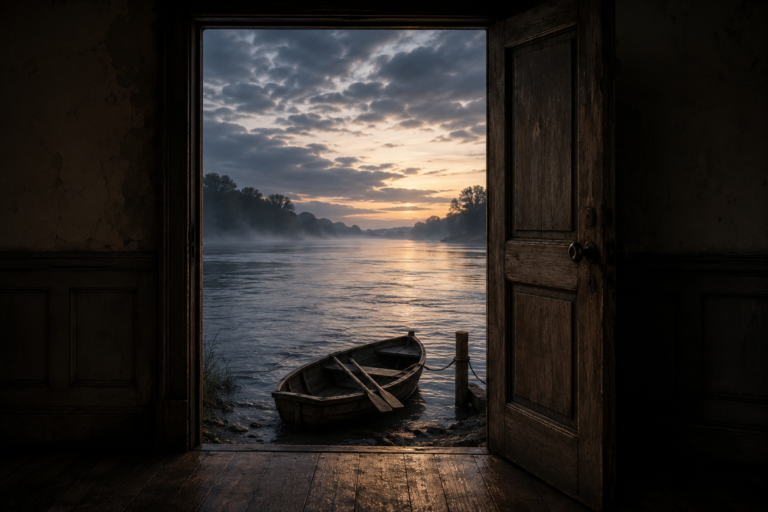
I still do not know what that something is. I have never known. A river and a canoe with no oars, I would later be shown when I asked—go with the flow. That is the entirety of the instruction I was given, and I have learned to be at peace with it.
Later, in the first hospital, when they could not stabilize me, I saw the end of my road. It was a black wall—both something and nothing, the simple terminus of the line, impossible to pass or go around. I had made my peace with it. And then the wall crumbled, and behind it was a horizon of gold and blue and red, a wide unending wash of light, and before me two paths. One ran on as far as I could see. The other ended abruptly, and I could sense what lay down it—what my ending there would mean for the people who would be left behind. It was not good. The grief of it was vivid. So I chose the path that continued, and from that moment I felt a change that was not subtle at all. The next day I was airlifted to the hospital that would save my life.
The third time was in the cath lab, at one of my lowest points, under sedation for a procedure. I came out of my body. At first it was exhilarating—I moved about the room, listening to the staff call out their numbers and measurements, and when I surfaced I had questions about things said while I was supposedly unconscious. The room appeared to me as black-and-white static, every object and person made of energy I could read. And off to one side, not part of the room, was a block of gold and silver light. It was watching me—I felt it, though it had no eyes, no form. From it came peace, and empathy, and an offer: the suffering could end now, if I chose it. Come, it said—and I marked the word even then, because it was come, not go. An invitation, not a command. Things had been bad enough that I wanted the end it offered. But the work was not finished, and I knew it. I declined, and felt something like a smile from beyond the shimmering curtain, and then I was pulled back into my body.
When I told Rabbi David about the gold and silver light, he recognized it. Within his tradition there is a slot for such a thing, and he named it: an angel. I understood why he said it, and I respect the framework he said it from. But I have never called it that, and I will not, because angel is his word and not my observation. What I observed was a block of gold and silver light that watched without eyes and offered without speaking. To call it an angel is to file it, to introduce a bias, to decide I know what it was when the honest truth is that I do not. I saw something. A man I trust calls it an angel. I decline to collapse the one into the other.
I should be equally honest about the other direction, because the discipline cuts both ways. There was a day, early, when I wrote to a friend that everything I had been reading as spiritual might be nothing of the sort—that it might be a misinterpretation seen through the dark lenses of poor health and a frightened ego. I genuinely entertained that. The practice is not only a refusal of religious explanation; it is a refusal of the easy skeptical one too. I did not resolve it. I held the doubt the way I hold everything else.
And then there is the one I can explain, which is why it belongs here. On my first full day after the transplant I was put on an epinephrine drip, and it produced in me a terror unlike anything I have ever known—a fear at a register I associate with comic-book villains, the kind that is engineered rather than felt. And precisely because it was so far past anything I have ever experienced, I knew it was not mine. I do not feel things like this, I thought, even inside it—therefore this is not coming from me, therefore it has a cause, therefore the thing to do is let it pass through and find out what it is. That is the whole practice in miniature, performed under the worst possible conditions: the terror was real, I did not deny it, and I did not drown in it either. I let it flow through me and observed it until I understood it was the drug. The point is not that I am brave. The point is that the same method works whether the thing has a chemical cause I can name or no cause I will ever find. Observe. Do not assign. Hold it intact.
The boulder in the flow
Here is the part I have never written down, and it is the reason for the rest.
For years I have understood existence, in the framework I actually live by, as flow. Energy, current, what the Kabbalists call shefa—the divine flow that moves through everything, blessing being the flow itself and curse being its blockage. I had been talking about exactly this with a close friend in the weeks before the crisis, turning over how a gate could close on shefa, whether the flow could be hindered at all. I had the language for it long before I needed it. I did not yet know I was going to need it.
They put the new heart in, and the body began its work of accepting it—the immune system’s long negotiation, the drugs that hold rejection at bay, the whole machinery by which a person’s tissue learns to stop calling a stranger’s organ an intruder. That part I expected. What I did not expect was that something else in me had its own version of the same problem, and no drug for it.
My energy would not flow right. I could feel it—not physically, though of course the physical was there too, the incision and the exhaustion and the rest. This was something else, the flow itself, and it was wrong. I lost the ability to meditate, which for me is not a small loss; it is the loss of the one instrument I have always been able to rely on to read my own interior. I would settle in and find that nothing moved the way it had moved my whole life. It was disordered, disorienting, and I could not explain it, and—true to the practice—I did not try to force an explanation. I observed. For months. It was, I will say plainly, quite something to sit inside.
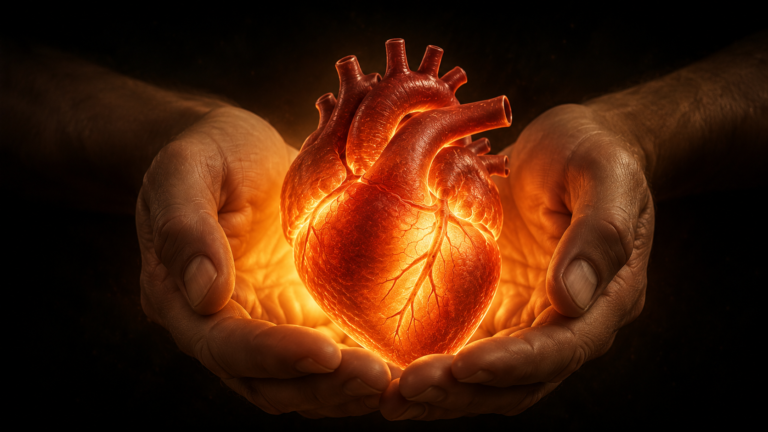
And then I understood it, and the understanding was almost embarrassingly simple, the way these things often are after they have cost you months. My energy was flowing around the new heart. Hitting it, bouncing off it, moving past it—but not through it. Someone had dropped a boulder into the middle of my essence, an enormous foreign stone right in the path of the current, and the flow was doing what water does at a boulder: going around. The heart was not yet part of me. Not the way the chart meant, where it was stitched in and beating and mine on every scan—but in the only way that mattered to the flow, it was still a stranger sitting in the riverbed.
The body had been saying not mine and slowly learning to say mine. I realized my flow was saying the same thing, and had to come to the same conclusion. The heart had to be integrated—taken into the current, made part of the essence, accepted by the energy the way the immunosuppressants were teaching the body to accept it. The soul, if you want to use that word, had its own rejection to work through, on its own schedule, with no medication to hurry it. So I did the only thing the practice allows. I observed it, I worked with what I observed, and I waited. And in time the current found its way through rather than around. The boulder became part of the riverbed. The flow ran whole again.
Much of my life has been lived under the sign of fire. I find myself now beneath the ebb of water. The canoe has no oars, and I have stopped wishing it did.
Approach
By any common definition, what I have described is a religious experience—the figure, the crumbling wall, the gold and silver light, the offers made and declined. People to whom such things happen tend to come out of them transformed in a particular and recognizable direction. They are born again. They join, they testify, they build their days around the certainty they were given.
I did not, and I have thought carefully about why, because the easy assumption is that I am holding back out of doubt. I am not. The experiences did not give me proof of something more, because I did not need proof. I always knew the something was there—it was the focus of my study for years, the unknowable source the Kabbalists call the Ein Sof, named unknowable for the excellent reason that it defeats our understanding. What the experiences gave me was not belief where there had been doubt. They simply removed the last sliver of room in which doubt could have stood. I knew the something was there before; now I know it past any possibility of pretending otherwise.
What I still do not have, and refuse to manufacture, is a name for it. To call it God, to call it the angel, to call it any of the things the traditions stand ready to hand me, would be to do the one thing my whole practice forbids: to take the thing I observed and file it where it fits, smaller and explained and no longer quite true. The traditions have their slots, and there is real wisdom in them. But I have seen what I have seen, and I will not call it anything but what it was.
So I do not convert. I do not conclude. I prepare for approach, and I approach with humility, which is the only posture that does not lie about how little I understand.
For now it is enough to stand at the back window and watch the snow come down, and feel the current running clean through a heart that is finally, fully my own, and think the simplest thing there is to think.
I’m still here.
Discover more from One More Beat
Subscribe to get the latest posts sent to your email.