While You Were Sleeping
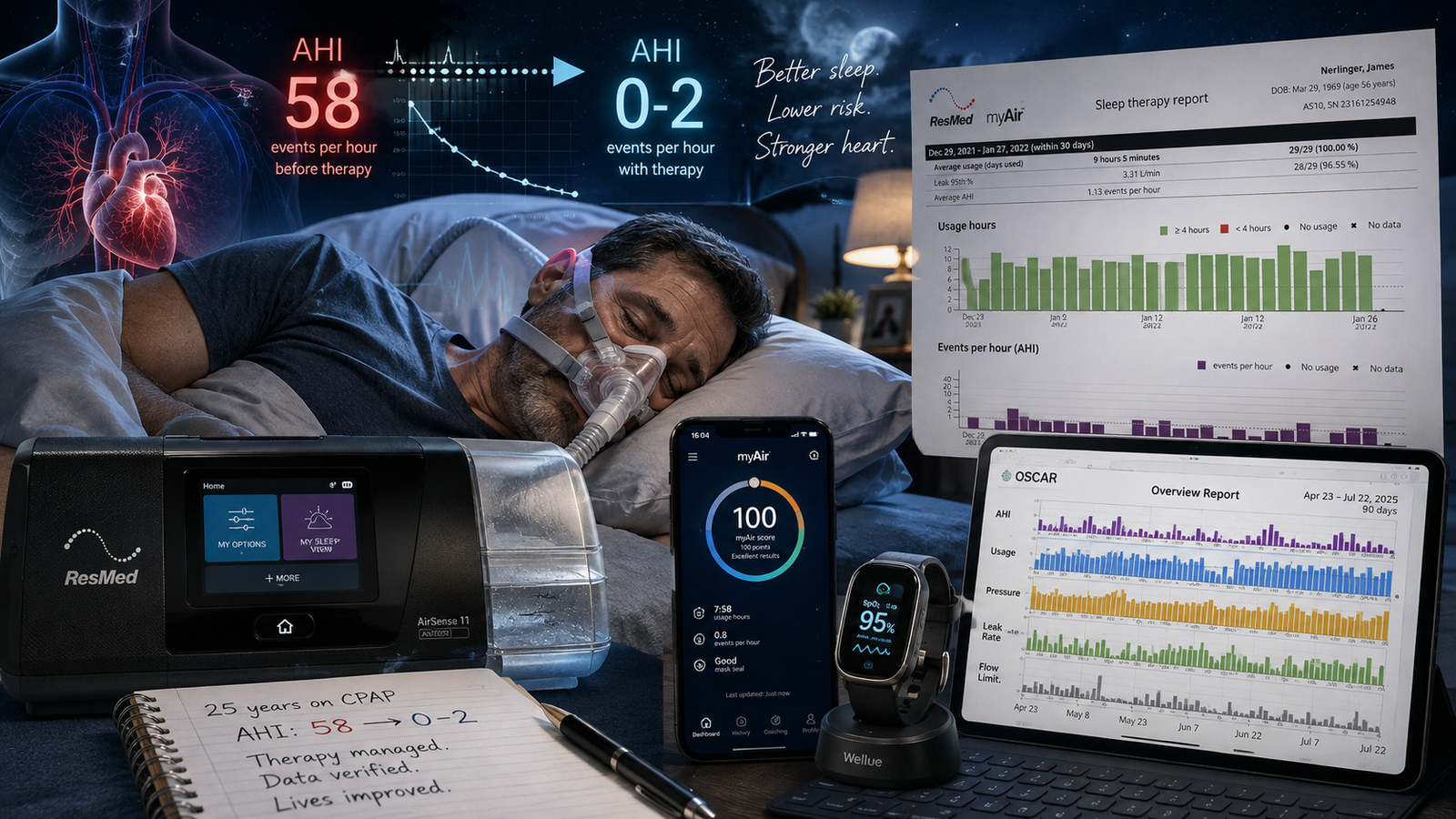
My number was 58.
In sleep medicine, that meant my AHI — the apnea-hypopnea index, the standard measure of severity — was 58. I stopped breathing, or breathed so little that it counted, nearly once every minute I was asleep. Fifty-eight times an hour.
That was roughly twenty-five years ago. Today, on a typical night, the number sits somewhere between zero and two.
I’ve been on CPAP — continuous positive airway pressure — therapy for the twenty-five years since, currently a ResMed AirSense 11 set to auto-adjust, though I’ve run it in fixed-pressure mode plenty of times over the years too — more on that distinction shortly. Understanding what happened between 58 and 2 means understanding what sleep apnea actually is, what it does to a heart specifically, and what a quarter-century of sleeping next to a machine has actually been accomplishing every night.
What Sleep Apnea Does to the Heart
The mechanism is a loop, and it’s worth walking through once, plainly, before any of the terminology.
You’re breathing. The airway narrows or collapses. Airflow drops or stops entirely. Oxygen in the blood falls; carbon dioxide rises. The brain registers the imbalance and sounds an alarm, triggering a burst of sympathetic nervous system activity that drives up heart rate and blood pressure and constricts peripheral blood vessels. That surge is what reopens the airway, often with a gasp or a brief arousal from sleep you may never remember in the morning. Breathing resumes. And then, sometimes within a minute, it happens again.
The problem isn’t any single event in that loop. It’s the repetition — dozens of times an hour, night after night, for years. Over time, that repeated surge stops being merely a sleep problem. It becomes a cardiovascular one. Untreated obstructive sleep apnea, or OSA, is associated with hypertension, arrhythmias, myocardial infarction, and heart failure, and the recurrent combination of hypoxia and sympathetic activation appears to be a large part of why. The arrhythmia risk is particularly notable for a cardiac readership: OSA is associated especially strongly with atrial fibrillation.
For heart failure specifically, the relationship runs both directions. OSA exposes the cardiovascular system to intermittent hypoxia, oxidative stress, systemic inflammation, exaggerated negative intrathoracic pressure, sympathetic overactivation, and elevated blood pressure, which can impair myocardial contractility and cause the development and progression of heart failure. And once heart failure is present, moderate to severe OSA has repeatedly been tied to worse outcomes and higher mortality. Untreated OSA doesn’t cause heart failure in any simple, direct line. It contributes to the conditions that produce it, and it makes an already struggling heart’s job measurably harder.
After the Transplant
If you’ve already had a transplant, the obvious question is why any of this still matters. The failing native heart that spent decades absorbing the damage is gone. Isn’t the apnea problem gone with it?
Not necessarily. Sleep apnea in heart transplant recipients has been studied directly, and the better-designed studies suggest it’s anything but rare. A polysomnography study of 45 heart transplant recipients found moderate-to-severe obstructive sleep apnea in 36% of the group. A separate, later cohort of 146 orthotopic heart transplant recipients similarly found OSA in more than a third of patients. But prevalence isn’t the finding that matters most. In that same cohort, patients with untreated OSA at the time of transplant had three times the risk of developing late graft dysfunction compared with those whose OSA was treated or absent — a hazard ratio of 3.2.
A significant driver is something many recipients experience after transplant: weight gain. In one series of transplant recipients referred for suspected sleep apnea, 16 of 17 — 94% — had gained weight after transplantation, by a mean of 10.4 kg. That’s not an isolated finding: a systematic review and meta-analysis of ten studies found a pooled average weight gain of 7.1 kg at twelve months post-transplant across all recipients, with the heaviest gains — averaging 10.4 kg — specifically in U.S. cohorts. Between steroids, changed metabolism, and the return of appetite after years of decline, post-transplant weight gain is common, and added weight around the neck and airway is one of the best-understood risk factors for obstructive sleep apnea in the general population as well.
When the Heart Itself Changes the Breathing
There’s a stranger chapter to this than ordinary obstructive apnea, and it’s part of my own story, not something I fully understood until researching this piece.
In the months before my transplant, as my ejection fraction fell toward 5%, my breathing pattern on CPAP changed. My AHI, which had been well-controlled on therapy for years, climbed back into the 30s — maddening, and clearly not an ordinary mask or pressure problem.
I suspected at the time that I was experiencing central sleep apnea associated with severe heart failure — Cheyne-Stokes respiration — and said as much to my sleep doctor. He dismissed the idea. I disagreed with him then, and the research behind this piece explains why I still do. Cheyne-Stokes respiration is a genuinely different mechanism from the airway obstruction that had defined my apnea for the previous two decades. Rather than a physical blockage, this pattern arises from instability in breathing control associated with severe heart failure. The key pathophysiological mechanism triggering Cheyne-Stokes respiration is hyperventilation and low arterial CO2 that, when it drops below the apneic threshold, triggers a central apnea. Prolonged circulation time and hypoxemia contribute to the pattern, and it’s specifically tied to how severely compromisedthe heart’s pumping function has become — it’s associated with a lower ejection fraction, as well as a worse functional class. This isn’t rare in advanced heart failure: in patients with stable severe heart failure, Cheyne-Stokes respiration has been described in 30 to 50% of patients.
There’s direct heart-transplant evidence for that connection, and it’s considerably stronger than anything drawn from a different organ. Researchers performed polysomnography on 29 patients with dilated cardiomyopathy and documented Cheyne-Stokes respiration before heart transplantation — their pretransplant ejection fractions ranged from 8 to 19% — then repeated the studies three to nine weeks after transplant specifically to see what happened once cardiac function was restored. Ejection fraction rose to a mean of 64% after transplant, and 23 of the 29 patients showed no further evidence of periodic breathing at all. Six still did, which is its own honest finding — restoring the heart resolves the pattern in most cases, not universally. Other published cases describe the same broad shape: central apnea tied to severe heart failure disappearing once graft function normalizes, including reports in both adult and pediatric transplant recipients.
My own resolution came the same way. Once I had a new heart, the pattern didn’t return. I haven’t experienced anything resembling that period of climbing numbers since. My most recent OSCAR report, covering ninety-one days, tracks Cheyne-Stokes Respiration as its own explicit metric — and it reads 0.00 throughout. I can’t prove a direct causal line any more precisely than the studies above can for their own patients, and I’m not going to pretend more certainty here than the research itself offers. But the pattern — apnea reshaping itself around the failing heart, then settling once the heart was replaced — lines up with everything the literature describes.
Apnea, Hypopnea, and Severity
Sleep apnea comes in three types. Obstructive — the most common by far — happens when the upper airway partially or fully blocks while sleeping; the chest and diaphragm keep working, but the airway won’t cooperate. Central is the opposite mechanism: no effort at all, because the brain isn’t sending the signal to breathe, as with the Cheyne-Stokes pattern above. Mixed combines both, beginning as a central event and evolving into an obstructive one within the same episode.
Hypopnea is the partial version: a reduction in airflow rather than a full stop, generally defined as at least a 30% drop for at least ten seconds, with a measurable oxygen drop or arousal. A full apnea means airflow reducing by at least 90%. Apneas and hypopneas are counted together into AHI, and the AASM’s severity bands are consistent across the field: below 5 is normal, 5 to 14 is mild, 15 to 29 is moderate, 30 or more is severe. My 58 wasn’t a borderline case. It was nearly double the threshold for severe. Put differently, I wasn’t occasionally having trouble breathing in my sleep. Untreated, I was having a qualifying respiratory event roughly every sixty-two seconds.
AHI has a real limitation worth understanding before the O2Ring section later: it counts how often events happen, not what those events did to your oxygen levels while happening. Two people can post identical AHIs and have meaningfully different oxygen desaturation, because AHI doesn’t capture the depth or duration of the drops — only that a qualifying drop occurred. AHI tells you the frequency. Oxygen data tells you something about the severity of what those individual events cost your body, which is a different and complementary question.
One more term worth knowing: treatment-emergent central sleep apnea, sometimes called complex sleep apnea, is a distinct phenomenon from what I experienced above. It’s a type of central sleep apnea that can develop after starting PAP therapy for OSA, in roughly 5% to 15% of new users, usually resolving on its own within weeks to months. Unlike my own case, it isn’t tied to advancing heart failure — it’s a separate, generally self-limiting response to starting treatment, and in some cases the cause can’t be identified at all. Worth knowing if your own numbers shift unexpectedly after starting therapy — it’s a different story from mine, but a real one.
Getting Diagnosed
The gold standard for diagnosis remains in-lab polysomnography — an overnight, technician-monitored study that measures brain activity, eye movement, muscle tone, airflow, effort, and oxygen simultaneously. It’s comprehensive, and it’s also expensive, less accessible, and inconvenient enough that many people never complete one.
Home sleep apnea testing (HSAT) has become the more common entry point for adults with a high likelihood of moderate to severe OSA, and it’s endorsed for that use: the American Academy of Sleep Medicine advisesusing a technically adequate home sleep apnea testing device for diagnosing OSA in uncomplicated, high-risk adults. The honest tradeoff is accuracy at the margins — at-home tests can underestimate the severity of sleep apnea by calculating an hourly rate that appears lower than it really is, largely because in-lab polysomnography can distinguish sleep from wake precisely, while home devices generally can’t. A broader review of the evidence found home sleep apnea tests are an appropriate diagnostic tool for adults with high pretest probability of moderate to severe OSA, though the severity of mild and moderate disordered breathing might be underestimated — which matters, because that underestimation can affect what treatment gets prescribed.
CPAP, APAP, BiPAP
These three terms get used almost interchangeably in casual conversation, and they shouldn’t be.
On many modern machines, including my AirSense 11, CPAP and APAP are two modes of the same hardware. The difference is a setting, not a different device. CPAP delivers one continuous fixed pressure all night. APAP — auto-adjusting positive airway pressure — automatically adjusts within a range, responding breath by breath to what your airway is actually doing. My own AirSense 11 has spent years running in both modes, depending on what my care team and I decided made sense at the time; it’s the same device either way, just a different pressure strategy.
BiPAP — bilevel positive airway pressure — is a genuinely different machine. Rather than one pressure or an auto-adjusting single pressure, it delivers two fixed levels of air pressure: a higher pressure when you inhale and a lower pressure when you exhale. It tends to come up when a single CPAP pressure becomes hard to tolerate, when higher pressure requirements make exhaling against the airflow genuinely difficult, or in certain central and complex apnea situations — though I’d avoid treating any single pressure number as an automatic trigger for switching machines. That’s a conversation for a sleep physician working from your actual titration data, not a threshold to self-diagnose against.
Adaptive servo-ventilation, or ASV, is a further specialized variant worth a careful, current mention given this readership specifically — because the evidence on it has genuinely changed shape.
The old evidence: for roughly a decade, ASV carried a firm warning against use in heart failure patients with reduced ejection fraction and predominant central sleep apnea. That warning stemmed from the 2015 SERVE-HF trial, which found a significant increase in risk of cardiovascular death in that specific population using an early-generation device, and it produced a standard-level recommendation against ASV in patients with an ejection fraction of 45% or below and moderate or severe central apnea.
The newer evidence and guidance: subsequent research produced a different result, and the AASM published an updated central sleep apnea clinical practice guideline in 2025 that replaces the old blanket caution with a conditional recommendation: ASV is now an option even in heart failure with reduced ejection fraction, provided it’s used at centers with experience and with close monitoring and follow-up. That’s a meaningfully more permissive, and more current, position than the flat 2016-era warning. If ASV comes up with your own team, it’s worth knowing the guidance changed in 2025, not merely “might be changing.”
The Part You Actually Have to Wear
None of the above matters if the mask defeats you, and after twenty-five years, I’ve worn most of what’s available.
Nasal pillows — small cushions that seal directly at the nostrils — are the least intrusive option, and they’re my own long-term preference. They avoid the claustrophobic feeling a larger mask can produce, and they let you sleep on your side or stomach without much interference. Their weakness is high-pressure tolerance; at higher settings, some people find the direct nasal pressure uncomfortable.
Nasal masks, covering the whole nose, distribute pressure more gently and tend to handle higher settings better, at the cost of more surface area to potentially leak or shift overnight.
Full-face masks, covering nose and mouth, exist for a specific and important reason: mouth breathing. If your mouth falls open and stays open during sleep, a nasal-only interface can lose much of its effectiveness, since the pressurized air escapes through the mouth instead of maintaining the intended airway pressure. If you wake up with a dry mouth and throat despite a properly fitted nasal mask, that’s one common clue. A chin strap, which keeps the jaw closed without switching mask types entirely, is a lighter-weight fix worth trying before jumping to a full-face mask, which most people — myself included — find considerably less comfortable to sleep in for years on end.
Leak management is the unglamorous, unavoidable maintenance work of CPAP therapy. Cushions age, seals degrade, and what fit perfectly a year ago may not fit the same way now. A heated humidifier, standard on most modern machines including mine, can substantially reduce the dry-airway irritation that leaks and mouth breathing both cause, and it’s worth using even if you don’t think you need it — the difference is more noticeable after the fact than while it’s happening.
None of this is complicated, and none of it is optional. Perfect pressure settings delivered through a mask you can’t tolerate for eight hours accomplish nothing. Comfort isn’t a luxury add-on to this therapy. It’s the difference between therapy that works and a machine gathering dust on the nightstand.
The Parts That Wear Out
Every component in this system has a service life, and most of them are shorter than people assume.
This matters more for an immunosuppressed reader than for the general CPAP population, and not for the reason you might expect. The concern isn’t that a neglected machine will make you sick — there’s no good evidence supporting that claim, and I’m not going to manufacture one. It’s that a humidifier chamber holds standing water in a warm room for eight hours a night, tubing stays damp between sessions, and both are attached to your airway. Basic hygiene on equipment that intimate is prudent for anyone. When your immune system is deliberately suppressed, prudent stops being optional.
One clarification worth making, since it’s widely misunderstood: the intake filter on your machine is a dust and particulate filter. It protects the device and cuts down on what gets pulled in from the room. It is not a sterilizing filter, and it is not an infection barrier. Change it because a clogged filter degrades airflow and pulls the motor harder, not because you believe it’s screening pathogens.
Keeping It Clean
The daily work is small. Empty the water chamber every morning rather than letting water sit through the day, wipe it out, and let it air dry away from direct sunlight. Refill at night with fresh water — distilled if your chamber specifies it, which most do, because tap water leaves mineral scale that builds into a film you’ll eventually be scrubbing at.
The mask cushion or nasal pillows get wiped daily as well. Mild soap and warm water, rinsed and air-dried, is the manufacturer-standard method and it works. Skip anything with moisturizers, conditioners, antibacterial additives, or fragrance — those leave a residue that both irritates skin and degrades silicone. Alcohol does the same thing faster, drying and stiffening the cushion until it stops sealing, so if you use pre-moistened wipes for convenience, check that they’re alcohol-free. Most products sold specifically as CPAP mask wipes are.
Weekly, the chamber gets a deeper clean. A soak in equal parts white vinegar and warm water for twenty or thirty minutes handles both mineral scale and general film, and it’s the method most users land on. Rinse it thoroughly afterward — vinegar residue in a heated chamber produces a smell you will not enjoy at two in the morning. Tubing gets washed weekly in warm soapy water, rinsed, and hung to dry with one end elevated so water runs out rather than pooling in the low spot. Headgear gets hand-washed and air-dried.
Two things to avoid. Don’t run any of it through the dishwasher, whatever the internet tells you — heat warps the plastics and destroys the silicone. And be skeptical of ozone and ultraviolet cleaning devices. The FDA has issued a safety communication on these, noting they aren’t approved for the purpose and that ozone in particular can damage equipment and pose a respiratory risk. Soap, water, and vinegar do the job for a fraction of the cost and none of the questions.
The Schedule
The intervals below are the ones most suppliers and manufacturers work from, and they line up closely with the Medicare replacement schedule that many private insurers mirror.
Mask cushions and nasal pillows carry the shortest life — roughly every two weeks to a month, depending on the type. Silicone breaks down against skin oils, and a cushion that’s lost its seal is the single most common cause of the leak numbers creeping up in your data. Full-face cushions run about a month.
Mask frames and standard tubing run about three months. Tubing develops micro-tears at the cuff ends long before anything is visible.
Headgear, reusable filters, and the humidifier water chamber run about six months. Headgear stretches, and stretched headgear gets compensated for by overtightening, which produces pressure sores rather than a better seal. A chin strap, if you use one, sits on the same six-month interval.
Disposable filters are monthly, and the coverage schedule generally allows two per month.
Cleaning extends none of this. It keeps the parts usable through their intended life; it doesn’t buy you additional months.
How Long the Machine Itself Lasts
The commonly cited figure is five years, and it’s worth understanding where that number comes from. Five years is Medicare’s reasonable useful lifetime for durable medical equipment — a coverage construct that determines when you become eligible for a replacement. It is not an engineering estimate, and it is not a failure date. Plenty of machines run well past it without complaint.
The more informative number is cumulative run hours, because five years at four hours a night and five years at eight hours a night are not the same machine. Most units track this internally, and the blower motor has a typical service life expressed in hours rather than years. Some machines will display a motor-life notification once that threshold is passed. The device continues to run, but it’s a signal to start the replacement conversation rather than wait for a failure at three in the morning.
That hour count usually lives in the clinical menu, which is not somewhere most users should be poking around — pressure settings live in there too. Your DME provider or sleep clinic can read it for you, and will, if you ask.
What Gets Covered
Coverage generally follows the replacement schedule rather than running on demand. Cushions and filters become eligible monthly, mask frames and tubing quarterly, headgear and water chambers semi-annually, and the machine itself at the five-year mark. Specifics vary by plan, and it’s worth confirming your own rather than assuming.
The practical wrinkle is that eligibility resets whether or not you order. Supplies you don’t request in a given window are simply not supplied, and there’s no accrual. This is why nearly every supplier runs an automated resupply program, and why signing up for one is the difference between replacing parts on a schedule and replacing them when something finally fails.
Twenty-five years in, I’ve learned that the maintenance is the therapy. A machine running on a two-year-old cushion and a filter nobody’s looked at is not delivering the therapy it was prescribed to deliver, and the data won’t always tell you that clearly enough to notice.
The Wellue O2Ring-S
I’ve used the Wellue O2 Ring for years now as a supplemental data source alongside CPAP, and the framing I’d offer is simple: CPAP tells me what the machine saw. The ring tells me what my oxygen actually did.
It’s a purpose-built device, not a general wellness wearable, and that distinction matters. It’s worn only during sleep, isn’t designed or comfortable for all-day wear, and needs regular charging — this isn’t a 24/7 ring like the ones in the general wearables piece. What it does is narrow: continuous overnight pulse oximetry, tracking blood oxygen saturation and pulse rate through the night.
On accuracy specifically, since I don’t think a device deserves a pass on scrutiny just because I like it: independent clinical validation found the O2Ring-S performed reasonably well at identifying moderate-to-severe apnea, with 87.3% sensitivity and 78.7% specificity for an AHI of 15 or greater when compared against in-lab polysomnography — useful screening performance, though notably short of diagnostic-grade accuracy. That’s an important distinction the manufacturer itself makes plainly: the O2Ring-S is not a medical device and isn’t intended for medical use — it’s marketed for sports and aviation applications. Nevertheless, tracking SpO2 and heart rate data can be a valuable starting point for gathering information, talking with your doctor, and finding or addressing potentially serious medical conditions.
What it adds specifically alongside CPAP is the oxygen-burden context AHI alone can’t give you. Your CPAP report will tell you how many events happened. The ring tells you what your actual oxygen saturation was doing during the parts of the night the CPAP data doesn’t capture as directly, and it does this session by session rather than as a nightly summary alone — average SpO2, oxygen level distribution across bands, drop frequency, pulse rate range. It’s not a diagnostic device, and it doesn’t replace a sleep study. It’s a second, complementary stream of data alongside the machine that’s actually treating you.
OSCAR vs. the Generic Apps
Here’s where the amount of available data escalates sharply, and it’s worth walking through the actual progression rather than describing it abstractly.
At the simplest end, a ring like RingConn will flag sleep apnea risk as close to a single data point: an AHI number and a binary read — abnormalities detected, or not. Useful as a screening nudge. Not remotely detailed.
ResMed’s own myAir app, the default companion for AirSense machines, isn’t much richer. It shows usage hours and average AHI as simple bar charts across rolling 30, 90, and 365-day windows. That’s genuinely useful for tracking whether you’re using the machine consistently — which insurance and your care team both care about — but it stops well short of showing you what actually happened on any given night.
The Wellue app, as described above, goes considerably further per session: oxygen range and distribution, pulse rate range and distribution, drop frequency by threshold. Real physiological detail, still bounded by what a single pulse oximeter can measure.
Then there’s OSCAR — the Open Source CPAP Analysis Reporter, a free, community-maintained program that reads the raw data straight off your machine’s SD card rather than the simplified summary the manufacturer’s app shows you. The manufacturer’s app hands you a score. OSCAR hands you everything the machine actually recorded: AHI broken down by event type — obstructive, central, hypopnea, unclassified — pressure delivered throughout the night, leak rate, minute ventilation, respiratory rate, tidal volume, flow limitation, and, notably given the discussion above, Cheyne-Stokes Respiration tracked as its own explicit metric. My own most recent ninety-one-day OSCAR report shows exactly that kind of granularity — and confirms zero Cheyne-Stokes activity throughout, which is the most concrete evidence I have that whatever was happening before transplant hasn’t returned.
The honest warning that comes with all of this: OSCAR is genuinely a lot. It’s easy, and common, to open it for the first time and feel completely lost in the volume of charts and numbers. That’s a real and reasonable reaction, not a sign you’re doing something wrong.
One practical note if you’re on the same machine I am: the AirSense 11 doesn’t ship with an SD card installed by default, since ResMed expects most users to rely on the cellular connection to myAir instead. If you want OSCAR-level detail, you’ll need to buy a card separately and insert it yourself — mine has been installed for years now, which is the only reason I have the reports referenced throughout this piece.
And the same caution that applies to every device discussed in the companion piece to this one applies here with even more weight: reading your own data is genuinely valuable. Adjusting your own pressure settings based on what you see in OSCAR is not something to do without your care team involved. The data can inform the conversation. It shouldn’t replace it.
Fifty-Eight Became Two
Twenty-five years later, the machine beside my bed is newer. The mask has changed more times than I can count. The algorithms are better, and the data is far more accessible than it used to be.
The important number, though, is much simpler than any of that.
Fifty-eight became two.
The machine didn’t cure sleep apnea. It did something considerably more useful: night after night, for twenty-five years, it stopped sleep apnea from doing what it would otherwise have done. Making sense of the growing pile of data these devices generate — CPAP, oximetry, and whatever comes next — is exactly the gap I’m building Aevora Wellness CPAP to close, the same project referenced in the companion piece on wearables. Understanding your own therapy isn’t about chasing a perfect number every night. It’s about knowing enough to recognize when something’s actually changed, and trusting the rest to keep doing its quiet, unglamorous work while you sleep.
Discover more from One More Beat
Subscribe to get the latest posts sent to your email.