
Intimacy and the Transplant Recipient’s Psyche
The central problem is not dysfunction.
It is silence.
Not the silence of indifference—the silence of two people each trying to protect the other from exactly what the other is already thinking. The recipient who doesn’t raise the question of desirability because they don’t want to make their partner feel obligated. The partner who doesn’t name their fear because the recipient has already been through enough. The result is two people sitting in the same room, carrying the same unspoken weight, each convinced the other doesn’t share it.
This is that silence. What lives inside it. What it costs. And what becomes possible when it ends.
The Body That Came Back
Before intimacy between two people is possible, something has to happen first: the recipient has to find their way back into their own body.
This is harder than it sounds.
After transplant, the body stops feeling entirely private. It has been cut open, observed, catheterized, biopsied, monitored, scanned, measured, medicated, and discussed by committees—for months. The body that used to feel like a private interior becomes, at least in part, institutional. It is no longer simply inhabited. It is managed. The recipient who comes home from the hospital is not returning to their body so much as negotiating reentry into a body that has spent months belonging, in various practical senses, to someone else.
And then there is the surveillance problem.
After transplant, the body becomes suspect. Every sensation gets interrogated. Chest discomfort—is this rejection? Fatigue—is this infection? A skipped beat, a fever, an unfamiliar ache—should I call the coordinator? Is this serious? The body that once generated sensation without editorial comment now generates sensation that requires immediate clinical evaluation. The recipient stops inhabiting the body and starts monitoring it.
This creates a specific conflict that medicine rarely names: pleasure requires presence, and hypervigilance makes presence extraordinarily difficult. A person who is surveilling their body for signs of rejection is working against the state that intimacy asks for. The two neurological states are structurally at odds. This is not a failure of desire. It is a consequence of months spent in a state where paying attention to every physical signal was not anxiety—it was survival.
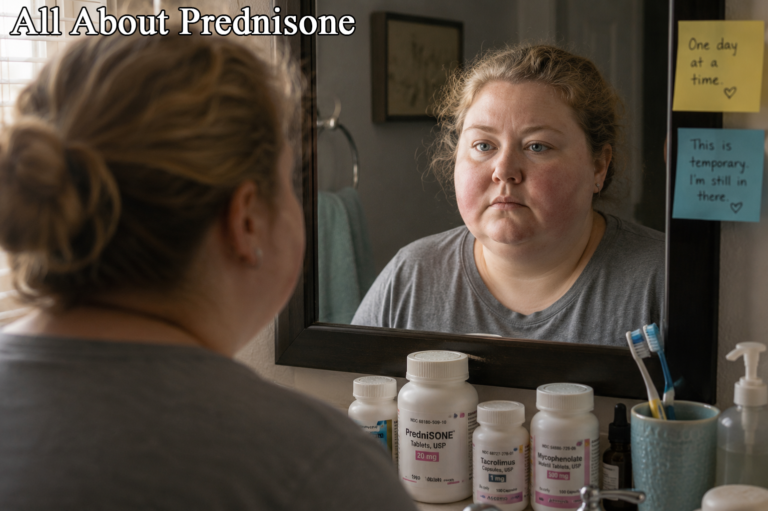
Add to this what the mirror shows. The scar from sternotomy. The weight that prednisone added, often rapidly, in the early months. The hair loss that some medications produce. The muscle mass that months of limited activity took. The body that looks back is not the body that went into the hospital, and the recipient knows it—sometimes before they are ready to know it.
Reclaiming the body for pleasure, after all of this, is its own process. It does not happen automatically when the discharge paperwork is signed.
The Person Who Existed Before
There is a grief that transplant recipients carry that rarely gets named as grief, because the thing being mourned is not a person and not a relationship but a self.
The person who existed before the transplant—the one who moved through the world with a different relationship to their body, to time, to physical certainty, to the future—is not the person who came home. Not dead. But changed in ways that are difficult to inventory and more difficult to explain.
The old assumptions are gone. Physical invulnerability—the ordinary unconscious confidence that the body will do what it is asked—is gone. Future certainty is replaced by a different relationship to time that borrowed time produces and that no one who has not lived it fully understands. The bodily trust that made it possible to inhabit physical experience without constant meta-commentary is gone, replaced by the surveillance described above.
The self who knew how to inhabit intimacy existed within those assumptions. That self understood, without thinking about it, how to be present in a body, how to give and receive physical pleasure, how to be vulnerable without it feeling like exposure of something damaged. That knowledge is not erased. But the ground it stood on has shifted, and finding solid footing again takes time that nobody officially allocates.
This is not the same as body image, though body image is part of it. It is not the same as trauma, though trauma is part of it. It is something more fundamental—the experience of discontinuity between the self who existed before and the self who exists now, with no map for the territory in between.
Recipients who find their way through this often describe it as a slow reacquaintance. Not with the body as it was, but with the body as it is—different, marked, medically managed, and still capable of being home.
What the Recipient Is Actually Thinking
No clinical softening. These are the questions running underneath the surface of every intimate encounter post-transplant, whether with a long-term partner or someone new. They are rarely said aloud. They are widely felt.
Am I still desirable? The scar, the weight, the changed body—do these make me someone a person would choose, given the choice?
Am I defective now? Not broken in the mechanical sense—but defective in the deeper sense of a person who required extraordinary intervention to continue existing. A person whose body could not sustain itself without outside help.
Am I permanently medical now? Is this all anyone sees when they look at me? Not a person—a patient. Not a partner—a condition.
Am I fragile? Will I be handled rather than held? Treated as something that might shatter rather than someone fully present?
Can I even have sex safely? The immunosuppression creates genuine uncertainty—infection risk, physical exertion, what the transplant team has and hasn’t said. Many recipients leave the hospital without a clear answer and fill that clinical silence with worst-case assumptions.
The two-flights-of-stairs rule of thumb circulates widely, and the American Heart Association reports it and then cautions against it: the studies behind it were done mostly in young married men, and the comparison may not hold for anyone older, less fit, or living with cardiovascular disease. The threshold it offers instead is the ability to exercise at three to five metabolic equivalents without angina, excessive breathlessness, ischemic ST-segment changes, cyanosis, hypotension or arrhythmia—a Class IIa recommendation at Level of Evidence C, which is expert consensus rather than trial data, and written for cardiovascular disease broadly rather than for transplant. The same statement says anxiety about sexual activity should be assessed in patients with cardiovascular disease, and names cardiac transplantation among the settings where that anxiety sits with the partner as much as with the patient. If the question hasn’t been asked, ask it.
Will anyone want me knowing the graft has a finite lifespan? That question is not abstract. It sits in the room.
Does my partner still want me now that I carry someone else’s heart? This one is more complex than it appears. Some recipients feel the donor’s presence in ways that are difficult to articulate—a sense of something altered in their bodily selfhood, a weight of obligation to a person who died so that they could continue, a complicated relationship to pleasure when it is experienced in a body that can feel, in some irreducible sense, like it belongs to two people. Intimate moments can carry that presence. Not always. Not for everyone. But enough recipients describe it that it belongs here, named directly, rather than left in the category of things too strange to mention.
What if I can’t perform? What if I’m not turned on the way I used to be? Here the question is not mechanical—it is existential. What does it mean about who I am if my body no longer responds the way it used to?
What the Partner Is Actually Thinking
The other side of the silence. Named with equal directness.
I don’t want to be the one who kills him. This has been said out loud, by real partners, in real conversations. It deserves to be named plainly because it is almost certainly being thought silently by partners who have never said it. The fear of physical harm—overexertion, infection risk, something going catastrophically wrong—sits in many partners even after the transplant team has cleared the recipient for normal activity. It is rarely asked about and rarely addressed. It should be.
I saw him in that bed, and I can’t unsee it. The image of the person they love—intubated, sedated, surrounded by equipment, reduced to a body being managed by machines—does not simply dissolve when the recipient comes home. It sits in the partner’s psyche and reshapes how they perceive the recipient’s body. That image change is real. It affects desire. It affects touch. It affects what the partner sees when they look at the recipient—and the recipient, who does not know this is happening, may interpret the partner’s distance as rejection or lost attraction when it is something else entirely.
She’s not the same person who went into the hospital. The personality changes—documented, real, and in the early months often driven by the neuropsychiatric effects of high-dose prednisone—land differently on the partner than on the recipient. The recipient experiences the changes from inside. The partner watches a person they thought they knew behave in ways that feel foreign. One spouse described it as waking up to a different person every day. Another said, nine years out, that she was still not sure it was fully possible to stop being a caregiver and simply be a wife again.
Someone died so he could be here. Some partners carry the donor’s presence as directly as the recipient does, and it lands differently from that side. For the recipient it registers as obligation. For the partner it can become a third presence in the room—the awareness that the person they are touching is alive because someone else is not. It sometimes surfaces as a question about wholeness: whether the recipient is entirely the person they were. Most partners never say it. Some do, and the recipient who hears it has nothing to argue with, because the premise is not wrong so much as out of order. The donor’s decision was made in advance of the death. Nobody died in order for a transplant to happen. That is a correction a partner can actually receive—and one of the few available in this territory.
I can’t say what this cost me. The partner’s own experience—the fear, the helplessness, the sustained effort of keeping everything running while someone they love was in the hospital—often goes unnamed because it feels wrong to claim suffering when the recipient is the one who nearly died. This is disenfranchised grief: real, present, and without a socially sanctioned outlet. When the recipient finally returns to health, the partner sometimes falls apart—not from weakness, but because holding on for that long required a form of suspension that cannot be maintained indefinitely. One husband described his wife finally collapsing after he went back to work, and understood it as expected and necessary. He had been gone, in the ways that mattered, for a very long time. The relief of his return made space for everything she had been holding. (Dew et al., 2004)
The Trauma Layer
Both people in this room have been through something that leaves a mark. The psychological literature on heart transplant recipients documents this clearly. A prospective study of 191 heart transplant recipients found cumulative three-year rates of major depressive disorder at 25.5 percent, transplant-related PTSD at 17 percent, and any assessed psychiatric disorder at 38.3 percent. (Dew et al., 2001) The subtler effect on intimacy receives less clinical attention than these numbers suggest it deserves: the hypervigilance that follows medical trauma makes inhabiting the body for pleasure structurally difficult. The body has become a surveillance subject. Pleasure requires presence. Hypervigilance makes presence extraordinarily difficult.
High-dose prednisone in the early months contributes its own particular damage to the relational picture. The neuropsychiatric effects of corticosteroids are well-documented—mood lability, irritability, personality changes, sleep disruption, and in higher doses, frank psychiatric episodes. (Psychiatric Adverse Effects of Corticosteroids, Mayo Clinic Proceedings) These effects are pharmacological in origin, not character. More than one recipient in this community has described themselves as a bear to be around in those early weeks. More than one partner has described watching a person they loved behave in ways they didn’t recognize. Naming this as a drug effect gives both people somewhere to put it that isn’t each other.
The partner has witnessed something that occupies its own psychological category—one that is rarely named as trauma because the recipient survived. A study examining 142 family caregivers of heart transplant recipients found that 7.7 percent met full DSM criteria for transplant-related PTSD during the first year post-transplant, with an additional 11 percent classified as probable cases—rates comparable to those seen in recipients themselves. By three years post-transplant, cumulative rates of any psychiatric disorder in caregivers reached 56.3 percent. (Stukas et al., 1999; Dew et al., 2004) The relief that the recipient survived does not erase what the partner witnessed and carried. The trauma is real even when its object is still alive.
The Silence That Compounds Everything
The fears on both sides are real. What makes them worse is that neither side names them—because each is trying to protect the other from exactly what the other is already thinking.
The recipient doesn’t raise the question of desirability because they don’t want the partner to feel obligated to perform reassurance. The partner doesn’t name their fear of causing harm because the recipient has been through enough. The partner doesn’t name their grief for the relationship as it was because that grief feels like a betrayal of someone who almost died. The recipient doesn’t name the donor’s presence because it sounds like something that couldn’t possibly make sense to anyone who wasn’t there.
Two people. Same room. Same weight. Neither speaking.
The research on couples navigating chronic illness and post-transplant recovery consistently documents that open communication about sexual and relational changes produces better outcomes—not just in sexual function, but in relationship satisfaction and psychological wellbeing for both partners. A meta-analysis of 93 studies found moderate but consistent associations between sexual communication quality and both relationship and sexual satisfaction across populations. (Mallory et al., 2019) The silence is not protective. It is corrosive. It does not spare the partner from the recipient’s fear. It simply ensures that the fear remains unaddressed.
Dating After Transplant
The preceding sections address people who already share a history. There is another population this series cannot overlook: the recipient who is single—either because they were single going in, or because the transplant period ended the relationship that existed before it.
For the coupled recipient, the work is renegotiation—returning to an existing architecture that has been structurally altered and finding out what it can still hold. For the single recipient, the work is different: deciding when and how to hand the blueprint of their life—including its medical dimensions—to someone who has never seen the plans.
The disclosure question is one of the most practically difficult aspects of post-transplant life for single recipients, and it receives almost no guidance from the transplant system.
When do you disclose? The community answers vary. Some recipients tell every potential partner immediately, because the transplant is central to who they are and they will not hide it. Some wait until a few dates in, once they have a sense of whether the person is worth the vulnerability of the full conversation. One woman describes her approach: she says she had a heart transplant, that she takes medication every day to protect her heart, and that she lives a happy and healthy life. Then she stops. She has decided the full medical history is not owed to a stranger on a second date. If it bothers them, they are not her person. She is not convincing anyone to date her. There is wisdom in that. The disclosure does not have to be a medical briefing. It can be a single honest sentence that tells the truth without requiring the other person to process everything at once.
The pity response. Recipients who have had this conversation describe a specific reaction they dread: the glazed eyes, the slow nod, the “aww” that signals the other person has reclassified them from a potential partner to a patient deserving of sympathy. It is not malicious. It is the response of someone who has no frame for what they are hearing. It is also, for many recipients, worse than anger would be. Being seen as a tragedy rather than a person is its own particular hurt.
Ghosting. It happens. Some people hear “heart transplant” and disappear. This is painful but clarifying. The recipient who gets ghosted after disclosure has not failed at anything. They have learned something quickly about someone who was not capable of what the relationship would have required.
The borrowed time question in new intimacy. Is it fair to begin something with someone when the timeline is genuinely uncertain? Recipients ask this, usually alone. The answer the evidence and the community point toward is this: the timeline is uncertain for everyone. It is more visible for transplant recipients, and that visibility changes things—but it does not make beginning something unfair. The man who married his wife knowing she would need a second transplant, and who watched her die from a blood infection two months later, said he knew what he was getting into and loved her every minute. That is one answer to the borrowed time question. Not the only one. But an honest one.
Fear of rejection—literal and figurative. The immunological rejection that the medications work daily to prevent and the social rejection that disclosure might produce share more psychological territory than is comfortable to acknowledge. The single transplant recipient navigating new intimacy is doing two forms of the same high-stakes work simultaneously: maintaining a pharmacological regimen to keep their own body from rejecting a foreign gift, while offering an altered self to another person who might reject them. Both require courage. Both happen largely in silence. Neither gets much acknowledgment from the transplant system or anywhere else.
What Actually Helps
Not a list. What the evidence and the accumulated experience of people who have navigated this actually show.
Named fears lose power. The fears on both sides are more manageable once they have been said aloud—not resolved, but named. The partner who can say “I’m afraid of hurting you” and the recipient who can say “I’m afraid you don’t see me the same way anymore” have given each other something to respond to. Silence has no response. Stated fear does. This does not require a formal conversation or a therapy session. It can be a single sentence. The sentence is the thing.
The transplant team is an underused resource. Most teams will address questions about physical activity, infection risk, resuming intimacy, and medication timing if asked directly. Many patients and partners don’t ask—because the subject feels too personal for the clinical setting, or because nobody signals that it is an appropriate question. It is. Ask it. The questions have answers.
Prednisone effects are real, neuropsychiatric, and temporary. The mood volatility of early high-dose prednisone is pharmacological, not character. Knowing this in advance—both partners knowing it before the difficult weeks—changes how both people interpret what is happening when it arrives. It does not make those weeks easier. It makes them survivable as a couple rather than as a verdict.
Professional support is not a last resort. Couples counseling with a therapist familiar with medical trauma and chronic illness, sex therapy, transplant-specific psychological support—these exist, they are underutilized, and they are most useful before the damage accumulates rather than after. The couple doing quarterly check-ins with a therapist not because anything is wrong but to ensure nothing is being missed are doing something the transplant system should recommend routinely and almost never does.
For single recipients: the right person may stay—and the wrong person leaving early is painful but clarifying. The transplant is part of who the recipient is. It is not a disqualification. It is a dimension of a complete person—one that includes everything the transplant produced: the clarity, the recalibrated sense of what matters, the specific quality of attention that comes from having nearly lost the ability to pay it. The person who meets a transplant recipient and stays is not being asked to accept a burden. They are being offered access to someone who has been changed by something most people never face—and who came through it.
What Comes After
Transplant medicine is extraordinarily good at keeping people alive.
It is considerably less practiced at helping people understand what survival changed.
The intimate life of the transplant recipient—the relationship to a body that has been institutionalized and returned, the fears that live on both sides of the bed, the silence that compounds them, and the slow work of finding one’s way back into physical life with another person—remains largely uncharted territory in the clinical literature and almost entirely absent from the discharge packet.
Survival was never the whole story.
What comes after survival—in the body, in the relationship, in the quiet moments when two people are alone together and neither knows quite what to say—matters too.
The information in this article is educational in nature and does not constitute individualized medical advice. Recipients experiencing significant psychological distress are encouraged to speak with their transplant team or a mental health professional familiar with medical trauma.
Discover more from One More Beat
Subscribe to get the latest posts sent to your email.