What We Take and Why: Supporting Cast
The immunosuppression regimen gets most of the attention. It should—it is the most closely managed, the most consequential, and the one that never ends. But it is not the only thing in the prescription bag when a recipient comes home from the hospital. For a full overview of the immunosuppression regimen itself, see What We Take and Why: Immunosuppression.
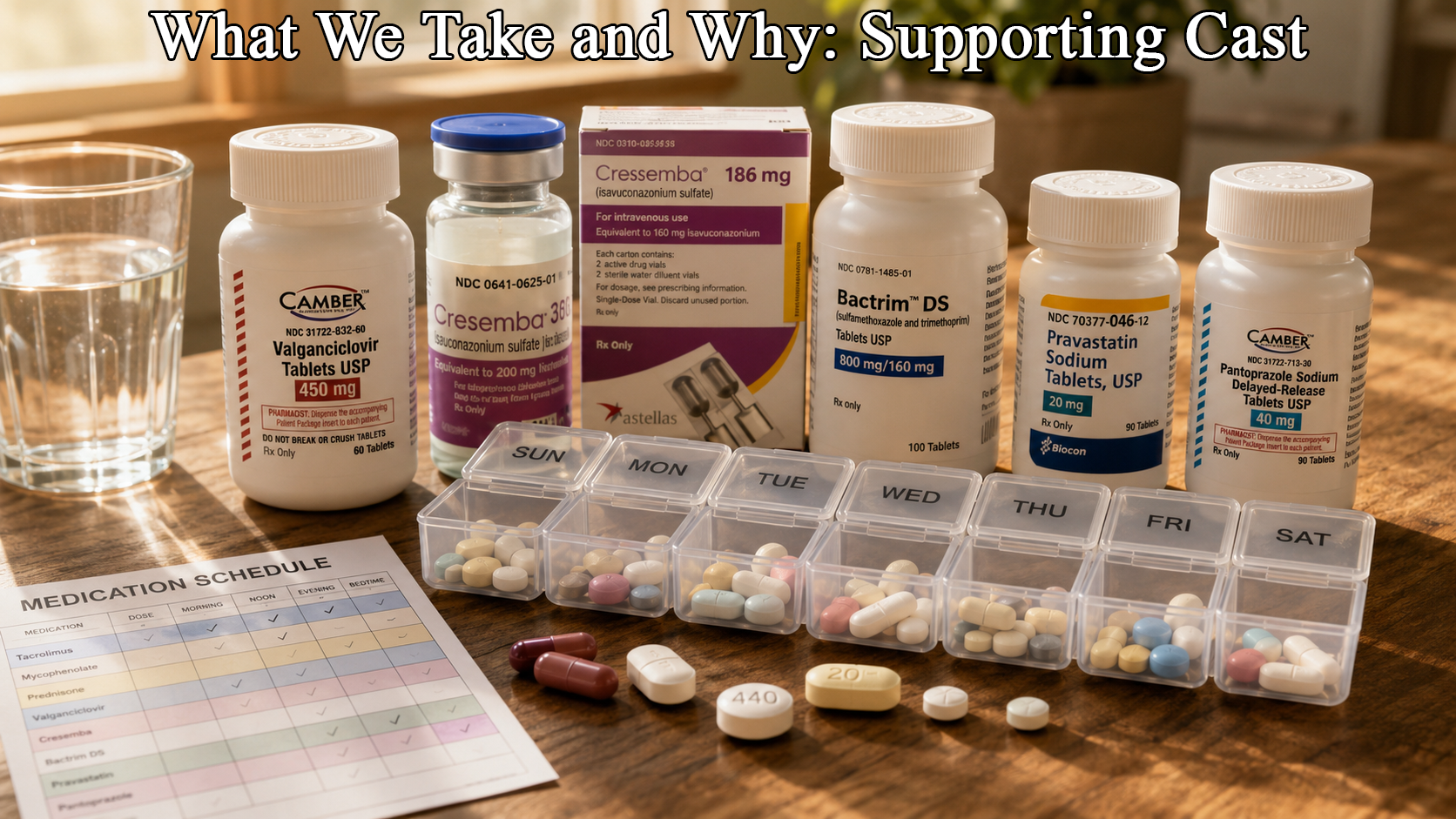
A second tier of medications accompanies the immunosuppression regimen, at least for a while. These are not immunosuppressants. They exist because immunosuppression opens specific doors that a healthy immune system keeps closed. Each one is standing guard at a particular door. Understanding which door each medication is guarding makes it easier to understand why they cannot simply be skipped when you feel well—feeling well is partly because the medication is working.
Most of them have defined endpoints. Some do not.
Antifungal Prophylaxis — Isavuconazole (Cresemba)
The immune system keeps fungal infections in check continuously, without any conscious effort or visible consequence. Remove that immune surveillance and certain fungi—particularly Aspergillus—become serious threats. Invasive aspergillosis in an immunosuppressed recipient is not a minor inconvenience. It is a life-threatening opportunistic infection.
Isavuconazole (Cresemba) is the antifungal prophylactic used at many transplant centers in the early post-transplant period, having largely replaced voriconazole at programs that transitioned based on a cleaner drug interaction profile. It covers invasive mold infections including aspergillus during the window of highest immunosuppression intensity.
Isavuconazole is a CYP3A4 inhibitor, which means it interacts with tacrolimus—the team will monitor trough levels accordingly during the prophylaxis period. The medication typically continues for approximately six months, at which point the immunosuppression regimen has usually been tapered sufficiently to reduce the fungal risk to a more manageable level.
Antibacterial Prophylaxis — Trimethoprim/Sulfamethoxazole (Bactrim)
Pneumocystis jirovecii pneumonia—PCP—is the opportunistic infection this medication is guarding against. Despite being treated with an antibacterial, Pneumocystis is technically a fungus—historically misclassified, which is why the treatment choice is somewhat counterintuitive. In a healthy immune system, Pneumocystis causes no illness whatsoever. In an immunosuppressed recipient, it can cause a severe and potentially fatal pneumonia.
Trimethoprim/sulfamethoxazole (Bactrim, Bactrim DS) is the standard prophylactic. Beyond PCP, it also provides coverage against toxoplasma and certain other opportunistic infections, making it a broad-spectrum prophylactic for the immunosuppressed recipient during the high-risk window.
Sulfa allergies are common enough that this question comes up frequently in transplant groups. Recipients with documented sulfa allergies may be placed on alternative prophylaxis—atovaquone or dapsone are both used—rather than simply going without. If there is a sulfa allergy in the history, the team needs to know before the first dose.
Bactrim is typically continued for approximately six months post-transplant, with the same logic as the antifungal: as immunosuppression is tapered and the risk profile shifts, the need for aggressive prophylaxis diminishes.
Antiviral Prophylaxis — Valganciclovir (Valcyte)
Cytomegalovirus—CMV—deserves its own explanation before addressing the medication.
CMV is a common herpesvirus. In immunocompetent people, primary CMV infection is usually mild or asymptomatic, and once acquired the virus remains dormant in the body for life, held in check by ongoing immune surveillance. Transplant immunosuppression disrupts that surveillance. In a recipient, CMV can reactivate from dormancy, transmit from the donor organ, or cause primary infection in someone who has never been exposed—and any of these scenarios can produce serious disease: pneumonitis, hepatitis, gastrointestinal involvement, retinitis, and systemic CMV syndrome.
The risk varies significantly based on the serostatus of the donor and recipient at the time of transplant—specifically, whether each has prior CMV exposure. The critical pairing is donor-positive / recipient-negative (D+/R-): a recipient with no prior CMV immunity receiving an organ from a donor who carried the virus. This is the highest-risk scenario, because the recipient has no existing immunity and the donor organ may introduce active virus. D+/R- recipients typically receive more aggressive prophylaxis, at higher doses and for longer duration, and are monitored with CMV surveillance labs throughout.
Valganciclovir (Valcyte) is the standard antiviral prophylactic for CMV. It inhibits viral replication, preventing CMV from establishing active infection during the period of maximum immune vulnerability. For most recipients, Valcyte prophylaxis continues for approximately twelve months. D+/R- recipients and others with ongoing CMV concerns may continue longer, guided by CMV PCR surveillance results.
Valcyte’s primary side effect of note in this population is bone marrow suppression—the same white blood cell reduction that mycophenolate can cause. The two work through different mechanisms, but their effects on white counts can compound. The team monitors accordingly, and dose adjustments are not unusual.
Cardiac Protection — Statins
Many heart transplant recipients are prescribed a statin after transplant, and the reason is not always what they expect. The common assumption is cholesterol management. That is part of it—immunosuppression, particularly tacrolimus and sirolimus, can raise lipid levels—but statins in the transplant context are doing something beyond what they do for the general population.
Clinical evidence dating to the 1990s has shown that statins reduce rates of acute rejection and slow the progression of cardiac allograft vasculopathy in heart transplant recipients, independent of their cholesterol-lowering effects. The mechanisms appear to involve anti-inflammatory and immunomodulatory properties. A recipient whose cholesterol is well within normal range may still be on a statin because the team is managing a transplanted heart, not just a lipid panel.
The choice of which statin matters in this population. Pravastatin has the longest track record here — it was the subject of the foundational 1995 clinical trial that established the transplant-specific benefits of statin therapy — and it is not metabolized through CYP3A4, which removes one variable from an already complex drug interaction landscape. Rosuvastatin is used at many centers for the same reason: it also bypasses the CYP3A4 pathway, avoiding the competition with tacrolimus metabolism that makes some other statins more complicated to manage. Atorvastatin is widely prescribed as well but is partially metabolized through CYP3A4, which means the team monitors the interaction accordingly. The choice of statin is not arbitrary; it reflects both the evidence base and the individual recipient’s full medication picture.
There is no standard defined endpoint for statin therapy in this population. It is generally continued indefinitely as part of long-term cardiac management.
Gastric Protection — Proton Pump Inhibitors
High-dose corticosteroids carry a significant risk of gastric irritation and ulcer formation. Proton pump inhibitors—omeprazole, pantoprazole, lansoprazole, esomeprazole, and their generic equivalents—are prescribed to protect the stomach lining during the period of highest steroid burden.
There are two things worth knowing about PPIs in the transplant context beyond their gastric protection role. First, they interact with mycophenolate: PPI co-administration reduces mycophenolate exposure, an interaction documented in the prescribing information. The team is aware of this and manages accordingly; it is not a reason to stop a prescribed PPI, but it is a reason this combination is on the team’s radar. Second, PPIs independently contribute to magnesium depletion—they inhibit the intestinal channels responsible for active magnesium absorption, compounding the renal wasting that tacrolimus is already causing. This is covered in depth in The Magnesium Problem.
As the prednisone taper progresses and the gastric protection need diminishes, PPI therapy is often reassessed. Some recipients come off it; others continue for other indications.
Supplements: The Ongoing Category
Unlike the prophylactic medications, which have defined endpoints, three supplements typically have no expiration date. The conditions that make them necessary do not resolve.
Magnesium. Tacrolimus continuously downregulates the kidney’s magnesium reabsorption mechanism, causing ongoing urinary wasting. Supplementation does not fix this—it offsets it. The moment supplementation stops, levels fall again. Of all the supplements in the transplant regimen, magnesium is arguably the one recipients spend the most time managing—form, timing, and dose all matter in ways that are not obvious from the label. The full treatment is in The Magnesium Problem.
Calcium and Vitamin D. Prednisone impairs calcium absorption and interferes with the conversion of vitamin D into its active form, making bone loss a documented long-term consequence of corticosteroid therapy. Calcium and vitamin D supplementation is standard from early in the regimen and continues as long as the clinical need exists. Calcium competes with tacrolimus and mycophenolate for absorption in the gut—meaning timing matters. See What to Avoid and Why for the spacing detail.
The Timeline
For a newly transplanted recipient trying to understand what they are taking and for how long, the rough framework looks like this:
Hospital through approximately six months: antifungal prophylaxis (Cresemba), antibacterial prophylaxis (Bactrim), antiviral prophylaxis (Valcyte), PPI for gastric protection, and all three supplements initiated.
Around six months: Cresemba and Bactrim typically discontinued as immunosuppression tapers and risk profile shifts.
Around twelve months: Valcyte typically discontinued in most recipients. D+/R- recipients and those with ongoing CMV surveillance concerns may continue longer.
Ongoing indefinitely: magnesium, calcium, and vitamin D—because the underlying drivers of depletion and bone loss do not go away. Statins are also generally continued indefinitely as part of long-term cardiac management.
This is not a fixed schedule. Individual recipients, center practices, and clinical circumstances vary. The team may discontinue something earlier or extend it longer based on what the bloodwork and clinical picture show. The framework is a map, not a contract.
A Note on Stopping
The most common mistake with prophylactic medications is stopping them because you feel well. Feeling well is not confirmation that the medication is no longer needed. It may be confirmation that it is working. None of these should be discontinued without explicit team guidance, regardless of how normal daily life is starting to feel.
Discover more from One More Beat
Subscribe to get the latest posts sent to your email.