
Rebuilding
Everyone talks about how chronic illness robs you of your life. Career, hobbies, family: all the things that make a life good are affected by a chronic health condition. In some cases, most of a life well lived is lost as the health problems compound, worsen and take over. Sometimes, as with a heart transplant, relief comes, and with it a chance to live again. That’s the part that doesn’t get nearly enough attention.
Living again, even living for the first time in years, is a glorious thing. It also comes with a few responsibilities renewed. At the top of that list: earning a living, because disability rarely covers the cost of simply staying alive.
The Responsibility Nobody Mentions
I formally left the workforce nearly ten years ago, after the last of my director roles ended in 2017. I wrote about that slow exit in Twenty-Two Years and I’m Still in There. I tried once to return, wasn’t up to it, and ended up back on the sidelines. Now, as I enter my third year post-transplant, the focus has shifted to exactly that: living again.
The first year after a transplant is unpredictable. You may need more rest, run into a complication, get sick or react badly to a medication. Programs vary on timing. My team advised giving the first year to healing, and I did. After that, most restrictions lift. That doesn’t mean going back to what you did before, though, or that you can suddenly do work you were never suited for in the first place.
I’ve been searching hard for work for the past several months, and on and off for about a year. I’m a seasoned IT professional with well over thirty years behind me. You’d think that would count for something.
One Hundred Fifty Applications
The IT job market isn’t good, even for experienced people without the added knocks I bring to the process. In a single week this past spring, I submitted around 150 applications. I didn’t get a single interview, and I received only a handful of responses of any kind. They ran from hands-on technical roles to middle management to senior leadership, and every one was a job I’m well suited to do.
The numbers back up what everyone on social media seems to be saying, that the help-wanted signs are up and nobody is actually hiring. In February 2026, the national hires rate fell to 3.1 percent, the lowest since April 2020, and economists have spent most of the year describing a “low-hire, low-fire” market in which companies hold on to the people they have and add few new ones. Some of the openings aren’t openings at all. The hiring platform Greenhouse found in 2024 that 18 to 22 percent of the postings on its own system led to no hiring activity whatsoever.
Add disability to that picture and it narrows further. In 2025, 22.8 percent of people with a disability were employed, against 65.2 percent of those without one. Among working-age adults with a disability, the share was 38.1 percent.
In a year of searching, with hundreds of applications and résumés sent, exactly two companies have shown real interest. One, a startup, simply never materialized. The other hit a year-end hiring freeze just as I was moving through the selection process. I remain hopeful that the second will call back in a few months and reopen the conversation. It’s a great company, and I’m a great fit for the role. I’m not resting on my laurels in the meantime; I’ve already started picking up the additional skills that would let me hit the ground running there from day one. That takes time, though, and money. IT training isn’t free, and a new skill set doesn’t happen overnight.
What the Résumé Says
To be fair, I recognize that I’ve been out of the nine-to-five market for the better part of a decade. That doesn’t read well on a résumé, especially for someone whose most recent roles were in senior leadership. The gap is what most employers react to, since it’s the first thing they see. I also disclose the heart transplant, because it’s the right thing to do, even though on paper it reads as an attendance risk. Between the two, a lot of prospective employers simply aren’t interested. I’m also fifty-seven, not a spring pup; ageism in hiring is a very real thing, and I suspect that shows in the results too.
There’s also the question of pay. After years out of the workforce, you generally can’t step back in at the salary you last earned, especially in leadership. And I couldn’t do that job the same way anyway. IT at that level meant long, unpredictable hours and a steady stream of people unhappy with you, and I used to put in more than 100 hours a week. A transplanted heart has real limits, and I would never work those hours again. What I’m looking for now is regular work I’m good at, on a schedule this heart can sustain, with room for transplant follow-up, at pay that reflects what I have to offer rather than where I was.
What’s particularly curious is that my mind is sharp again, perhaps sharper than it was when I finally left my last regular role. I may need some retraining on current technologies and techniques, which I’m actively working on, but the world of IT itself hasn’t changed all that much. And I’ve become genuinely skilled at using AI in software development and automation, the same tools employers are now trying to bring into their own shops. It’s how I build and ship apps every day.
The Office Problem
Then there are the real concerns about my health. I’m heavily immunosuppressed, and Covid changed things in a big, big way. If I catch Covid, it could well knock me flat and land me back in the hospital. A closed office in the colder months, with recirculated air and people coming to work sick, is a genuine risk for someone in my position, as I wrote about in The Year of Living Carefully.
These days, most days are simply normal days. What I need from a job isn’t less work; it’s some say over where and when the work happens. A clinic visit or a lab draw doesn’t wait for the weekend, and immunosuppression makes a crowded office in flu season a real risk. Remote or flexible work absorbs all of that without anyone noticing. A five-day office mandate turns each one into a conversation, and the push to return to the office is underway across most industries.
On paper, the law has an answer for this. Under the Americans with Disabilities Act, working from home can be a reasonable accommodation for a qualified applicant or employee: someone who can do the essential functions of the job with that accommodation in place. In February 2026, the EEOC issued guidance, written for federal agencies but built on the same ADA principles that bind private employers, stating that telework may be required when it’s necessary for an employee to perform the essential functions of the job. The same guidance makes clear that it isn’t automatic, that it’s decided case by case through an interactive process, that it isn’t required if it would impose an undue hardship, and that an employer may offer a different accommodation that’s also effective, or revisit one later.
In practice, an applicant who needs remote work is asking for the one thing a lot of employers are working hardest to take back. A ResumeBuilder survey of business leaders found that three in ten companies planned to end remote work entirely by 2026, and nearly half would require at least four days a week in the office. The ADA forbids turning down a qualified applicant because they’ll need an accommodation. It can’t make anyone call them back, and from the outside, a rejection for that reason looks exactly like every other unanswered application.
What SSDI Allows
Then there’s the money. The obvious answer to an income that doesn’t cover the cost of staying alive is a paycheck, and the first thing most people on disability want to know is what a paycheck does to their benefits. The Social Security Administration’s Red Book lays out the rules, and they’re more forgiving than most people assume.
The trial work period. Any month in which you earn more than $1,210 (the 2026 figure) counts as a trial work month. You get nine of them, within a rolling five-year window, and your benefits continue in full while you use them. The point is to let you find out whether you can actually do the work.
Substantial gainful activity. After the trial work period, Social Security looks at whether you’re earning at the level it calls substantial gainful activity: $1,690 a month in 2026 for people who aren’t blind. Above that line, it generally considers you able to work. That $1,690 is a threshold, not a living wage. Some disability-related work expenses can be subtracted before Social Security compares your earnings to it, but the line itself isn’t built around what it costs to live with a transplant: for me, hundreds of dollars a month in copays, prescriptions and supplies.
The safety net after that. The trial work period is followed by a 36-month extended period of eligibility. During it, your benefits can be paid for any month your earnings fall below the substantial-gainful-activity level, without a new application. If your health turns and you have to stop working, they can restart. For most people who qualify, Medicare continues for at least 93 months after the trial work period ends, which matters a great deal to anyone whose immunosuppressants cost what ours do.
Ticket to Work. Social Security’s Ticket to Work program offers free employment support and benefits counseling, and while you’re using it and making timely progress toward your work goals, Social Security won’t start a medical review of your disability.
Disability alone is hard to live on. The average SSDI check is about $1,633 a month, roughly $19,600 a year, and many have to keep Medicare, so the $202.90 Part B premium comes out of it first. A modest one-bedroom apartment, food, utilities and a few hundred dollars a month in medications take the rest, and then some. A job doesn’t automatically fix that. Once the trial work period and its grace months are used up, earning above the substantial-gainful-activity line doesn’t shrink the check; it stops it, and if your earnings stay above that line past the 36-month eligibility period, benefits end altogether. Work adds its own costs: commuting, work clothes, meals away from home, income tax and employer health premiums. Income past roughly twice the poverty line also closes the door on most outside help, and many people come out of a transplant with hospital bills besides. Earning double the disability check can still leave you barely getting by.
None of that is a reason not to work. It’s a reason to understand the rules before you start, ideally with a benefits counselor, because the mistakes are expensive and slow to unwind.
The Consulting Myth
Some will say, “Hey, you’re a smart guy; can’t you just pick up some consulting gigs?” What people don’t understand is that consulting work comes almost entirely through the people you already know. The days when you could walk into a company and offer your services as an IT guy on invoice are long gone, and AI has only made it more difficult.
Self-employment is the other road, and on paper it suits a transplant recipient well: you set the hours, you work where you choose, and a clinic day needs nobody’s approval. People with disabilities take that road more often than most; in 2025, 9.1 percent of employed people with a disability were self-employed, against 5.9 percent of employed people without one. But it has its own costs: no employer health plan, irregular income, quarterly taxes and a long, unpaid stretch of building before anything pays. Self-employment affects SSDI benefits too, and Social Security looks at the work itself, not only the profit: past a certain number of hours a month in your own business, that time can count against you even if the business hasn’t earned anything yet. Anyone on disability who’s building a business should sit down with a benefits counselor first.
Building Anyway
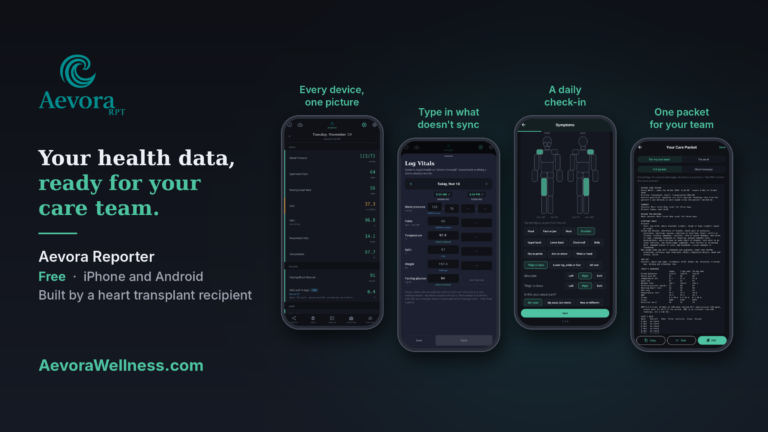
So as I retool, I’m making sure to do it in a way that not only refreshes my skill set but also gives me a sustainable option to work for myself. I dusted off my software development skills and started building apps, for phones and for computers, beginning with the ones I like and need. I build them for fun and to sharpen my skills. The details of that work are in I’m Still in There, and the latest is Aevora Reporter, the first of a suite of tools for managing complex health. I’ve also doubled down on my nonfiction writing, with several active blogs, this one included.
None of it is generating money yet, and most of it never will. I need some of it to pay eventually; that’s the point of eventually launching Deep Dark Abyss Productions as a formal business in 2027. But money isn’t the only thing it’s for. Building is how I’m rebuilding: creating a new life, returning to life, albeit a different one, rather than sitting on an empty board or in the ashes of the old one. It’s far from simple, often utterly exhausting, and in my case there aren’t many resources available to help.
My two-year evaluation was November 9. It was the first follow-up on the CAV found at my one-year exam, and the sedation knocked me down for the better part of three days. A week later, the transplant team called to tell me everything looked good, including the test result that had kept me on edge all weekend. That’s the reason any of this matters: it looks like I’ll be around a while longer, and I’d rather spend that time building something than waiting. I spent the rest of the week writing.
Discover more from One More Beat
Subscribe to get the latest posts sent to your email.