The Conversation I Was There For
A quick note before any of this: nothing here replaces your transplant team or the instructions they give you. The goal of this piece is to describe a gap I didn’t know I had, and the tool I now use to cover it. I bought my Fieldy on my own, after looking at everything else on the market, with no code and no arrangement with the company. When I reached out to them before publishing, they offered a discount code for readers, so the Fieldy links here are now affiliate links: if you buy through one, I earn a commission at no cost to you.
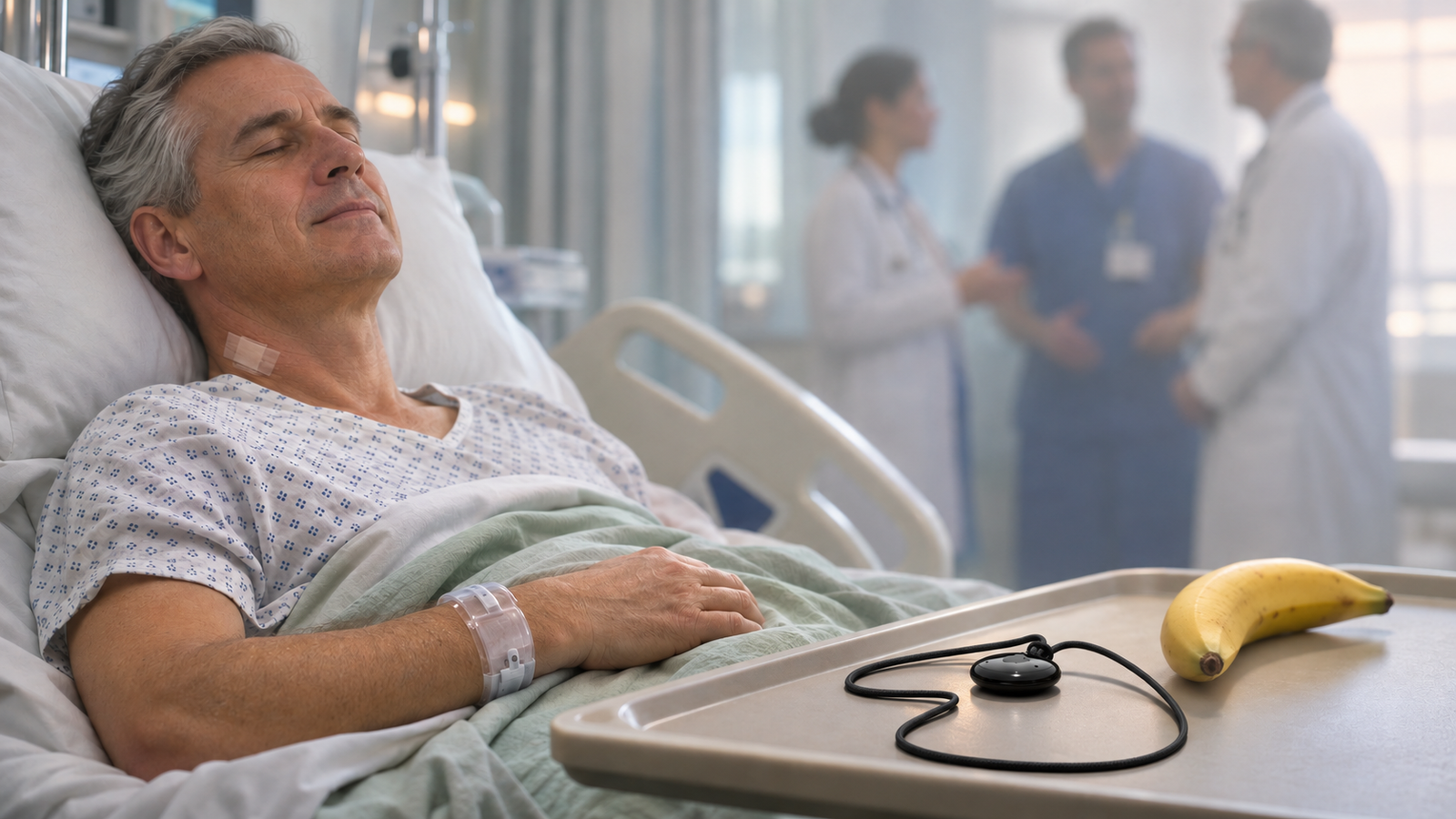
My mother bought me bananas a couple of days after my cardiac catheterization. I don’t generally eat them, so they sat on the counter until she asked why I hadn’t touched them. The transplant team, she reminded me, had said my potassium was a little low and that a banana or two would help bring it back up.
I had no memory of anyone saying that. Worse, until she asked, I had no idea there was anything to remember.
The Hour That Didn’t Stick
On Monday, November 9, I went in for my two-year evaluation, which landed on the transplant anniversary itself: a right and left heart catheterization, an endomyocardial biopsy, and intravascular ultrasound to check the coronary arteries for the vasculopathy diagnosed at my one-year mark. What that day involves is laid out in The Follow-Up Gauntlet. The sedation was the standard pairing, fentanyl and Versed, and this time it knocked me for a loop.
About an hour after the procedure, the cardiologist who performed it came in to go over the results. A little later, Dr. Bhat, who heads the transplant program, came in with Joe, one of my nurse practitioners, and Marcie, my coordinator, to go over the bloodwork and the plan. I remember them coming in. I have no recollection of what any of them said.
I knew the overall news was good. I suspect I only knew that because I’d gone through the bloodwork and the reports myself afterward. Everything else—the numbers, the plan, the potassium—was gone, and nothing about the gap announced itself. I knew I’d been there, because I had.
My memory is generally solid. I lose the occasional small detail, which is about what anyone on this medication list should expect, and none of it has ever looked like this. That’s the part worth sitting with: the person who lost that conversation trusts his memory, and he had no idea anything was missing until his mother asked about a bunch of bananas.
What Versed Is For
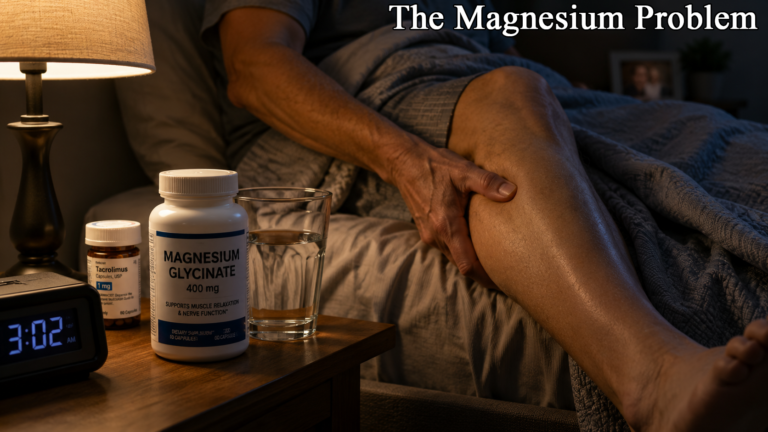
Versed is the brand name for midazolam, a fast-acting benzodiazepine, and the gap it leaves is not a side effect in the usual sense. Its prescribing information lists amnesia alongside sedation and anxiolysis as part of what it’s given to produce. For an uncomfortable procedure, not remembering is considered a kindness, and most of the time it is one.
The effect isn’t uniform. Researchers measuring it have found a dose-dependent decline in recall and recollection of events after intravenous midazolam, and in at least one study of patients sedated during surgery, free recall was the most sensitive measure of impairment, persisting for more than two hours. Fentanyl given alongside it, as it usually is for a cath, adds its own sedation. So the same procedure, with the same team, can leave a different-sized hole from one year to the next.
The detail that explains the bananas is this one: people under midazolam often don’t know their memory is being affected. In one study, participants given the drug rated how well they expected to remember what they were studying, and those ratings were no different from people given a placebo, even though their actual recall was substantially impaired. The drug takes the memory and leaves the confidence.
My own experience added a wrinkle the studies only partly capture. When I finally read what had been said that morning, it came back. Not all at once, and not crisply, but the points were familiar the way a conversation you were actually in is familiar. I remembered saying that this year’s vessel-wall measurement was an improvement over last year’s, and the cardiologist correcting me. I remembered the talk about one of my blood pressure medications. Some of it sat right at the edge of what I could reach. The information wasn’t missing so much as out of reach until something pointed me back at it. Free recall had failed. Recognition, given something to recognize, mostly hadn’t. Some of what came back wasn’t in the transcript at all. Reading one exchange brought back the conversation beside it, as if the transcript had found the door and the rest of the room was still there behind it.
How a Memory Gets Made
Memory isn’t a single event. It’s usually described in stages: information is registered, stored and later retrieved, and the hippocampus, a small structure deep in the temporal lobe, sits at the center of the first two. It’s required for consolidation, the step that turns a short-term memory into a long-term one, while the amygdala beside it adds emotional weight. Short-term memory can hold what someone just said long enough to answer them. Keeping it until tomorrow takes more.
Some of that more is deliberate. Psychologists distinguish automatic processing from effortful processing, the kind that happens consciously and takes attention. My own habit is to sort a conversation while it’s happening: this needs action, this I need to keep, this can go. There’s nothing clever about it, but it’s a version of the best-documented memory techniques there are. Giving selective attention to what matters, and processing it for what it means rather than letting the words go by, is the core of the levels-of-processing framework researchers have built on since 1972: information processed for meaning, and connected to what you already know, is remembered better than information taken in at the surface. Repeating an instruction back in your own words works on the same principle.
Midazolam goes after exactly that machinery. Benzodiazepines act on GABA-A receptors, the brain’s main inhibitory system, and the amnesia they produce has been compared to the memory loss seen with damage to the medial temporal lobe, where the hippocampus sits. Researchers who tried to separate the pieces concluded that midazolam impairs conscious, controlled memory processes, which is precisely what a sorting habit like mine depends on. Under sedation, the technique has nothing to run on. That isn’t a lapse in discipline. The drug is quieting the machinery the discipline uses, and how it does that at the level of individual cells is still not fully understood.
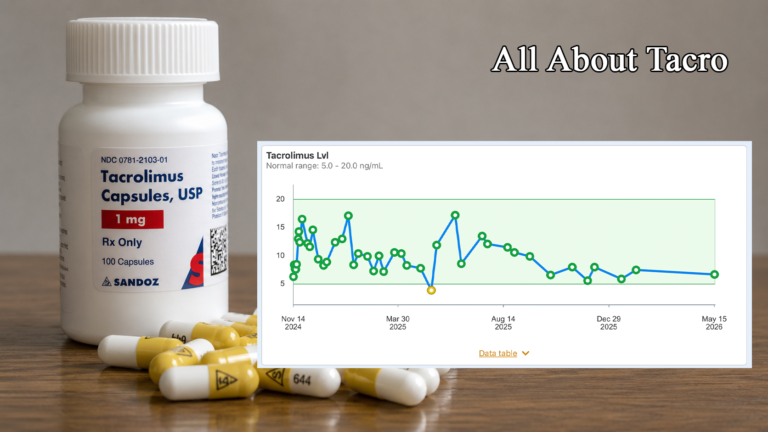
Tacrolimus is the slower half of the story. It works by blocking calcineurin, an enzyme that turns out to be abundant in neurons, where it helps regulate the strengthening of connections that memory depends on. In kidney transplant recipients, cognitive changes are considered an under-recognized problem, and one small study found cognition improved when tacrolimus levels were lowered. The evidence doesn’t all point one way—in Alzheimer’s research, the same enzyme block looks protective. For me it shows up as the occasional lost detail and nothing more, part of what I wrote about in Am I Still Me?. It isn’t what happened on November 9. That was a sedation cocktail doing its job, a little more thoroughly than usual.
Adapting Instead of Insisting
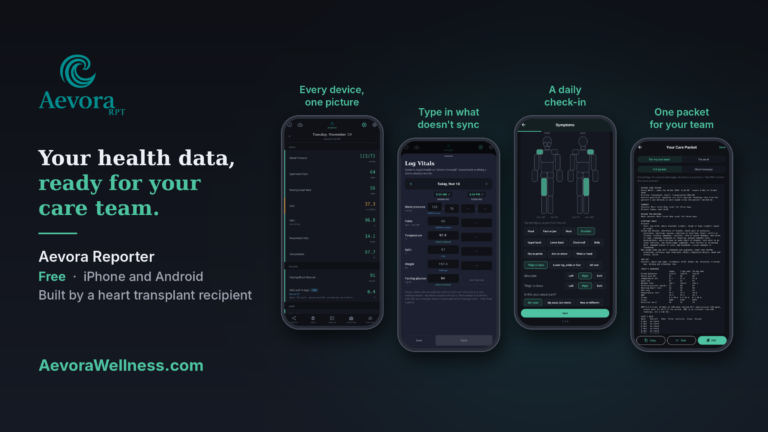
A good part of living well after a transplant is accommodating the shortfalls instead of pretending they aren’t there. My hands shook too badly to write my vitals down in the early months, so I let Bluetooth devices write them for me and eventually built an app to report them. This is the same move applied to memory.
The oldest version of this accommodation is a second person. My mother remembered the potassium, and a caregiver whose only job during the debrief is to listen and write things down is still the best low-tech answer there is. When I told the cardiologist that vocabulary wasn’t my thing at the moment, he said that was why I’d brought extra ears along. Many programs also post an after-visit summary to the patient portal, and the clinic notes themselves often follow within a day or two. If you’re sedated for a procedure, it’s worth assuming you’ll need one of those, because you won’t be able to tell afterward whether you need it.
None of those is a weakness to work around. The normal response to a sedated debrief is to forget some or most of it. Planning for that is just planning.
A Second Set of Ears
My version is a small wearable called Fieldy, which I bought a couple of weeks before the procedure. It comes on a lanyard and can also be worn on a wristband; it listens and sends the audio through the phone to be transcribed and summarized. Fieldy says the raw audio is deleted once the transcript is extracted, so what’s kept is the words, not a recording. If the phone is out of range, the device holds the audio on itself, encrypted, and syncs and transcribes it when it reconnects; after that, the same deletion applies. The company also describes the service as HIPAA-compliant, which is a claim about how they handle the data, not a guarantee about what you do with it once it’s yours.
The recovery room is where it proved itself, but most of its use is everywhere else. Managing a chronic condition is complicated, and an organ transplant more than most: clinic visits, lab results, medication changes and calls from the team, all arriving on their own schedule. I wear it to other appointments, and I use it for the small things that used to slip away: building a grocery list, getting down a sudden idea for an app or an article, or catching a reminder the moment I think of it, before it vanishes. The app turns each recording into a searchable transcript and, on request, a summary, with templates for different purposes, medical notes among them. It can link a recording to the matching Google or Outlook calendar event and add the summary to the event’s notes, and you can ask questions about any single conversation and get answers drawn only from it. A speaker profile teaches it to recognize your own voice, though not anyone else’s, and a desktop app transcribes Zoom, Teams and Slack calls into the same account. Any conversation can be shared by link or exported. For someone juggling everything a transplant brings, it helps keep things sorted.
What made the difference on November 9 was what happens after the transcript exists. Fieldy can connect to AI assistants like Claude and ChatGPT through what’s called an MCP connection, which lets the assistant search and read your conversations when you ask it to. A few days after the procedure, I asked Claude to find that morning’s visits and tell me what had been said. Here is what it gave back, lightly edited:
What It Caught
The cardiologist, right after the procedure (about 11:06 AM)
- Overall, “everything looks fantastic.” The pressures in your heart were normal, and so was the flow from your heart to the rest of your body.
- No progression of the vasculopathy. The vessel-wall thickness was 0.47 this year versus 0.51 last year, and the margin of error is about 0.1, so it’s unchanged. He said the images “look identical” and are in an appropriate range this far out from transplant. You mentioned they had switched you to sirolimus, and he agreed it’s working.
- He’s leaning toward no more routine biopsies unless your symptoms change. Your blood tests have been reliably predictive, so he’d rather rely on those. The left-heart cath through the wrist will still happen every year for at least a couple more years.
- He said the neck access was “not the most ideal” because of the angle, but he was able to steer the biopsy toward the septum.
- No medication changes. Biopsy results take about two days. They said they’d call if anything needs changing, like they always do.
Dr. Bhat, Joe and Marcie (about 11:41 AM)
- They said nothing had changed since last year and your vessels look “beautiful… huge.”
- No change to your immunosuppression or statins. One more drug was “where you need to be,” but the transcript garbled its name. There was also something about keeping an eye on what is probably your triglycerides.
- Potassium was a little low, so they gave you some and mentioned bananas. That matches what your mom told you.
- They plan to repeat the cardiac PET scan within six months to look at the heart’s microvascular function. If that goes well, it may replace the yearly left-heart caths in the future.
- Your PSA is slightly up at about 5.4. Mention it at your next urology visit so they can track it.
- They asked about exercise, and you said “a little bit, not much.” You told them about your apps.
- You said you had another question but couldn’t remember it because you were still groggy.
The garbled drug was amlodipine, one of my blood pressure medications. Reading the summary brought back the conversation: it stays for now, and it’s on the list to revisit. The last line is my favorite. Even in the moment, I knew something was slipping. I just didn’t know how much.
Claude’s wasn’t the only summary. Fieldy writes its own for every conversation, and the one for that morning caught something the debrief summary hadn’t: a full set of discharge instructions, gone over by the nurses hours after the debrief and before I went home, that I have no memory of receiving. They told me to keep the pressure dressings on the wrist and neck for twenty-four hours and to keep my right wrist still for the same twenty-four, which meant no typing, no texting and no lifting. I wasn’t to lift anything heavier than ten pounds, about a gallon of milk, for five to seven days, and my right arm was off-limits for blood pressure cuffs and blood draws for seventy-two hours. Showering the next day was fine, but no soaking or submerging for five days.
Those aren’t trivia. They’re what keeps a wrist or neck access site from reopening, and they’re often given while a patient is still coming out of sedation. The same summary recorded my potassium at 3.4, which is where the bananas came from.
Between the two summaries, I could piece together the debrief and the discharge instructions, delivered in person by people who know my case well. By the time I got home, almost none of it was within my reach. The bananas were the only reason I found out.
What It Can’t Do
Fieldy is the best transcription tool I’ve used, and what it can do is remarkable. It doesn’t take over your own due diligence, though. You still read the actual lab reports, the discharge instructions and the chart, and its limits are worth knowing going in.
It mishears, and there’s nothing to check it against. One line of the cardiologist’s after-care advice came through as “Use yourself back in the wheel pits.” The automatic summary spelled my cardiologist’s name wrong. Because the audio isn’t kept, per Fieldy’s stated policy, a garbled word stays garbled. Most errors are obvious from context. The one that matters is the one that isn’t.
The summary can be wrong even when the transcript isn’t. Mishearing is one kind of error. The summary is a second layer, written by AI, and it can produce a plausible fact that nobody said. Fieldy’s summary put my HDL cholesterol at 13 when the lab report says 35. That’s the dangerous kind, because a wrong number in a summary looks exactly like a right one. For anyone tracking tacrolimus troughs, potassium or creatinine, check every number against the lab report.
It doesn’t reliably know who’s talking. Every speaker in that morning’s transcript is labeled “Unknown.” I hadn’t set up a profile for my own voice, and there’s no practical way to set one up for a room full of people you may be meeting for the first time. The summary got the attributions right because the context made them clear, but in a crowded room it’s worth reading a transcript as a record of what was said rather than of who said it.
It needs a reasonably current phone. Fieldy’s own support pages list minimum system versions, and on iPhone the requirement is recent. Check before you buy.
It needs charging. Battery life depends on how you use it. Left on around the clock, mine lasts about two days; switching it on and off with its button as needed stretches that further.
It hears everything. That includes the family conversation in the waiting room and the people in the next bed. There’s a mute, and it’s worth using. It’s also worth taking the device off, or asking first, before you’re wheeled into a procedure room.
It costs something. The Fieldy 3 device regularly sells for $179 and goes on sale from time to time; its 2026 Black Friday price, in effect as of November 19, is $129. A free plan covers 150 minutes of recording a month. An unlimited plan costs extra. For clinic visits alone, the free minutes may well be enough. If you decide to buy one, the code onemorebeat15 takes a discount off at checkout, or you can go through this link.
It’s not a medical record. The transcript tells you what was said. Your chart tells you what was decided. Where they differ, the chart wins, and the portal and a phone call to the team are how you check.
Telling the Room
Recording a conversation you’re part of is legal in most of the country. Federal law and most states require only one party’s consent, and that party can be you; Ohio is one of those states. About a dozen states require everyone’s consent, and some treat in-person conversations differently from phone calls. Hospitals can also set their own rules about recording on their premises, whatever the state law says.
The better habit is to ask the team before the conversation starts, and to say why. “The sedation wipes out what you tell me afterward, and I’d like to have it” is a sentence clinicians are likely to understand immediately, and it turns the device from something that might make people guarded into something everyone in the room is helping with.
I think I mentioned it to the team on November 9, but I can’t say for certain. It’s one more thing from that morning I don’t remember. Next time I’ll ask before anyone starts talking, while I’m still sure to remember doing it.
Back in Reach
I didn’t know how much of that morning I’d lost. Reading the transcript brought some of it back. The rest was there to read.
The bananas were on the counter the whole time.
Discover more from One More Beat
Subscribe to get the latest posts sent to your email.